What to do with a painting that’s a little meh?
There are numerous paintings that I undertook that I thought would be amazing when I applied the first few brush strokes. Somehow they often just get away from me and get shuffled somewhere in the back of my studio often never to be seen again. Overworked? Underworked? In retrospect, sometimes I have no idea what I was even looking for? Some artists just toss these canvases out. Some paint over and start anew. Art history is littered with good but lesser paintings underneath masterpieces.
When I was an art student I completed a large square canvas of a firehouse in Halifax. I really liked the light at the time as it caught the edge of the red fire trucks parked in the open garage bay. Upon completion I decided I really disliked it. A friend offered to take it off my hands. Did I have a price? I suggested the cost of the materials would be sufficient. Years later I saw the picture at his house and realized it was amazing. It was a lesson in judging a work too soon.
This year I have been pulling out a number of my unfinished paintings, or paintings I thought had been finished but never got up to my expectations. With a lot of time in-between, I thought I could apply fresh eyes and do something with them.
Sometimes the original composition is so off that it is unredeemable without wiping the canvas and completely starting over. Last year I spent an incredible amount of time on a painting of French River, PEI, only to determine the composition was too clipped and the lighting a little too overcast to bring out the shapes of the boats and buildings, and ultimately, it did have boats.
For those who have ever watched the BBC series Landscape Artist of the Year, the judges are very down on boats, sometimes even when the assignment is to paint a harbour scene. I believe the suggestion is that boats make an artwork a little too “twee.” In future blog entries I’ll show you some of my boats and you can decide. In this case, yeah, it looked twee.
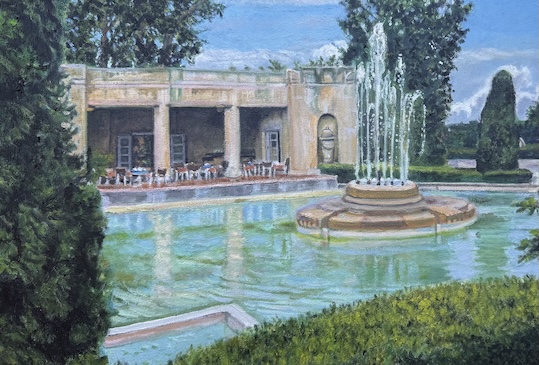
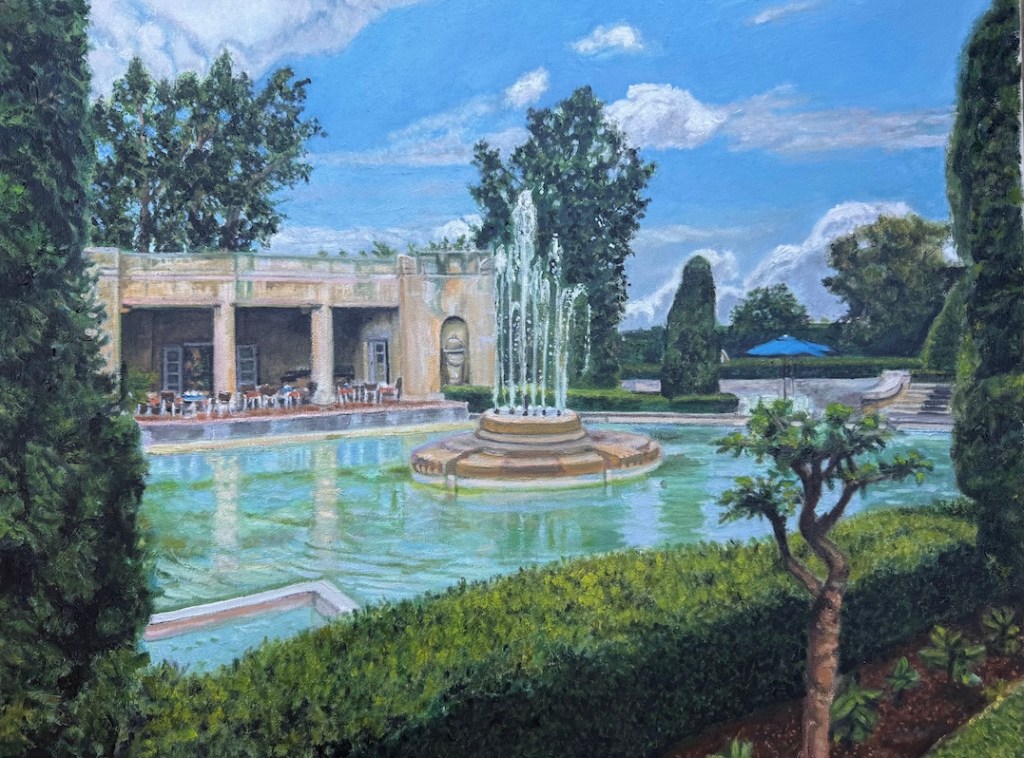
The first abandoned painting I put back on my easel this year was of the formal gardens at Parkwood Estate (above), which is within a short walk of where I live in Oshawa, Ontario. Parkwood Estate was the home of Colonel Sam McLaughlin, the first president of GM Canada. When the good Colonel shuffled off into the great beyond at age 100, he left almost his entire estate to Lakeridge Health, including all the furniture, art, books and even the Colonel’s collection of pipes. The exception? Paul Peel’s painting After The Bath was donated to the Art Gallery of Ontario, and a replica was subsequently put in its place in the dining room. McLaughlin did have daughters, but being quite elderly themselves, they weren’t interest in his stuff, just as the next generation in our family would be horrified at the prospect of inheriting any of ours.
As a result, Parkwood is one of the most incredible historic sites of its kind. Whereas many historic American homes had to find the furniture and artworks that had formerly belonged to these estates (such as the mansions at Newport, Rhode Island), everything here was intact.
This was not my first painting of Parkwood. Previously I had done one of the pond in the Italianate garden closer to the main house. I had good intentions of a series, but those good intentions are usually replaced by ideas about something else.
The reference photo I took of this view was a bit odd. The colours seemed to be strange in retrospect — perhaps something to do with the ominous clouds in the distance.
Walking through the formal gardens one feels as if you have entered another world, and I don’t necessarily mean that of the fabulously wealthy, which the GM President likely was. Looking at it, I felt as if it could be the setting for a mythical play.
Parkwood Estate is used a lot for movies and TV, and the formal gardens you may recall from the Mini-Series The Kennedys.
The classical-looking building in the image is a tea house in the summer.
I initially started this maybe 15 years ago. Looking at it with fresh eyes, I realized it needed the colour and contrast amped up. I also did a poor job of addressing the water in the pond, which looked decidedly green (call the pool company!). This year I spent quite a bit of effort in improving that part of the painting. I also decided to emphasize the odd colourization rather than try and return it to something a little more expected. I think that contributes to the other-worldly quality of this picture.
In the end, the entire painting did get painted over, but because paint is more transparent that most people think, the old image contributes to the new. This quality of layering I think is what makes painting continually interesting, at least when you see it in person. You just don’t get that with a photograph.
Is it done now? Maybe.
Reworking old paintings is not new. Apparently the French painter Edouard Vuillard called for changes to paintings in the room as he lay on his deathbed. We remain our greatest critics, and its hard not to pass our own work without thinking it needs just a little bit more or a little bit less.
Tomorrow we’ll look at another of my recycled paintings.
Support my BLOG! Feel free to leave a comment, give me a like, or share this on your social media account or sign up to get notice of new posts.
 Rick Janson Art Studio
Leave a comment