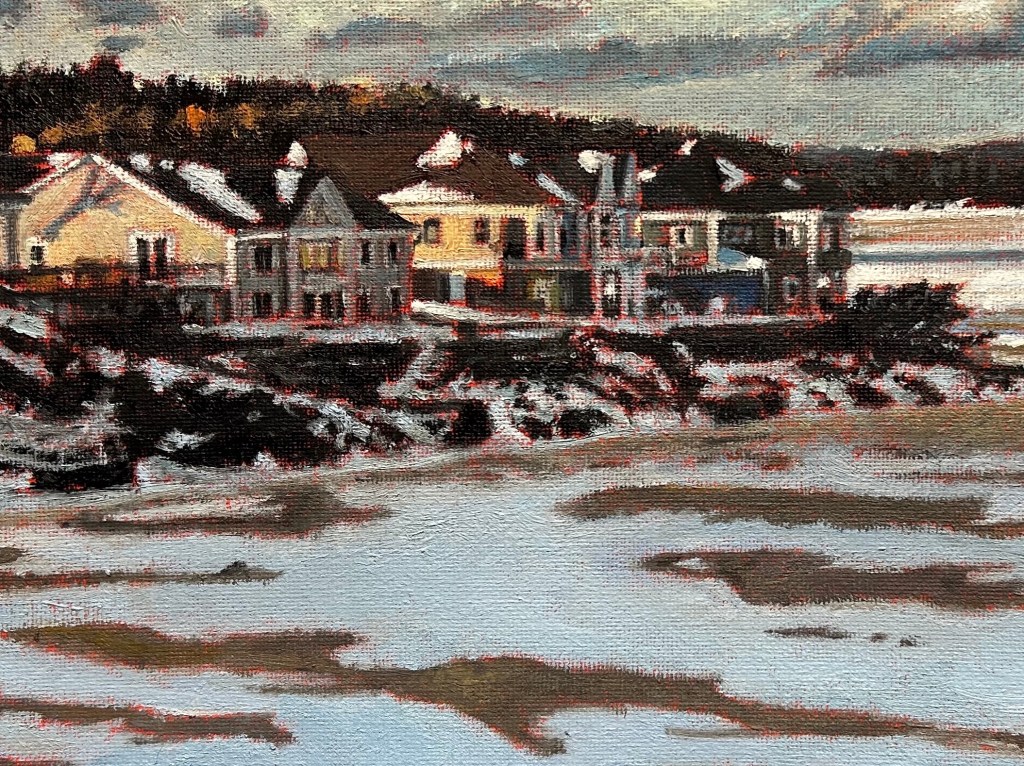
There is a sad story in the New York Times today. As an artist, it made me stop in my tracks. Could this be me some day?
Author Alissa Quart writes about having to sell and give away about 400 paintings by her 90-year-old mother, who was a literature scholar up until her retirement 30 years ago. After taking some art classes — “a whole new second life” — she began painting every day. Some of the paintings got exhibited in group shows, but she never had a solo show. Quart hints that perhaps her mother didn’t feel worthy of a such a moment, nor did she now want a gallery show based on pity. Four months ago she was diagnosed with cancer, of which Quart has been helping her with her chemo appointments.
“Finding homes for the paintings while she is still with me has taken on a strange urgency — I want to know where they will dwell,” she writes.
Quart speaks about how the paintings gave shape to her mother’s way of seeing.
“A painting is the promise that our consciousness can persist beyond the hand that picked up the brush.”
Earlier this year I started collecting together images of my life in painting, realizing that there are many more that are simply missing. Some friends and family were able to let me know about the work they had in their possession, sending photos of the paintings still hanging in their homes. In one instance, I discovered that one of my student works had been damaged and disposed of. That’s happened to me too — I certainly never took offence. What’s remarkable is how much of it has survived.
I am still hoping to put together a little book, a summary if you will, of what I’ve spent a lifetime doing. A record should anyone care about my work sometime in the future. Perhaps that will open the door to advance my art. More likely not. Quart points out that only 20 per cent of artists will exhibit their work in their lifetime. It’s even worse for women.
I’m a bit obsessed about documentation. Every year I print about 15-20 books that document my life with my spouse, distributed before Christmas to family and friends. The books are photographs and stories about our activities as well as my view of the changes in the world about us. We use those books now as a substitute for memory. What year did we go to Washington? When did we renovate our basement? When was the last visit by my Dad before he passed away?
The art book would be a little more focused.
Fortunately, many of my paintings have already found homes. Some were given away — particularly when our moving van from Halifax simply didn’t have any space left and some were given away on the spot to friends who had helped with the move. Some of my paintings have since been sold for a modest amount, mostly to friends and family. Some were placed in silent auctions to raise funds for charities, such as today’s image which helped raise funds for a hospice in Saint John, New Brunswick.
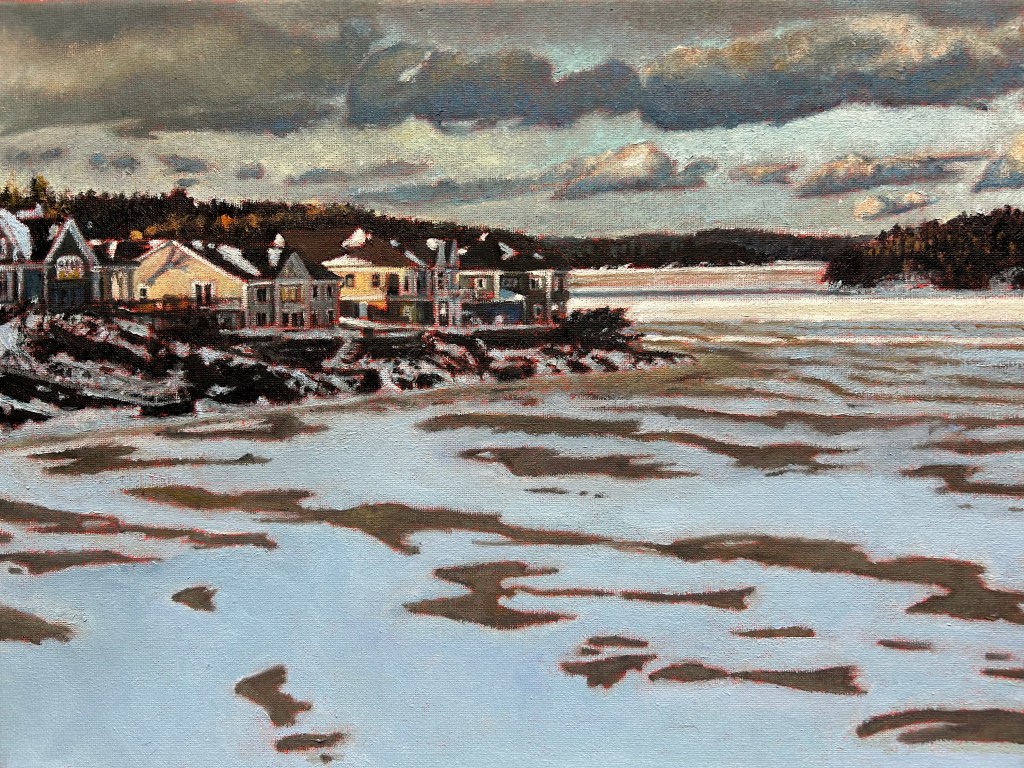
My spouse’s sister sent us a picture from a house she had once considered purchasing in Saint John. Did I recognize these? she asked. Hanging in the house were two of my paintings. Turns out a local doctor had been collecting them at the same annual hospice fundraiser. It was his house that was listed for sale.
The fact that so much of my work is still out there makes me believe that perhaps this was more than just a fool’s errand. Sometimes my reaction is, “you kept that all this time?”
The difficulty I am having with the “little book” is when to stop? Almost daily I am spending 3-4 hours in my studio with my brushes and paint. Not surprisingly, my art is changing.
Many artists strive for consistency in their work. Some, having success with a certain kind of painting, appear frozen in their creativity and churn out essentially the same work over and over. I could never do that. When I was in art school, it was not hard to notice those who were experimenting less and instead seeking to create within a small window permitted by the demands of consistency. I think we all thought that was what the art world demanded of us.
I never sought to do that. Instead in my final year at art school I think I started to frustrate my fellow classmates as I swung from conceptual art to figurative work to large colorfield abstracts. I didn’t think I ever found a style.
Then a few years ago someone told me they liked the style of my painting. Gathering my images together after that, I realized that there was more consistency to it than I had ever thought. The style found me, I didn’t find it.
I feel as if I am still in that experimental stage, putting a lot of thought into where my work goes next. Having to put it down in words is actually a help.
But I do fear that in twenty years somebody else will be trying to find homes for the work left behind in my studio, or worst still, have these canvases find their way into the skip. Quart speaks about another person from her mother’s art group for whom their caregiver had donated his canvases to an art school to be painted over. She didn’t want to do that. For me, that would feel like being erased.
Hopefully the New York Times article will help spur the distribution of those paintings by Allissa Quart’s Mom. She noted that she had found homes for 35 paintings so far. With 400 in her mother’s apartment, there’s a lot more to go.


Leave a comment