Claude Monet’s gardens and home in Giverny see a succession of tour buses arrive daily, including ours which had left early morning from Paris. Curiously, outside the compound, the town is full of artist studios, all proclaiming to be modern-day impressionists.
A few days earlier we had been to the L’Orangerie in the Tuileries Garden to see the water lily paintings in person. It was like visiting a shrine. Surprisingly, it wasn’t as crowded as the impressionist galleries at the Musee D’Orsay, and we had plenty of time and space to take it all in. It felt like being in a church.
In person, seeing the house and gardens was like literally walking into his paintings. Monet’s eyesight was an issue of national concern towards the end of his life and it made me wonder how much it contributed to the almost abstract look of many of these paintings.
Monet hadn’t always been celebrated in France and was not particularly wealthy. When Monet first moved to Giverny in 1883, he had to borrow money to attend the funeral of his mentor, Edouard Manet, who died shortly thereafter.
Breakthroughs in optometry are attributed to what turned out to be a national effort to restore Monet’s sight. After undergoing cataract surgery, and with the aid of a Zeiss lens made specifically for him, his eyesight was sufficiently improved that he destroyed much of the artwork created during that period. It was said many of these paintings were very dark in pigment as a result of his inability to see properly.
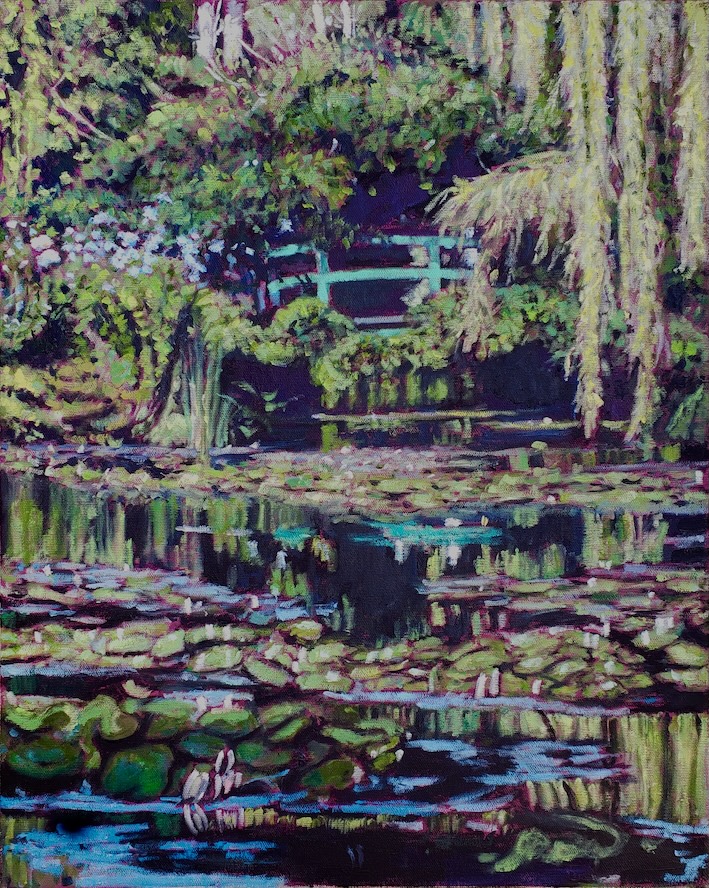
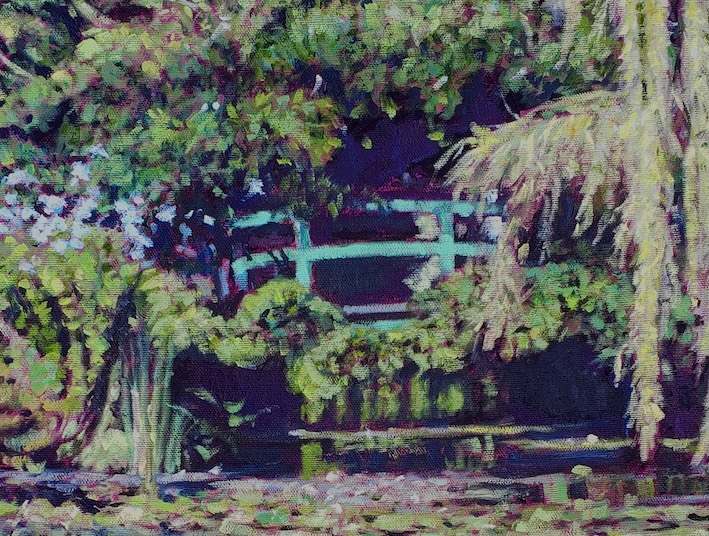
Bringing back a lot of material from our trip to Giverny, I decided to have a go at making my own painting to get a feel for what I had seen, but of course, in my own style. I was self-conscious that this may have been just a little bit nervy.
I kept the brush strokes loose and did my best to reflect what I was feeling walking down the same garden paths as Monet had a century earlier.
It was also unusual for me to tackle a picture that was almost entirely made up of natural elements. While I have painted many landscapes, they tend to be based more in urban environments. In this painting there are no buildings or people. I suppose there was Monet’s Japanese bridge to anchor the picture.
I deliberately avoided looking at Monet’s water lily paintings while doing this. I didn’t want to create a weak copy.
Sadly, the massive gift shop at the site is Monet’s former studio. It might have been interesting to see it set up as a studio as he had experienced it, but then again, we all had to get our souvenirs.
Like this post? Give me a “like” or feature it on your social media feed. Use the buttons below. If you want to leave a comment, be aware that all comments require me to approve them, which can take a little time. They won’t show up right away.
 Rick Janson Art Studio
Leave a comment