Women make up 80 per cent of fiction sales, according to statistics from an opinion column in today’s New York Times. “The fiction gap makes me sad,” writes columnist Maureen Dowd.
Me too. It also explains a lot.
Dowd quotes author (and man) Richard Babcock: “Not to blame the current cultural landscape on Ronald Reagan, but I think the obsession with money and wealth that arrived in the 1980s may have encouraged the false idea in men that there was little to learn from a novel.”
Fiction goes a long way in helping us see “the other.” You can’t read a book without stepping into the shoes of the author’s protagonist for an extended period of time. Is it any wonder that we seem to have an extreme shortage of empathy these days?
This divergence in our culture may also go a long way to explaining why we are seeing a widening gap in how women and men vote.
I can’t say this surprises me as much as confirms my worst fears.
And I don’t think its limited to published fiction. I’ve noticed during visits to most large public art galleries that the majority of visitors are also women, and I suspect many men there were dragged along by their partner (except me and the other shaggy-looking art-types, of course). Tip for single hetero men: maybe you should hang out at the art gallery a lot more.
It used to be the oldest and funniest pick-up line cliche: “Would you like to come upstairs to see my etchings?” That meant: “would you like to come up for some sex?” The likely (and thankful) disappearance of that cliche owes its explanation to the fact that men likely don’t have any etchings anymore, and quite possibly, he may not know what an etching is?
I was once romantically linked to a woman who gave me a gift of two etchings. She broke up with me shortly after, which made me wonder whether she was just helping me along on the road to the next romantic encounter.
In 2007 I attended the summer leadership school put on by the National Union. Among the presenters was a singer-songwriter by the name of Tom Juravich, who spoke about how using the tools of culture had more ability to “stick” with the public than simply presenting the facts of the case. I took that to heart, including sponsoring a theatre company who I assisted to tour Ontario doing readings from a play about Canada’s tainted blood scandal. At the time a private for-profit company was setting up in areas of the province where individuals may be more desperate to be paid for their blood plasma. It would be direct competition for the not-for-profit Canadian Blood Services and posed debatable risks of contamination. The for-profits were setting up in direct conflict with the recommendations of the Krever Inquiry set up to look into Canada’s tainted blood tragedy. After our tour, all three political parties agreed to shut the for-profits down.
After that successful campaign, rather than be patted on the back, I was put on the hot seat, my immediate boss at the time likely having never attended Tom’s session at leadership school. Who gave me approval? The union board. Where did the money come from? The union board and NUPGE. I had to point out that unlike many campaigns that spent much more of the union’s funds, this one was a success, sweating out the grilling by two managers who clearly didn’t get it, or maybe didn’t want to get it. Our unionized members at Canadian Blood Services certainly did.
On that tour we met with many tainted blood survivors, many of them hemophiliacs. They had their lives upended from the lack of diligence around the use of tainted blood from the United States exported to Canada. It turns out that much of that tainted blood came from the American prison population. The play catalyzed the survivors to speak up. Just in case the politicians still didn’t get it, we also did readings at Queen’s Park and the Canadian Parliament.
The arts can make you feel deeply about issues, helping you to see something from different points of view.
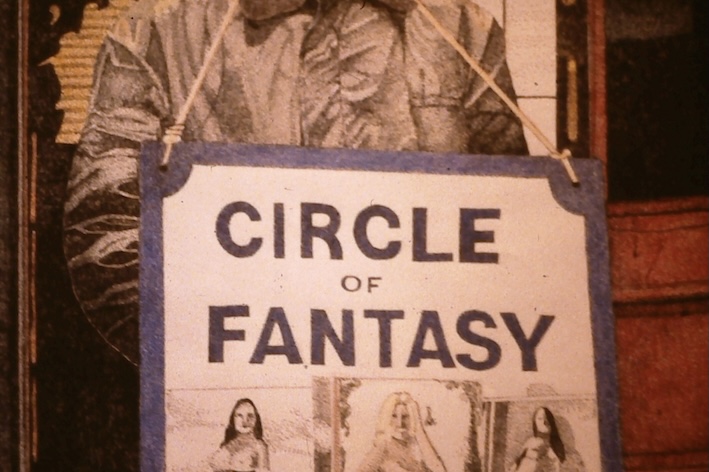
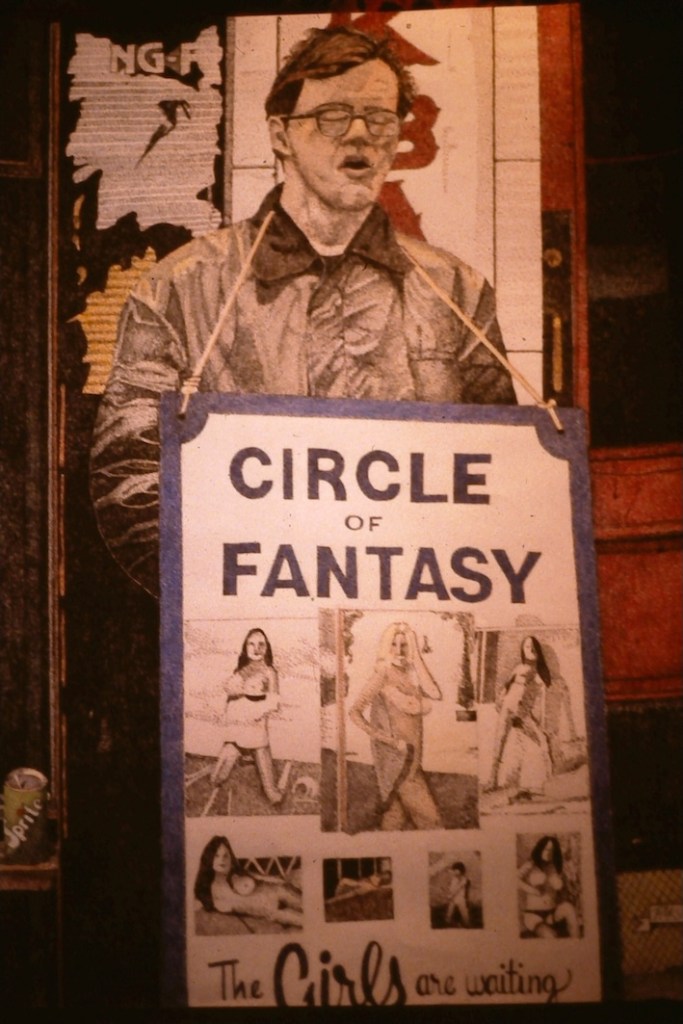
When I was in high school I was invited to submit an entry to a TVO series called Electric Essays. I entered a slide show (with musical accompaniment) called Selling Out To The Bare Walls. It was about the sad dehumanization I found on Yonge Street, the central commercial artery running through the city of Toronto. There were no words, only images. It was not the finest of times for the city’s grand old street with blocks of peep shows, strip bars and porn cinemas. One of the street pictures I took (with permission) was of a young man hustling to get patrons into a strip bar. That picture stuck with me, and later I did an ink and Prismacolor drawing from that image.
To me, it was more effective that a dozen editorials.
Want to read more? Subscribe — it’s free. Just use the black box on this page. You’ll get a notification every time a new post goes up. Likes and comments are always welcome too.
 Rick Janson Art Studio
Leave a comment