There was a time when Lunenburg looked like what you would expect of a town of 2,300 permanent residents. Not a lot. The first time I visited was in the off season, and frankly, there wasn’t much there for casual visitors beyond the Fisheries Museum of the Atlantic and perhaps walking around to view the buildings that make up the town. There was a Chinese take-out restaurant along Lincoln Street, which on that day (a Sunday), was closed.
Then in 1995 it was designated a UNESCO World Heritage site, the old town the best surviving example of a British pre-designed model town that could be essentially plunked down anywhere. To that end, Lunenburg shares a similar heritage to about 20 other towns and cities in North America, including Niagara-On-The-Lake.
The old town has 400 buildings. According to Parks Canada, 70 per cent of them are from either the 18th or 19th centuries. The town was officially founded in 1753 by 1,453 German-speaking Swiss and French emigres. The town is perhaps best known for its wooden ship building, the home of the famed racing schooner Bluenose, and its successor Bluenose II.
We almost didn’t make it there during my last trip to Nova Scotia in 2021. We had spent some time in nearby Mahone Bay and debated whether to go the additional distance. We had already driven a considerable way that day, doing the Peggy’s Cove loop before heading south along the Lighthouse Route past such communities as Hubbards, Chester, and Western Shore (where we saw signs for Oak Island).
For a town essentially frozen by being named a UNESCO World Heritage site, a lot had changed. There were lively shops, attractive restaurants, galleries, an excellent ice cream shop, and even a Bluenose Company Store, which celebrated the refit that was going on at the time for the Bluenose II. I noticed that the locals had amped up the colour of the building stock too. The Fisheries Museum is still there along the waterfront.
A friend had told me that some believed the Bluenose refit was so extensive the ship should have been renamed the Bluenose III. The Bluenose II was never intended to last as long as it eventually did — it was originally built as a promotion for Schooner Beer, but soon became a symbol of the province. I bought some Bluenose socks that day.
It made me wonder how, according to the town of Lunenburg, 200 long standing active businesses could survive with such a small permanent year-round population? That’s about one registered business for every 10 permanent residents.
I’ve been to Lunenburg many times, including for its folk festival in the summer. Having been away for a whiie, it made me realize what a difference the UNESCO designation has made to the town.

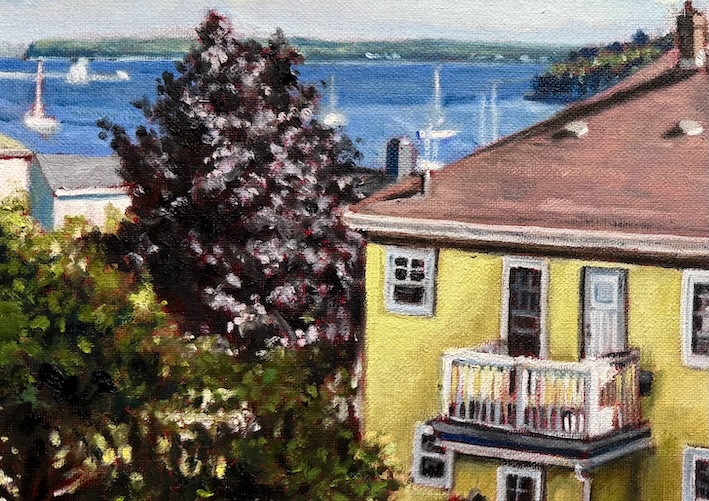
I did this painting in tandem with the previous one of Peggy’s Cove. The photographs I used as reference were both shot on the same day.
Unlike the Peggy’s Cove painting, I had no intention to make this one about tourism, although there were many visitors walking around that day amid the splendid sunshine. Perhaps that painting is to come.
I liked the distant view in this one, giving some depth through the buildings and trees to the famed harbour and beyond. When my spouse first saw it, she thought it was from France (a lot of my paintings are). The light did look more like the south of France than Nova Scotia.
I’ve previously noted that I have a tendency to tighten up as I go in for more detail. This time I consciously kept the painting loose, which I think in turn gives it a bit more energy. It likely helps that the canvas sizes are generally increasing for me, which gives me more latitude on the brush strokes. Likely it is also because of the format of this BLOG. When I first began using this WordPress template (Nook) the feature photo containers were all the same proportion. That was a problem, as it would crop my images. It finally struck me that I could do a detail as the feature image, and also insert an image of the painting in its original proportions further within the text. Cropping the details, I started to like what I was seeing, realizing I could still get the kind of details that bring a painting to life and at the same time keep the bush strokes alive. Hmmm. This could work.
—
Yesterday I delivered a painting to Oshawa’s Robert McLaughlin Gallery (RMG) in response to a competition/exhibition call-out for work by seniors over age 55. The exhibit will run from August 15 to September 25. After speaking with the curator, I roamed the gallery to take in, among others, a small exhibit of work by the Painters Eleven Group. The Painters Eleven include such notable Canadian abstract artists as Jack Bush, Harold Town, William Ronald, Oscar Cahen, Tom Hodgson, Walter Yarwood and Kazuo Nakamura. The group essentially met at Alexandra Luke’s Oshawa cottage to plan an exhibition together in 1953, remaining as a group until 1966. Remarkably, the RMG holds in its permanent collection about a thousand pieces of work by these artists as a result of the involvement of Luke, herself a member of the group.
Visit my on-line gallery. Click here.
 Rick Janson Art Studio
Leave a comment