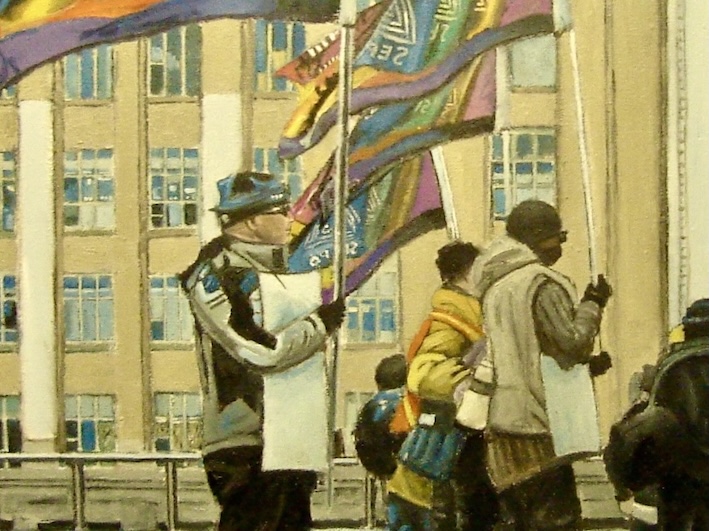
Quick: name a Canadian visual artist who is known for their portrayal of labour? Still thinking about it?
Likely the worst thing to happen to art that celebrates working people was Soviet Realism, which was so over-the-top it likely made many Western artists run in the opposite direction, especially amid the growing awareness of the brutality associated with Stalinism.
Having been around the labour movement in Canada for about 20 years, I have to say that while there have been valiant efforts to promote “the arts” through such events as the annual Mayworks Festival, it has never risen to the mainstream within labour. I have to fully admit that despite my background, I have never attended a Mayworks event, and neither have most of the workers I have ever represented. I have, however, been to the Workers Arts and Heritage Centre in Hamilton.
When I was in the National Union’s summer leadership school in 2007, Tom Juravich gave a session on using the arts as key part of our work. A musician and labour studies professor, Juravich emphasized the deeper connections that could be made with both our members and the public through the arts. When I returned to my own union and started incorporating those ideas, I was met with a great deal of skepticism despite some overwhelming success incorporating both music and theatre into my campaign work. I actually worked with Tom on a number of projects, including recording a song he wrote for one of our rallies in support of home care workers. It was later used in a video that never got traction after the government gave up on its insistence on a terrible contracting process that put home care workers out of a job, even in situations where their non-profit organizations had been doing the work for a century.
Working for a CUPE Local in the early 00s, I did once apply for and received a grant from the Canada Council for the Arts to work with a local theatre group in building puppets for the annual Labour Day parade. The members appeared to love getting involved, although I had moved on to another employer by the time of the parade and missed the final product.
Portrayal of working people has always been controversial. When Gustave Caillebotte painted the now iconic Floor Scrapers in 1875, the Salon of that year rejected it, stinging him with their rebuke, deeming the portrayal of working people as a “vulgar subject matter.” Caillebotte none-the-less painted another version of the scrapers the following year. He also depicted house painters at work in 1877. Caillebotte reportedly took his cue from Degas, whose paintings of women engaged in laundry were deemed somehow more acceptable, as did his portrayals of dancers.
While Diego Rivera’s mural may have been jack hammered out of the lobby of the Rockefeller Centre, (see my previous discussion by clicking here) many of his murals portraying working people in American industry remain in place, including his stunning 1930s Industry Series at the Detroit Institute of Art. Americans were okay with the Communist-supporting Rivera as long as he kept Lenin out of his pictures.
In Canada? You have to look a lot harder. The National Gallery staged a small labour-related exhibit in 2023, which included work from Canadian artist and architect Frederick B. Taylor (1906-1987). Taylor painted a broad range of subject matter, but during the war years had produced a number of works that showed workers in important industries, including welders in an anti-aircraft gun factory. The same trend was happening in Britain. It was less about celebrating workers than it was about projecting industrial strength in wartime.
I suspect that there is a certain amount of paranoia by the business community around the portrayal of work. There is a frieze on the exterior of the old Toronto stock exchange building. That frieze shows workers contributing their labour to industry, but also slyly shows the capitalist with his hand in the pocket of the worker.

While it is difficult to find resources on the portrayal of labour by Canadian artists, the Workers Art and Heritage Centre in Hamilton has just published The Act of Solidarity, Labour Arts and Heritage in Canada (Between The Lines Press). The book looks at a cross-section of arts, including protest music, union banners, murals, community theatre and oral history.
Co-author Rob Kristofferson (a labour studies professor and Wilfred Laurier University) told the Hamilton Spectator that “in the postwar period, the role of the (labour) arts and heritage was a diminished one.” Yeah, no kidding. The authors note that with the demise of industrialization, the focus shifted to issues of inequality, abuses, and underrepresentation. I suppose portraying office workers hard at work is a little visually challenging.

Today’s painting: This was a commission I did in 2007 as a gift to Leah Casselman, the then retiring President of the Ontario Public Service Employees Union. It shows union members on stage at a rally in Yonge-Dundas Square, the rally held for striking college faculty. When I first presented it to those commissioning it, I was told to change one of the figures in the painting — it turned out to be a little too recognizable as an individual they claim Leah was not fond of. I did make some changes, including to his tell-tale hat, but Casselman recognized him anyway. Whoops.
Happy Labour Day to all my Canadian readers.
 Rick Janson Art Studio
Leave a comment