One of the first things I was taught as an oil painter is that you never place thin over the thick. In other words, if you are using turps to thin your paints, don’t put them atop a layer of paint that was used directly out the tube.
The reason is simple: the net result is the paint will crack.
So when I see oil painters dripping diluted paint at the end of a process, I wonder what the conservation issues will be around this work. It has become so overused it likely doesn’t matter.
It is an interesting question given how much critics love to see evidence of process in the work. But what they love may be undermining the painting itself, assuming the artist didn’t have the foresight to use even thinner underlayers or work in another medium altogether.
We likely have artists doing this thanks to Jackson Pollock and his famous drip paintings from the mid-1940s. They revolutionized the art world, but themselves are frequently the discussion of conservation issues. Not all of it is related to the paint Pollock used.
Pollock famously used ordinary housepaint, most of it on unstretched canvas unrolled on the floor of Pollock’s barn. However, as numerous scientific analyses have shown, he often also tubed oil paint under it. Sometimes one colour would go on over another, creating intersectional points where the paints blended. Other times, he would wait for a layer to dry before applying the next. In his 1947 painting Alchemy, he also added other materials, including sand, pebbles and twine. In the 2018 restoration of Number 1 (1949) conservators found cigarette butts in the work as well as a honey bee they calculate flew in there by accident.
Louis Menand in his fantastic book The Free World: Art and Thought In The Cold War, speaks about the reluctance of the Boston Museum of Fine Arts in 1976 to purchase Pollock’s famous Lavender Mist (1950) because it had already badly deteriorated. That didn’t stop its owner Alfonso Ossorio from selling it to the National Gallery in Washington for $2 million in the same year. Ossorio had paid $1500 for it in 1950 at the disastrous Pollock show at Betty Parsons Gallery. The poor sales at that show likely ended his interest in making drip paintings. Pollock turned his attention to figurative painting after that, and by 1954 he stopped painting altogether.
Conservation issues repeatedly show up for Pollock’s work, and I can only speculate that the cost of conservation may have been a consideration for the Museum of Modern Art to de-accession Pollock’s Number 12 (1949) in 2004.
In the past museums varnished Pollock’s work to try and preserve it, only decades later leading to more restoration to remove the varnish after it dulled the colours and yellowed.
In the famous mural Pollock did for Peggy Guggenheim, the canvas supports started to sag, leading the paint to chip off as the canvas buckled (this is a more common problem that you would think — works by other major abstract expressionists have undergone this problem too). It required the entire painting to be placed on new stretchers.
One of the issues that conservators also face is what happens with the aging of areas of unpainted canvas. If it hasn’t been primed, the canvas will brown. I was aware of this myself on the only work I did on unprimed linen. I thought it would be interesting to see how the painting changed over time. The owner of the painting still appreciates it.
British artist Damien Hirst says that it was his intent to have his shark deteriorate as part of the process in his landmark The Physical Impossibility of Death in the Mind of Someone Living (1991). You may recall that Hirst first came to everyone’s attention by building large tanks filled with a formaldehyde solution and placing various creatures in them, the first a tiger shark. It was said by the time Hirst replaced the shark, that one could barely see it in the cloudy formaldehyde solution.
And that, of course, raises the question of value, given the piece is no longer 100 per cent original. I’ve seen an extensive rationale on why it should retain its values, including the originality of the tank and frame. Hmmm.
Hirst’s company says that it will replace any of the animals that are older than 10 years.
Artists working with non-conventional or poor materials are always going to be a concern. Galleries now caution painters, for example, not to use cheap canvas. If you are going to Michael’s and getting a value five pack, that’s cheap canvas. The difference is usually the supports the canvas sits on.
Among Canadian artists, Emily Carr is well known for the conservation issues that arise with her work, painting many of her pieces remotely using gasoline instead of turps (apparently doable, although very dangerous). She also worked on inexpensive papers that have deteriorated, or had them mounted on acidic backing boards that leached into the painting. Collectors still seek out her work despite this, and more recent criticisms that she appropriated the work of indigenous artists. I won’t offer an opinion on the latter.
Visiting the Vancouver Art Gallery some years ago, I noticed an Emily Carr exhibition had to be shown under dimmed light for preservation reasons.
The lesson for artists: know your materials. Don’t save $10 on a canvas to totally make all your work on that canvas valueless.
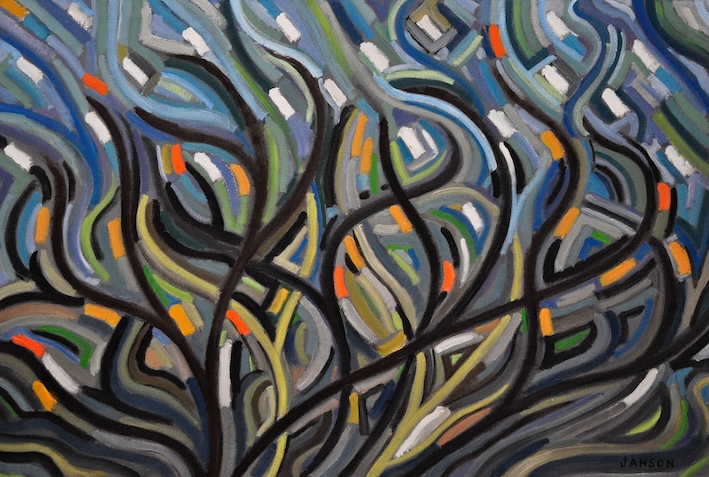
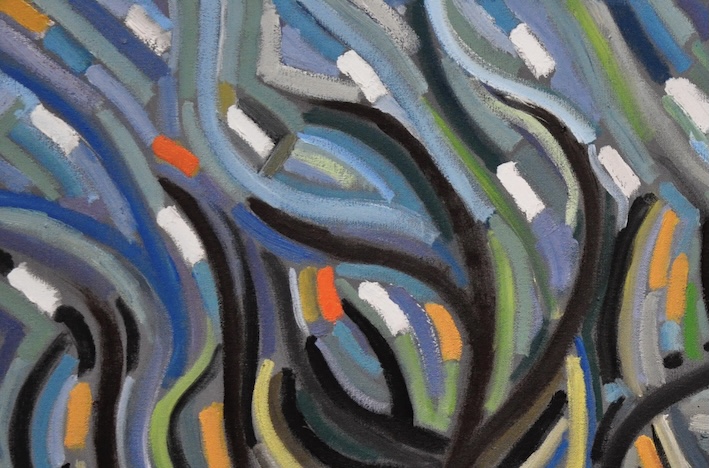
Today’s painting: Another of my abstracts from 2019. It sold almost immediately, I hope it has survived the rigours of time well.
—
Subscribe and never miss another post! It’s free. If you want to look at some of my more recent work, click here.
 Rick Janson Art Studio
Leave a comment