
When I was at the Nova Scotia College of Art and Design, everyone was aware of US conceptual artist John Baldessari’s work at the college. In 1971, unable to afford to bring Baldessari to Halifax, students from the college worked on an exhibition based on Baldessari’s instructions delivered to them remotely. The idea was simple: during the life of the show students would repeatedly write the sentence “I shall not make any more boring art.” At the end of the show the gallery would add up the number of times the sentence was written out and sent it back to the artist.
The Whitney Museum insists Baldessari was poking fun “at the entire system of art education, which he felt encouraged students to imitate rather than experiment and innovate.”
Ironically, prints were made as a fundraiser for the college, and somewhere in my drawers I have (or had) a t-shirt with Baldessari’s sentence on it.
The irony is, of course, that watching students write the sentence over and over again, such as pennance for doing something wrong, is in itself rather boring.
But can boring art be good art?
A friend sent me a link to post (Aesthetics for Birds) which discusses this issue and offers up an answer: yes.
The essay written by John Gibson and Andreas Elpidorou argues that in more than just a few instances that art can be good precisely because it is boring: “boredom is the pain of emotional and intellectual discontent.”
Curiously most of their examples are of films, such as Andy Warhol’s 8-hour plus Empire, which is a single shot of the Empire State Building shot in slow motion over that period of time. Warhol said he wanted to document time going by.
Where they really build their argument is over Chantal Akerman’s 1975 film Jeanne Dielman 23, quai du Commerce, 1080 Bruxelle, which documents in tedious detail over three and a half hours the minutae of the character’s life, small variations eventually leading to a shocking ending. Akerman, incidentally, was inspired early on by the filmwork of Canadian artist Michael Snow, who most people have likely encountered his public sculptural work at the Rogers Centre and Eaton’s Centre.
“We wouldn’t fully experience the film’s point if it didn’t bore us,” the author’s write.
Regularly the New York Times often posts a single image of an art work and asks its readers to spend 10 minutes looking at it without distraction.
Most people would see that as boredom in itself, but if you try it, you will find that there is a reward at the end as the Times delves deeper into the meaning of the painting. Akerman’s film works like that, with a shocking bit thrown in at the end.
To that extent, maybe all still images fit into that category. Our society is so awash in visual images, its easy to dismiss any image, or simply ignore it all as so much wallpaper.
A painting can be an invitation to slow it down, to have a longer look, to find meaning that may not have initially been there at the surface. It can be looked at from the perspective of the representational content — what is the artist trying to say — or it can be looked at from the perspective of the action of the artist’s hand in the creation of the piece.
When I first started painting I didn’t know what I wanted to say. The things that most upset or delighted me were hard to capture in a single image, and I didn’t want to be didactic about it. Was this really the right medium to tackle issues of inequality, for example? But being older I realize that there was content there all along, just as I never went looking for a style, it just came out of my hands and my perseverance. While many of my paintings deal with issues of travel, they are also about the act of being human and searching the globe to understand what we’re all about. Sometimes it can be boring, until you look a little harder.
—
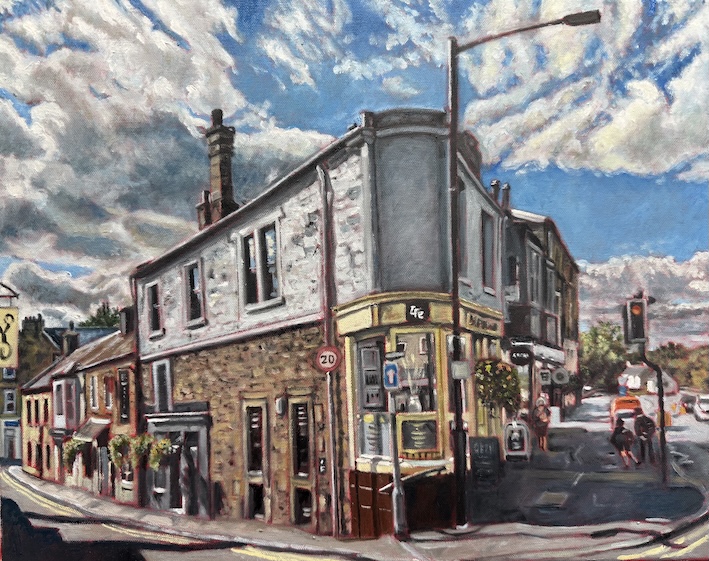
Today’s painting: Changing Weather is from a photograph I took on my last day in Scotland in 2022. Its the intersection of two streets, but also an intersection in the weather. The High Street (Bridge of Allan) looks rather ordinary, but if you look harder there are stories to be told, including two school kids heading home and another shopper whose body language looks a little apprehensive. She hugs the edge of the buildings while the kids appear to be headed towards her. It’s likely a meaningless encounter, or is it?
Don’t miss another post! Subscribe for free. If you’d like to view a collection of my recent work, click here. Come back regularly — it changes as new work comes off the easel.
 Rick Janson Art Studio
Leave a comment