
When we first arrived at Glasgow’s Burrell Collection we got offered a tour before even taking stock of where we were. Given the somewhat disorientating layout of the building, it turned out to be a good idea, although I was somewhat distracted at the time by the medieval players off in one corner of the lobby (see photo above). The guide began by emphasizing that this was a “collection,” and not a traditional gallery or museum, per se. It reflects the collecting habits of one person, albeit one very rich person. Like many of these “collections,” it tends to be a bit quirky despite little doubt that Burrell would have received the advice of curators and gallerists in putting together this pile. The “Souvenir Guide” states that Burrell had developed an interest in art as a child: “He used his wealth to steadily build his collection, quickly surpassing his local contemporaries in terms of the quantity and quality of his artworks and firmly established an international reputation as a collector of good taste and judgment.” The initial donation in 1944 included 6,000 items.
Sir William Burrell made his money from the shipping business, of which another Glasgow institution — the Kelvingrove Art Gallery and Museum — reminds us that much of that wealth derived from not treating his ship crews very well. That seemed less of an issue than some of the other great benefactors of art and culture in the city, some of whom were directly involved in the business of slavery. According to his Wiki biography, much of Burrell’s wealth came from selling his ships during World War I for much more than what he had paid for them. In other words, he became very rich by becoming a war profiteer.
But I suppose its water under the bridge — it is the public that now has his stuff.
Today the collection is administered by the City of Glasgow, and as such, is free to visit. There is no admission charge, like many of the public galleries in Scotland.
The collection is an odd assortment of art and artifacts. Burrell loved Edgar Degas’ work and collected a lot of it. Unfortunately for us, they had just featured a Degas retrospective so many of those paintings were now off display. The rooms of painting also including works by Cezanne, Manet, Monet, Sisley, Whistler, Fantin-Latour, Gauguin, Boudin as well as then-contemporary work by the Glasgow Boys, including S.J. Peploe, George Henry and John Lavery. Then there were more historic pieces, including a Rembrandt self portrait, as well as more minor works by Courbet, Hogarth, and Hals. Almost every art gallery and museum has much more in its collection that it can reasonably display, so its no surprise that the building housing the Burrell Collection also makes sure to hold back some of that collection for rotation and also for restoration and maintenance. It makes a show of it in the lower level, a film about the collection giving way to a view of the storerooms by the end.
The collection is a bit of this and that, from the medieval armour and weaponry to furnishings, stained glass, carpets, ceramics and tapestries going back to antiquity. Our guide showed us a portal taken from Hornby Castle in Yorkshire, noting that Burrell had got it at a bargain from the collection of William Randolph Hearst. This massive stone portal has been to America and back. We also got a look at a headboard that once belonged to Anne Boleyn — a rarity given Henry VIII destroyed many of her belongings after her execution. Perhaps it was retained because it included a carving of Henry on the left side with a rather noticeable codpiece.
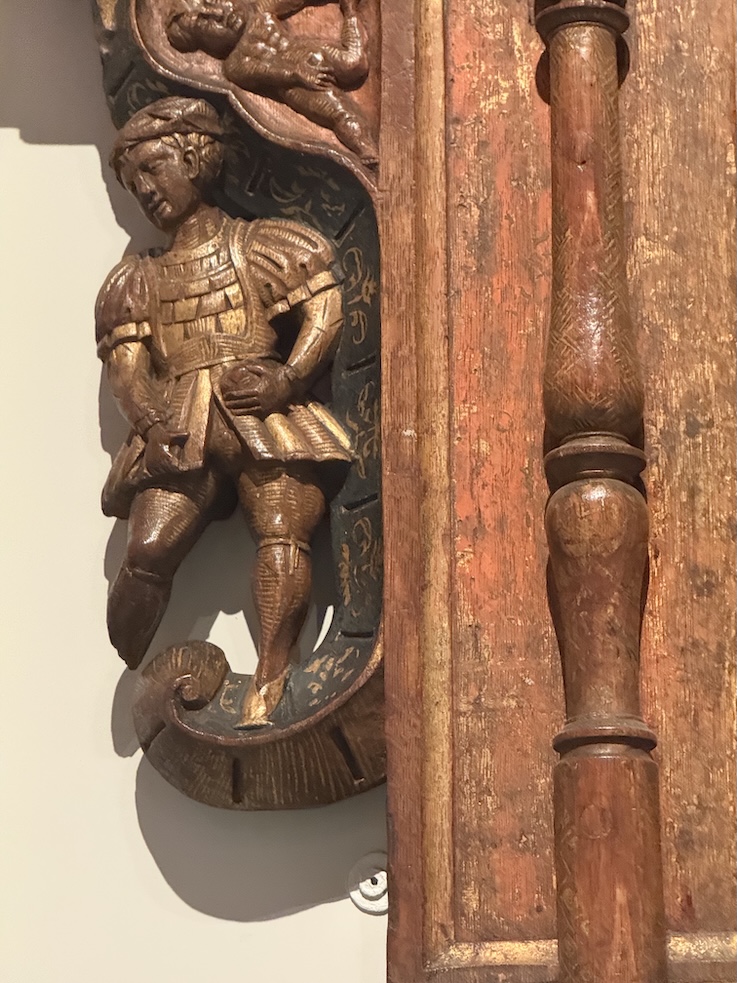
But that is the ultimate problem with these “collections” — once the benefactor has passed, they mostly become static collections, or at the very least, collections limited to their “vision.” Depending on the conditions set by the benefactor, that means lesser works or works that haven’t passed the test of time can remain in the collection. However, we did notice that there have been some new acquisitions since Burrell passed away, including the Warwick Vase, estimated to have been originally made in Italy in the 2nd Century CE. The Burrell hadn’t acquired it until 1979 (more than two decades after Burrell’s death), although it does seem to still fit within Burrell’s vision for the collection. The building didn’t open to the public until 1983, the construction supported by significant public money.
It does, of course, raise the issue of who decides what art has value to a society? Is it the ultra-wealthy who call the shots, or can this be mediated by other players, including artists, gallerists, academics, and curators. Where does the public come in, especially in an environment where art education has been in decline?
These collections sometimes feel like cultural tombs. And unlike many contemporary cultural institutions, it is not in a position to easily address changes in public sentiment, such as the addition of works by women or people of colour.
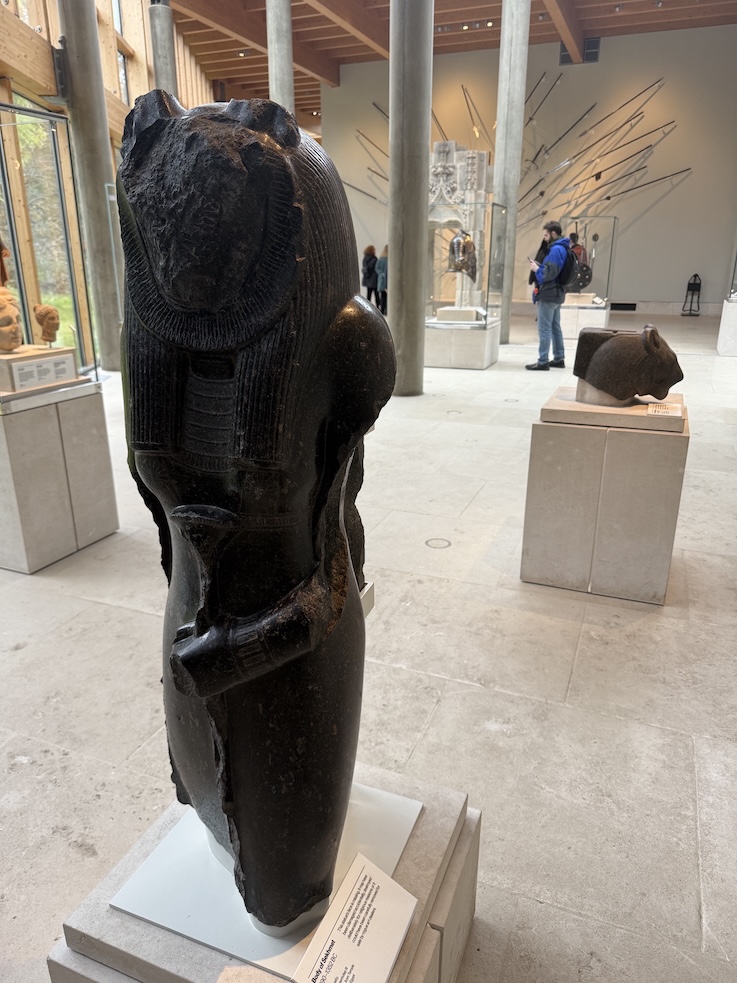
The day we chose to visit turned out to be a good one. There were a lot of people present. There were actors sword fighting as well as musicians in medieval dress playing to a group of dancers. There appeared to be a lot of docents giving tours. It did present challenges in the cafeteria, where one must find a table first, then go to a counter to order your meal, give them your table number, then return to have it delivered. It means both of you have to figure out what you want, find a table, then have the other order and pay for the food. For two people it worked out, but it would be confounding if you were visiting the collection alone.
On the walk to the Burrell through the beautiful Pollak Park, we spoke to an American woman from Chicago who lamented what was happening in her country. Of Hispanic descent, she was worried for her family amid the ICE raids. She also noted the growing intolerance here in the UK, especially with the rise of Nigel Farage. These are frightening times.
—
Thinking about this idea of who curates what we get to see, I experienced a bit of that while out shopping yesterday. When I was in the UK I saw that David Byrne (of Talking Heads fame) had a new LP out. I didn’t want to drag it back from Britain, instead preferring to buy it locally after I returned.
When I visited the mall yesterday I stopped by a good-sized record store tucked into the far end of the building. They didn’t have it. In fact, they didn’t have much in the way of new releases at all. What made it harder was that it was difficult to distinguish the new from the overwhelming number of reissues of older material that they chose to highlight on their shelves. I checked for some other new titles I was interested in. None of them were there. But you could get a reissue of Who Are You, an album I bought when I was in my early twenties. There were a lot of copies.
I found that disturbing, especially having once worked in the record retail industry in the 1970s. Back then all the new stuff was highlighted at the front of the store. There was a lot of it. Magazines like Uncut and Mojo have pages of new material every month. Problem is, you won’t find much of it in a local record store. In the end, and with much reluctance, I ordered it on-line.
 Rick Janson Art Studio
Leave a comment