
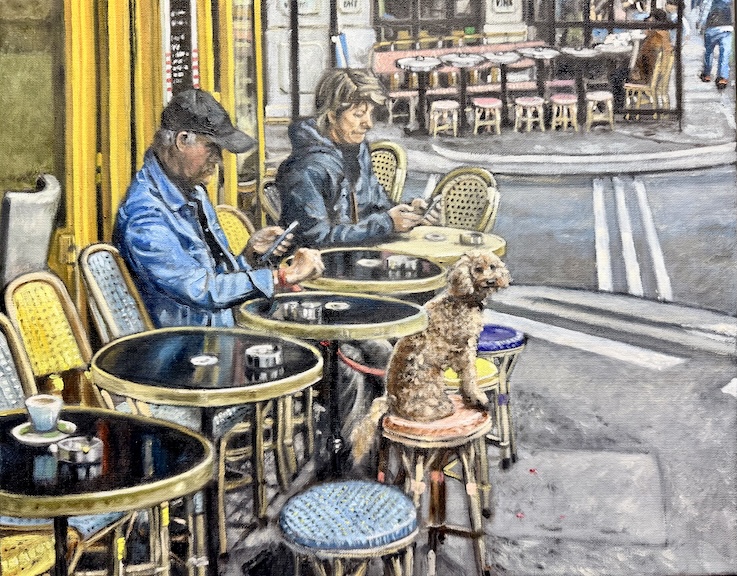
This is probably the worst sales pitch ever. The second painting of mine to be completed in 2026 has to be among the saddest I’ve ever done, although I have been thinking about it since I snapped a photo of two people in a Paris cafe who seemed to be totally absorbed in their cell phones.
It was during a free day in the City of Light. I was determined to collect images that day which would provide fodder for my easel over the next few years. Most of those images tend to glorify the social aspect of the city, cafes filled with people interacting in that old-fashioned way: face to face. In an age of increased isolation and loneliness, walking around Paris appeared to be the anecdote to such affliction. I was also determined to visit many of the sites painted by the masters, filled with the idea that it would be interesting to revisit those sites and bring my own approach to the same subject matter a century or more later.
It was still relatively early in the day when I passed this pair and their dog. The two were not in the present. The dog was. The cafe was in Le Marais, not far from the Pompidou Centre. I have no idea of whether they were French for foreign tourists, or whether they were even together. The way these cafes work it is often difficult to tell, which has the added bonus of throwing people together to interact with one another — something we definitely did during our time in Paris.
I don’t mean to pass judgment — I think everyone wrestles with how much of their lives are controlled by their phones and somebody else could have just as easily stumbled across me doing the same. But it seemed particularly ironic in a city with as much life as Paris.
According to a paper published by the Oxford University Press, there are two hypothesis regarding cell phones and loneliness. The Displacement Hypothesis suggests that nomophobia (an addiction to your cell phone) leads to loneliness, whereas the Compensatory Internet Use Theory suggests that people who are already lonely develop an addiction to their phones. The paper itself leaned more to the latter than the former.
In the end, I ventured to capture that feeling of loneliness in the picture. I think it may have looked differently without the dog as contrast to what was going on.
In a recent interview with the New York Times, writer George Saunders speaks about Chekhov: “He says a work of art doesn’t have to solve a problem — it just has to formulate it correctly… (On Lincoln In The Bardo) I wrote myself into a place where the question got more and more profound, and I found myself less and less capable of giving a definitive answer. That’s not for an artist to do.”
While technology has changed our lives and made things more convenient in many ways (remember when you used to have to line up hours early before a box office opened to get tickets to your favorite band?) the technology also changes us in many ways, perhaps something we are becoming increasingly aware of in an increasingly scary world. Saunders appears aware of this, noting that he’s as flawed as anyone else, “one who’s still wrestling with questions about how to best move through life with a modicum of grace and compassion.”
I hope some of that ambivalence and searching comes through my painting.
This painting will be on view and can be purchased January 28 to March 1, 2026 at the Leslie Grove Gallery Gallery, 1158 Queen St. E. in Toronto (at Jones). The painting is listed at $1200 CDN (including the black float frame it will be shown in). Most of my work is shown in non-commercial municipal galleries, so this is a chance to purchase directly from the Leslie Grove Gallery. Additional work will also be available for sale in May as part of the Scugog Studio Tour. More information on that to come.
–
In recent days I have been working on a small painting of a carnival at night. I got a little flustered after a while, realizing I couldn’t replicate the colours of the rides with conventional oil paints. I went on-line and found that I could get neon colours in a alkyd resin oil paint that works with conventional oils. Those paints arrived this morning, and I’ll let you know how it went when I get back to that canvas (I rotate four or five works at a time). The alkyd apparently helps the paint to dry faster too, allowing one to layer more quickly.
Meanwhile, don’t forget to a) subscribe (it’s free and I won’t fill your inbox with spam) and b) if your not into reading a bunch of words, you can skip ahead to my portfolio by clicking here.
 Rick Janson Art Studio
Leave a comment