Some Of It Is Still Being Recovered Almost 90 Years Later
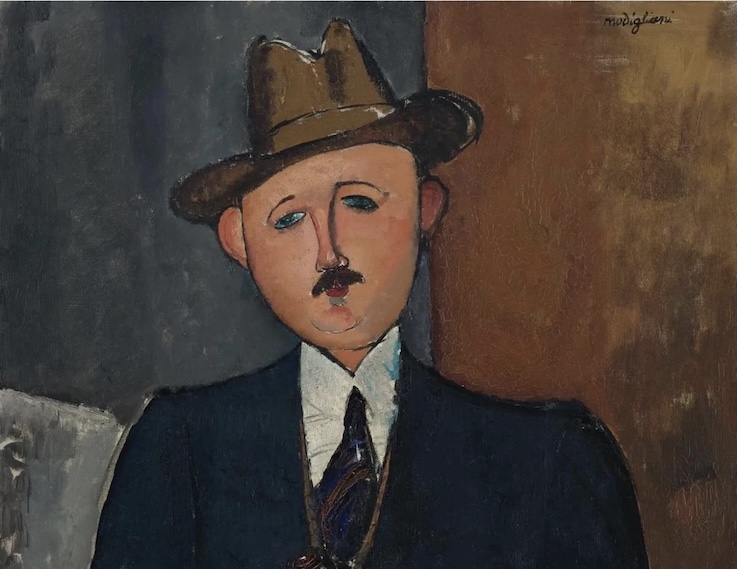
A recent court case over a $25 million painting by Modigliani resulted in its return to the estate of the Jewish art dealer who had originally owned it prior to fleeing Paris from the Nazis in 1939.
Nearly 90 years later, we are still seeing cases of art stolen by the Nazis run through the courts. In this case, it was a 17-year pursuit by the grandson of the original owner, Oscar Stettiner, to return the painting, Seated Man With A Cane, a portrait of Modigliani’s friend and chocolate merchant Georges Menier.
Recovery of Nazi-stolen art is still a major pursuit. With works valued in the millions of dollars, it is not a surprise that there are companies like Monex that still exist specifically to recover stolen art.
The Nazis looted an estimated 650,000 works of art in Europe, much of them from Jewish art collectors, although to complicate matters, unscrupulous French art dealers traded legitimate works for pieces considered by Hitler to be “degenerate art.” While the Nazis disliked modern art, they had no problem using it to barter for other works or to ship pieces by Picasso, Matisse, Modigliani and others to Swiss auction houses for sale, the proceeds to fund their war. Under the occupation, French art dealers shipped stolen work to clients around the globe, in some cases their wealthy clients undermining the war efforts of their own countries.
A recent book by Michelle Young about French curator Rose Valland speaks about her brave efforts to document the looting during the Nazi occupation and after the war, to recover about a tenth of that – or 61,000 pieces. It is estimated that there are still 100,000 Nazi-looted art works still unrecovered. Make that one less with this recent court case (maybe).
What seized “degenerate art” the Nazis couldn’t sell or swap, they simply destroyed. Valland was witness to the cutting and burning of valuable artworks on the grounds of the Jeu de Paume, the museum the Nazis used as their clearing house in Paris for seized artworks. The Jeu de Paume would set up exhibitions for Hermann Goring, then considered the second highest ranking individual in the Nazi hierarchy, to select pieces to send back to Germany.
While Valland was doing her best to document what the Nazis were doing – and subsequently putting herself at great peril – many were suspicious that she was instead collaborating with the Nazis, which has been since debunked (Valland is one of the most decorated French heros from World War II). The 1964 Burt Lancaster movie The Train is based on Valland’s book about the period, including the race to stop the last train loaded with Nazi plunder from leaving Paris. Valland was a secret member of the French resistance and had alerted them to the urgency of stopping the train.
Curiously, the whereabouts of the Modigliani was confirmed by the Panama Papers, which, according to Artnet, led Swiss authorities to raid a storage facility in Geneva in search of it. The work had first surfaced in 1996 at a Christie’s auction in London, purchased by a billionaire’s holding company. Marcel Phillippon, an administrator working for the Nazis, sold the Modigliani in 1944 to John Van der Klip, who had claimed he had sold it on to an American military officer, although the provenance lists a J. Livengood as the owner, but Livengood was the work’s consigner and Van der Klips heir and grandson. “It would seem he lied to the court about having sold the painting to avoid returning it to Stettiner,” writes Sarah Casone on Artnet.
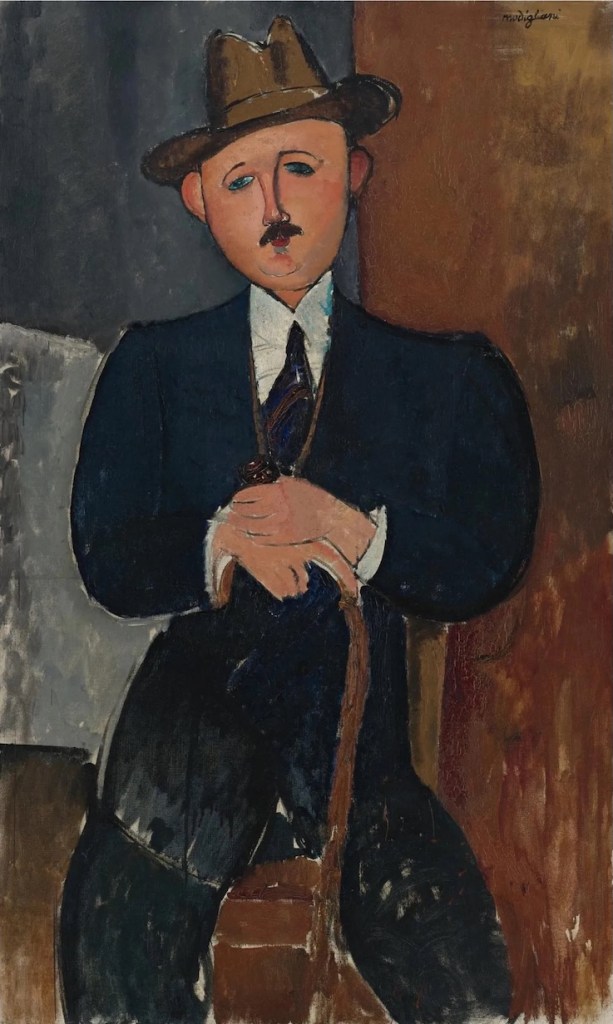
The Artnet story states that billionaire David Nahmad initially denied that he owned the painting until the Panama papers suggested otherwise. His lawyers then argued in an American court that there was no evidence that it was stolen Nazi loot. Nahmad had tried unsuccessfully to sell it on at Sotheby’s New York for $18 to $25 million. The Sotheby’s researcher had contacted the Wildenstein Institute in Paris looking for information related to provenance. The Wildenstein provided a photograph of the painting from its archives that included, according to Artnet, notes reading “Famille Stettiner” and “vole” (French for stolen).
The case is still fresh, and there could yet be an appeal. It does underline the difficulty of restitution almost 90 years after the German army walked into Paris and began looting collections throughout Europe.
One of artists who didn’t flee the Nazis was Pablo Picasso. Michelle Young’s book (The Art Spy) repeats the often told story of the Nazi’s arriving at Picasso’s Atelier and seeing a picture of Guernica on the wall. Guernica was Picasso’s famed depiction of the horror of the Nazi bombing of the basque town of Guernica in support of the fascist forces during the Spanish Civil War. It is still considered a strong anti-war statement and likely Picasso’s best-known painting. A German officer, spotting the photo, asked Picasso if he did that? Picasso purportedly replied, “no, you did.”
Meanwhile, war continues to put the world’s heritage at risk – the recent attacks on Iran have impacted a number of UNESCO World Heritage sites, including the 16th-Century Golestan Palace, The Sotoun Palance and the Jameh Mosque.
Sometimes we forget the importance of art to the world, but then you look back at the enormous efforts to plunder the art of another nation and realize that it plays an outsized role in our culture.
In Canada that is sometimes hard to fathom. This week the Kingston Prize, the predominant portrait competition in the country, has just moved from biennial to annual. We couldn’t previously run this competition more than every other year?
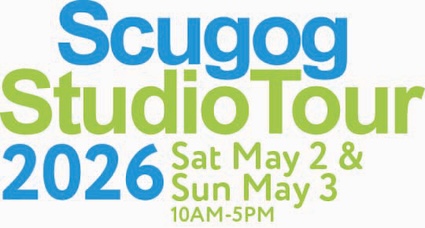
This week I am toiling away in preparation for two upcoming events — the annual Oshawa Art Association show at the Robert McLaughlin Gallery in Oshawa, and the Scugog Studio Tour. I’m still aiming for eight new 12″ x 12″ paintings for the tour, numbers seven and eight well advanced. I’m also looking at applying to show at the culture hall outside the City of Oshawa Council chambers. Given how few opportunities there are for this space, I suspect competition will be great. The City has been advertising its call for entries for weeks now on Facebook.
Meanwhile, if you want to see my latest work, click here on the gallery section. Yes, these works can be purchased, although with two events on the horizon I’m not spending a lot of time pushing sales right now.
 Rick Janson Art Studio
Leave a comment