Rick Janson Art Studio

My Art Journal

  • The process of painting

    The most common beginner mistake made by new oil painters is to think they can start at one side of the painting and simply work across and finish at the other.

    There are some materials where there is little choice but to do that — such as an artist doing a proper fresco and having to work into fresh plaster every day. You only have so much time. Michelangelo did his Sistine Chapel in small squares, adding a bit more each day as if they were all pieces of a puzzle.

    But for most of us, oil painting is a process of building layers until you achieve what you set out to do. The risk is always of overworking a canvas, but for most, the danger of underworking is usually much greater.

    I decided to document the various sessions I had with this new painting, each session representing two to three hours. Many artists use different and valid processes, but this is the one I commonly use.

    The painting is from an image I took in Newport, Rhode Island, while attending one of the jazz festivals there. I liked the long light and the story it told of the person walking uphill towards, presumably, a job. There was a hotel at the top of the hill, and I suspect he was headed there. I liked the fact that the houses were all irregular shapes, no doubt partly from settling over time. It’s far from crisp vertical and horizontal lines.

    Working on a white canvas is very difficult, given it is hard to assess your colours as you initially put them down. As such, many artists put down a flat ground first. In this case, I simply painted the canvas gray. After that, I use the grid method to transpose my image on to the canvas, in this case going a little further in delineating some of the darker areas.

    For those who are not familiar with the grid method, it involves drawing a grid on the canvas in an equal number of squares to your original image. I use a gridding software, so I don’t have to physically made the lines on the original photograph or drawing, although prior to the software, that is literally what I used to do.

    Once the original has been gridded, it makes it much simpler to figure out where all the key lines in the piece fit, matching the squares one by one. The grid helps you avoid making major corrections only to discover a key part of your composition is now off the canvas altogether. You don’t want to fix the proportions on a body to discover that the head is now off the top of the canvas. Likely there will still be some drawing corrections but they will be relatively small by this point. At every stage of the process I am making drawing corrections.

    The next step I call the rough-in, where you take the general colour pallette and do a quick once around to give a sense of the painting. I apply rough colour knowing I’m likely going to fine tune those colours as I god, now having some reference points to work from. Often the colour on your pallette will look different than it is on the canvas. I have no qualms about doing some find mixing right on the picture. Having a general sense of the painting, it makes it much easier to figure out the right colours.

    The next level you start refining the details. You’ll notice I’ve added some lines on the left side of the first house to indicate the siding. I’ll rough up those lines in the next pass. I seldom use a ruler when I paint, but in this case I think it was a necessary evil in this one part of the picture. I’ve also gone into more detail on the trees and shrub and started darkening the figure in the painting to indicate he has entered the shade. When I worked into the shrub I inadvertently given the figure a man bun, which I eliminated in the next pass. I’ve started working up the details on the windows. At this point I’ve done nothing with the curb other than to show where it runs. I’ve also done the first pass of the leaves on top of the roof of the second house.

    Here I have gone into the curb to provide some detail, as well as the way the road repairs have picked up the light. I’ve emphasized the right arm of the figure by indicating some light silhouetting that arm. There is much more detail in this pass, including how the sun casts shadows on the first building. At this point I’m looking to finish with smaller tweaks to bring it to life, including doing some more drawing corrections, such as the lining up the three windows on the first floor of the first house and providing more detail on the cobblestone on the sidewalk in the middle ground.

    On The Way To Work (2025) 16″ x 20″ Oil on Canvas.

    Above: the “finished” piece, although I am not reluctant to go in at a later date and rework any aspect of the painting that I see needs addressing over time. Writing this, I have just noticed one minor tweak. I’ll repost in the gallery section once I’ve made it. Come back tomorrow and see if you can figure out what it was. This is also one of the reasons I don’t like to varnish my work anymore. You can rework a varnished painting, but it usually involves first taking off the varnish. The idea of reworking “finished” paintings is more common than you likely think. The French painter Edouard Vuillard is the one master everyone likes to point to for reworking stories. He was said to have snuck into the homes of those who had purchased his paintings to make small changes, carrying with him a brush and whatever colours he needed in his pockets. There is a story that he also did the same in museums that held his work, often involving an accomplice to distract the guards. That may be more story than truth.

    Once someone buys one of my paintings, for me it is always done.

    Don’t miss another post — subscribe. It’s free. Will always be free. I will never sell my subscribers list. If you want to browse my recent photos, click here.

  • Brilliance or bad vision?

    Last month I had the annual visit with my optometrist and somehow the discussion turned to art (it often does with me anyway). I had said to her that I wondered how my vision issues are or will manifest themselves in my painting?

    At this point I do have the start of cataracts, but we’re nowhere near the point of requiring surgery. How much it impacts my work is anyone’s guess at this point.

    Monet was also diagnosed with cataracts and refused surgery for years owing to his reluctance to undergo a procedure that would change his colour perception. He was particularly alarmed when Mary Cassatt underwent similar surgery without the results she was seeking.

    It would appear the cataracts were changing his colour perception all on their own. Cataracts tend to make your vision more brown, which effectively filters out the blue light. That left Monet’s colour choices increasingly dark.

    Monet’s water lily paintings in the Paris Orangerie.

    By 1918 Monet was reported to be selecting his colours based on the label on the tubes. After he finally underwent cataract surgery, he intended to destroy many of the works produced during this period of vision impairment, including several of the water lilly paintings that ended up in the Paris Orangerie. However, it wasn’t as if his vision entirely went back to normal. Reportedly, following cataract surgery, many people see an excess of blue and yellow light. In Monet’s case, it took two years for his brain to adjust to his new vision. He underwent a second surgery in 1923, but still required special glasses with colour filters to do his work.

    Edgar Degas also had vision issues later in life, making it difficult for him to distinguish the subtle colour differences needed for oil painting. Both Degas and Mary Cassatt took up pastels in the later career, making their work much more linear in nature. Degas also shifted more into sculpture.

    Vincent Van Gogh was also diagnosed with xanthopsia, a vision deficiency that is said to make the sufferer see more yellow.

    Other well-known figures in the art world thought to have vision problems include El Greco (1541-1614) and Rembrandt Van Rijn (1606-1669), although in their case it is largely speculative based on the work they produced. There was a case made that El Greco’s elongated figures owed to an astigmatism, but as another art historian suggested, if that was the case he should have self-corrected when it came to applying his drawing to canvas.

    It does raise the question of how much of these artists unique vision was really their unique vision, and how much was a matter of choice.

    The Impressionists frequently come up in this category, although it is extremely dubious that their choices that revolutionized the art world were entirely the result of bad vision.

    Yesterday I got new glasses (see above). I’m seeing a little better, but somehow doubt it will make all the difference.

    Hoping to have some new art for you tomorrow. Come back for a peak!

    Don’t miss another post! Subscribe for free on this page. Want to see more of my work? Click here to look at my recent gallery of work.

  • Pop quiz on labour day

    Quick: name a Canadian visual artist who is known for their portrayal of labour? Still thinking about it?

    Likely the worst thing to happen to art that celebrates working people was Soviet Realism, which was so over-the-top it likely made many Western artists run in the opposite direction, especially amid the growing awareness of the brutality associated with Stalinism.

    Having been around the labour movement in Canada for about 20 years, I have to say that while there have been valiant efforts to promote “the arts” through such events as the annual Mayworks Festival, it has never risen to the mainstream within labour. I have to fully admit that despite my background, I have never attended a Mayworks event, and neither have most of the workers I have ever represented. I have, however, been to the Workers Arts and Heritage Centre in Hamilton.

    When I was in the National Union’s summer leadership school in 2007, Tom Juravich gave a session on using the arts as key part of our work. A musician and labour studies professor, Juravich emphasized the deeper connections that could be made with both our members and the public through the arts. When I returned to my own union and started incorporating those ideas, I was met with a great deal of skepticism despite some overwhelming success incorporating both music and theatre into my campaign work. I actually worked with Tom on a number of projects, including recording a song he wrote for one of our rallies in support of home care workers. It was later used in a video that never got traction after the government gave up on its insistence on a terrible contracting process that put home care workers out of a job, even in situations where their non-profit organizations had been doing the work for a century.

    Working for a CUPE Local in the early 00s, I did once apply for and received a grant from the Canada Council for the Arts to work with a local theatre group in building puppets for the annual Labour Day parade. The members appeared to love getting involved, although I had moved on to another employer by the time of the parade and missed the final product.

    Portrayal of working people has always been controversial. When Gustave Caillebotte painted the now iconic Floor Scrapers in 1875, the Salon of that year rejected it, stinging him with their rebuke, deeming the portrayal of working people as a “vulgar subject matter.” Caillebotte none-the-less painted another version of the scrapers the following year. He also depicted house painters at work in 1877. Caillebotte reportedly took his cue from Degas, whose paintings of women engaged in laundry were deemed somehow more acceptable, as did his portrayals of dancers.

    While Diego Rivera’s mural may have been jack hammered out of the lobby of the Rockefeller Centre, (see my previous discussion by clicking here) many of his murals portraying working people in American industry remain in place, including his stunning 1930s Industry Series at the Detroit Institute of Art. Americans were okay with the Communist-supporting Rivera as long as he kept Lenin out of his pictures.

    In Canada? You have to look a lot harder. The National Gallery staged a small labour-related exhibit in 2023, which included work from Canadian artist and architect Frederick B. Taylor (1906-1987). Taylor painted a broad range of subject matter, but during the war years had produced a number of works that showed workers in important industries, including welders in an anti-aircraft gun factory. The same trend was happening in Britain. It was less about celebrating workers than it was about projecting industrial strength in wartime.

    I suspect that there is a certain amount of paranoia by the business community around the portrayal of work. There is a frieze on the exterior of the old Toronto stock exchange building. That frieze shows workers contributing their labour to industry, but also slyly shows the capitalist with his hand in the pocket of the worker.

    The capitalist has his hand in the worker’s pocket in this frieze on the old Toronto Stock Exchange.

    While it is difficult to find resources on the portrayal of labour by Canadian artists, the Workers Art and Heritage Centre in Hamilton has just published The Act of Solidarity, Labour Arts and Heritage in Canada (Between The Lines Press). The book looks at a cross-section of arts, including protest music, union banners, murals, community theatre and oral history.

    Co-author Rob Kristofferson (a labour studies professor and Wilfred Laurier University) told the Hamilton Spectator that “in the postwar period, the role of the (labour) arts and heritage was a diminished one.” Yeah, no kidding. The authors note that with the demise of industrialization, the focus shifted to issues of inequality, abuses, and underrepresentation. I suppose portraying office workers hard at work is a little visually challenging.

    Waving Banners (2007) Oil on Canvas.

    Today’s painting: This was a commission I did in 2007 as a gift to Leah Casselman, the then retiring President of the Ontario Public Service Employees Union. It shows union members on stage at a rally in Yonge-Dundas Square, the rally held for striking college faculty. When I first presented it to those commissioning it, I was told to change one of the figures in the painting — it turned out to be a little too recognizable as an individual they claim Leah was not fond of. I did make some changes, including to his tell-tale hat, but Casselman recognized him anyway. Whoops.

    Happy Labour Day to all my Canadian readers.

  • How long should art last?

    Years ago I visited London’s Victoria & Albert Museum and stumbled upon the cast collection. In the 19th century it was popular to make plaster casts of well-known sculpture for educational purposes. Opened to the public in 1873, these life-size casts included work from around the world, initially starting with the most revered pieces from the Italian Renaissance, include Michelangelo’s 17 foot tall David.

    I was awestruck walking around the two rooms and seeing everything in one place like this, literally jammed together in close proximity.

    Students did initially use the casts as learning tools, it being difficult to travel the world to encounter all these sculptures in person. In the late 1920s there was debate about whether or not to get rid of them. Chuck ’em out. The fad had passed.

    Fortunately, the V&A didn’t put them in the dustbin, and they have become a detailed record for restorers after centuries of weathering, the effects of pollution, and previous poor restoration attempts. Some of these works have been forever lost through the wars and the V&A now has the only such record of them.

    In Florence, in the same year the plaster collection was opened, a replica of Michelangelo’s David was used in the sculpture’s original location, and David instead was installed at the Accademia where he is now out of the rain and in the spotlight. Just walk into any old graveyard and its not hard to see what the elements do to stone and marble over time.

    Michelangelo’s David was sculpted between 1501 and 1504. But what about an outdoor sculpture unveiled in 1971?

    That’s a hot topic in San Francisco right now, where the city’s plans for renovating the square containing the so-called Vaillancourt Fountain doesn’t include the brutalist sculpture the fountain is built around. Armand Vaillencourt, who is now 95, showed up himself to forestall his work’s demise. Surprisingly there has been little coverage in Canada despite Vaillancourt’s Quebec origins. It might have something to do with Vaillancourt’s political views — the day before the sculpture was unveiled, he spray painted “Quebec Libre” on it. It was 1971, after all. The city of San Francisco immediately removed the message. Bono, who has no connection to the sculpture, thought that he could likewise spray paint it with “Rock and Roll Stops Traffic.” Hmmm.

    There is not a love lost over Vaillencourt’s Fountain — not entirely a surprise given there is little affection for brutalism in the 21st century. The San Francisco Arts Commission itself described the piece as resembling “a ruined heap of building blocks, toppled and abandoned by some gargantuan and disappointed child.” Artnet reports that the fountain has been described as “Stonehenge with plumbling problems,” no doubt a response to the fact that the fountain pump has stopped working, and estimates on its replacement alone are in the vicinity of $3 million. Obviously they are not shopping in Home Depot’s garden centre for water pumps.

    There’s more wrong than just the plumbing. The concrete is crumbling and is said to contain asbestos, which would make it a hazard for any restoration, let alone its dismantling. The city currently has a fence around it for safety purposes. Full restoration is said to be closer to $30 million — a tough ask in the current environment for a piece of art that is not well loved, except, perhaps for skateboarders.

    Not all art movements are always cherished, but rather go through a re-evaluation process from time to time. Sometimes they are lost to time, sometimes they are revived.

    I was surprised to see a new book published on Jean Leon Gerome, the French Romantic painter. Gerome has long been out of favour, in part because of his portrayal of a colonialist past in North Africa, and in part because of his method. In the late 19th century and into the 20th century it was all about making the brush stroke visible in the work. Gerome taught more than 2,000 students how to make the brush invisible.

    Gerome’s work is often well observed, and contains a meticulous record of North African culture that is warranting a fresh look in the 21st century.

    Surprisingly, it is the Arab Museum of Modern Art that is sponsoring this new look at Gerome. It was their catalogue that arrived in my post box. Will museums be dusting off the Geromes in their collection again?

    Gerome was among the first artists I learned about in Mr. Samatoka’s Grade 9 Art History Class. I don’t think I have heard his name since.

    Which brings us back to Brutalism. Will brutalism have another day? If we destroy its best examples now, will we regret it later? When I watched Brady Corbet’s 2024 film The Brutalist, it made me wonder if we are on the cusp of a new appreciation? But maybe not in San Francisco, or it seems, in Canada.

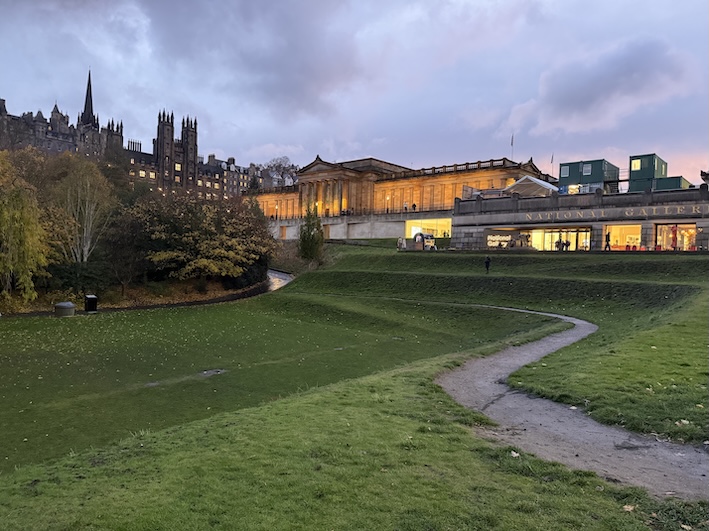
    Top Photo: Me in front of Alexander Calder’s Cheval Rouge (1974). The work is featured in the scuplture garden in front of the National Gallery in Washington DC. None of my work today! If you want to check out the Rick gallery of newer work, click here.

  • Making art amid two cultures

    As a visual artist its always been clear that mass culture has always had an uneasy relationship with fine art. We go to specialized schools that not only teach us our craft, but also the words we need to use to distinguish ourselves as professionals as opposed to weekend warriors. Yeah, we’re taught to be art snobs.

    I remember taking a readings in contemporary art course as part of my BFA studies. It was about that second professional language. After we learned how to translate what these leaders in contemporary art criticism were saying, often it wasn’t to some kind of enlightenment or a-ha moment as much as it was a shrug. Just stick in the word “reify” and you’ll do fine because it sounds good even if nobody can quite agree on what it means exactly.

    For artists we all want to be in the blue chip galleries for no other reason than it is the only real opportunity to make a living, that is if you don’t have an external source of income as I do (I have a pension). But those blue chip galleries are another world altogether. Artnet speaks about offerings of work for less $10,000 (USD) like its a bargain basement sale. And for that you’re talking about a signed artist print.

    It is interesting to look at the galleries that are outside the art system — they seem to cater to families who have bought McMansions and need to fill out a lot of wall space. They’re not investors or people truly interested in visual arts. They just don’t want to stare at blank walls and they want their homes to look as bland as those they see in the magazines (why are Canadian home decor magazines so afraid of colour?)

    I noticed one Toronto gallery that has a bricks and mortar location (but also sells on-line) sets as its requirements for new artists that it only wants large and medium size works — mostly painting — and that work should be consistent. The photos they post of the gallery show work literally stacked from floor to ceiling. This is not about art. Its about turning artists into factory workers.

    I noticed the pricing at that gallery is such that it is unlikely any of those artists are making much from their work, although the gallery’s commission is not publicized on their website, so it is difficult to tell. It’s usually half, although there are various schemes in place now, so it does vary. Artists need to look at all their true costs. In addition to commission, there is the cost of materials, time to create the work, the maintenance of a studio, marketing time and the fact that a certain percentage of their work will never sell. A friend of mine calculates his prices based on two-thirds of his work never selling. That seems realistic to me. Then there is the cost of merely keeping up and educating oneself. That BFA didn’t come for free, nor does my travel to see what’s in the galleries. You might eke out a living if you can dash off the same version of the same sellable painting over and over again. It’s not about creativity. It IS about consistency, as that Toronto gallery asserts.

    There is an interesting opinion piece in today’s New York Times that speaks about how with the shrinking of the middle class the culture is shifting increasingly towards catering to the wealthy. In the world of the visual arts that’s not entirely new, but it has been expanding to other cultural realms.

    The focus of the story is how Disney’s theme parks are now chasing after the wealthy through $3,000 (USD) a night suites at the Polynesian Village Resort, or a bar and lounge in EPCOT which offers a package that includes a tower of “bites” and a choice of drinks with a view of Cinderella’s castle during the fireworks for $179 per person (entry to the park not included). A Disney prix-fixe meal at the Michelin starred Victoria and Albert’s starts at more than $1200 for two.

    Everyone in the Magic Kingdom is no longer a VIP. The VIPs are the VIPs. That includes paying extra so your kids can skip the long lines for the star attractions, a feature, to be fair, that exists at most theme parks now. The middle class kids get to wait in long lines while watching their more well heeled cousins go to the front.

    Anybody who has bought a concert ticket in the last decade is probably also familiar with this. It used to be prior to the internet that the best seats were available to whoever was at the front of the physical line. Now the rich can simply buy VIP tickets for thousands of dollars and take up the best seats without having to be elbow to elbow with the working class.

    “That middle class has so eroded in size and in purchasing power — and the wealth of our top earners has so exploded — that America’s most important market today is its affluent,” writes Daniel Currell in today’s NYT.

    Currell quotes Len Testa, who has written guide books around avoiding such lines. Testa states that a Disney vacation today is “for the top 20 per cent of American households — really, if I’m honest, maybe the top 10 per cent or 5 per cent… Disney positions itself as the all-American vacation. The irony is that most Americans can’t afford it.”

    The suggestion is that while wages have increased and jobs have been plentiful, it is the creation of a culture that is earmarked for only the wealthy that is starting to make Americans angry.

    The wealthy have carved out a space where most of us cannot afford to go. They don’t want to be around us.

    As artists we face the choice of participating in a culture that is open to everyone, or aspiring to actually make a living by catering to the tastes of the wealthy (whom usually take their cues from the gallery consultants). I also get the impression that the truly wealthy prefer their artists to be well established and dead. When you look at the list of artists that some of these blue chip galleries represent, all of them are dead.

    There has been much written about how the wealthy have used their money to change the face of visual art. In 1933 the Rockefellers commissioned popular Mexican artist Diego Rivera to paint “Man At the Crossroads,” a giant mural contrasting Capitalism with Communism. Rivera, himself a Communist, likely tilted that presentation a little more to the Communist side, resulting in criticism from the press that the Rockefeller Center’s new art was anti-Capitalist. A fresco, the only way to get rid of it was to jack hammer it off the wall and re-plaster. A great work of art was lost, although Rivera did replicate it later in another more welcoming environment.

    It is perhaps no surprise that after that incident, that the tastes of the wealthy tilted more towards abstract art, not that the general public particularly embraced that shift, creating a dichotomy in the art world. Keep in mind that painters like Jackson Pollock only had one successful exhibition in his shortened lifetime. The rich can only buy so much art. Pollock had stopped painting altogether two years before his death in an automobile crash. To what extent that shift in tastes served the art community is an open question.

    Ogunquit (2014) 36″ x 36″ Oil on Canvas

    Today’s painting: Back in the days before Canadians became the “nasty” neighbours to the north, we used to travel regularly to Maine, often en route to New Brunswick. One of the regular stops was Ogunquit, where the wealth was clearly on display in the massive summer homes we saw overlooking the coast. At the time I was in one of my “I need to loosen up” panics and made a painting that in the end was a little disappointing in retrospect. I think I focused too much on the paint strokes and not enough on careful observation, which is usually my forte. Unfortunately, I varnished this work and as such, reworking it would difficult to do in order to address some of its shortcomings. I also painted a smaller draft of this beforehand, a little unusual when it comes to my landscapes. I’m usually a one and done guy. A third try? Going back to Maine is out of the question now, not wanting to support a US economy at a time when its President has set his sights on attacking ours. It doesn’t look likely there will be a third iteration. That’s okay.

    Go ahead and subscribe. It’s free. You’ll never miss another post.

  • Blooms you can’t get rid of

    Day lillies are great when they bloom. Problem is, if you ever change your mind, they are next to impossible to get rid of. They also spread like crazy. And if they are anywhere near a pool — as ours are — when the blooms fade they tend to fall off into the water and end up in the skimmer.

    We’ve had them in our back and front yards for years. In the late 00s I decided to use them as the basis for a series of abstract paintings that turned out to be not so abstract.

    Wassily Kandinsky had issues around what was truly abstract, some claiming his early abstracts did have physical representations in them. I’m not so sure. But my abstracts always seem to yearn back towards whatever inspired them, often in a very obvious way. By the end of the 2000s they weren’t really abstracts at all.

    If nothing else, my brief excursions into abstract art do push me — at least for a while — to become much looser in my application of paint. I also become more conscious of my desire to apply paint more thickly. If you have been following this BLOG for a while you’ll notice that the work tends to bounce back and forth between a tighter form of representation and a more enthusiastic splash back into the qualities of the paint strokes. I think that is often a factor of how big the canvas size is and how tight the last painting finished up.

    This painting in particular has been hanging in my studio for a long time. It tends to catch people by surprise when they come into my tiny space, although lately other canvases have mostly obscured it as I am in the process of scaling up my work again.

    Day Lily (2009) 36″ x 36″ Oil on Canvas

    Don’t forget to subscribe and you’ll never miss a post again. Use the black box on this page. All I need is your email address. Meanwhile, feel free to visit my more recent work by clicking here.

  • If the model is willing

    It’s interesting to watch artists at work on a portrait commission. For starters, its never about taking a photo then replicating that photo. The best appear to make it a process about getting to know the person, then making multiple sketches and some preparatory paintings before tackling the main commission.

    Artists speak about getting to know the surface of their subject’s face, which over a series of preparatory works, becomes the equivalent of muscle memory.

    Of all the genres I’ve played with, portraiture is the hardest given it has to be so much more than just a decent painting with all the usual parameters, such as colour, line, composition, contrast, surface and the ability to situate the person in a space.

    Most artists commit to a self-portrait at some point in their lives. For some, such as Cindy Sherman, every work is a self portrait (sort of) as she takes on different personas.

    I’ve done three self-portraits (sort of) ever. The first in art school (click here), the second an absolutely tiny one about twenty years ago for a project at the Art Gallery of Ontario, and the third, a new one completed over the last few weeks. The latest is really a preparatory painting for a full-length self-portrait in 2026.

    Watching other portrait artists, it occurred to me that I should be taking time with this, doing a series of drawings and paintings in preparation for the main event, so to speak.

    Self Portrait Study 1 (2025) 12″ x 16″ Oil on Canvas.

    Given this was really just preparation for an eventual piece, I decided to work from a selfie that I may have dashed off a little too quickly — eager to get to my easel. Almost immediately I noticed that my eyes were partly obscured by my glasses. I could have abandoned it at that point and taken a new selfie — its not like I had to go far to find my model. Instead I used it as a challenge.

    After I wrapped this up yesterday, I sent it out to a number of people I knew for feedback. Two thought it a total miss, one not even recognizing me. Two thought it was very recognizable, one thinking it captured me exactly.

    That was a head scratcher. Portraiture can be hard simply because the physical image on the canvas may not live up to either how the individual sees themselves, or in this case, how others see me.

    The other thing that portrait artists comment on is how a simply stroke of the brush can completely alter how the finished painting looks. After the feedback, I did add in a few more strokes — mostly around the glasses — but I would suggest it didn’t make that much of a difference.

    I’m happy with the picture today, but may think otherwise in a week or two. But I plan on starting another today as a means of continuing to prep for that final self-portrait.

    That is if the model is still willing.

    Like this post, don’t forget to subscribe. It’s free.

  • Little Stories

    When I was studying at the University of Ottawa I used to regularly cross the Rideau canal to the National Gallery of Canada, which was then located in a former office tower on Elgin Street.

    Among the works I spent a particular amount of time with were those of the 18th Century Venetian painter Canaletto (1697-1768). Painting in a style known as Vedutism — a genre known for its complex cityscapes and urban life — Canaletto was popular with English Aristocrats on the Grand Tour of Italy. A prolific painter, much of his work ended up in Britain thanks to British Consul Joseph Smith, who bought Canaletto’s remaining collection posthumously for King George III.

    Canaletto’s (a nickname meaning “little canal”) real name was Giovanni Antonio Canal. His father was also a painter.

    What I really liked about his paintings, aside from the incredible level of detail in them, was the vibrancy of the city life depicted therein. It didn’t suprise me that Canaletto cut his artistic chops as a scenic painter: the figures in his work look like they could be actors in an opera. The figures not only give scale, but breathe some life into the scenes, giving us some idea of what Venice may have been like during Canaletto’s time.

    Canaletto did a lot of plein air painting. There is also debate about the extent that he used the camera obscura to obtain the accuracy of his landscapes.

    Canaletto inspired other like painters who did a brisk business painting for English tourists. Artists need to make a living. The National Gallery room with the Canalettos was also filled with other like images from the Venetian school. Having spent time in Rome and London, Canaletto’s connection to Britain also influenced artists such as Constable and Turner, the latter considered one of the fathers of modern art. We do stand on the shoulders of those that went before us.

    The Tree (Koblenz) (2025) 30″ x 48″ Oil on Canvas.

    In yesterday’s post I spoke briefly about debating whether I was a figurative artist or a landscape artist. But really, going back to those Canalettos I can see where this all got started for me. I do like to put figures in the landscape (contrary to the preferences of some art critics), and as you’ve seen in some recent posts, they can be the landscape itself.

    Today’s image is no exception, the landscape is about a remarkable tree, but the figures are much more interested in the distant landscape. It was taken from a stop in Koblenz, Germany, on a trip down the Rhine River from Basil, Switzerland to Amsterdam, Holland. We took a cable car up on the bluff on the opposite side of the river overlooking the town, where I came across this scene.

    While the view was spectacular, I was taken with the view of those taking in the other view. The father taking away the bored child. One reaching for a camera. Others aiming their phones off in the distance. Two sitting on the chairs with their feet up on the rail. There are multiple little stories here.

    By the way, if you are interested in the history of the Grand Tour, I did come across an amusing 2006 DVD series by art critic Brian Sewell where he recreates the journey of the British Aristocrats through Italy. Sewell weeps at the catafalque of Michelangelo and demonically scoffs at lesser works in churches and galleries that the grand tourists would have also likely seen in between what he describes of their insatiable sexual adventures. Sewell even includes his own anecdotes, telling the story of he and his companions scraping their vehicle on a narrow roadway between two buildings, then quickly realizing their only exit was to drive the vehicle down a steep set of steps. Sewell speaks in a very strange and pompous style that has been described as having “some intonations of Vita Sackville West.” As an art critic, he was considered “deeply hostile” to contemporary art, trashing Lucien Freud and Jenny Saville in the series despite no apparent connection to the subject matter. We were totally addicted to this series and sad when we reached the end. Sewell passed away in 2015.

    Don’t miss another post! Subscribe using the black box on this page. Subscriptions are and forever will be free. To view my gallery of recent art, click here.

  • After 950 kms, crrrrack!

    I don’t know why I chose to do this drawing back in the mid-1980s. Being a long-suffering Maple Leafs fan, I must have choked colouring in those red Habs jerseys.

    I think it may be the largest drawing I ever did using a rapidograph pen and Prismacolor pencils. Unfortunately back then I didn’t get the importance of recording details such as a drawing’s size.

    The picture had been displayed for some time in a commercial gallery attached to the Ottawa Simpson’s Department store. Alas, there were no takers back then.

    Amazingly, despite the huge sheet of glass in the frame, it made it intact when I first moved to Halifax from Ottawa. The day of my arrival, I had placed it gingerly on the sofa, thinking about hanging it above the furniture. Then a friend arrived, and decided to sit on the couch without noticing that there was a large framed picture on it that almost covered its entire width. He leaned back and crrrrrrack! The picture had made it about 950 kilometres unscathed, but couldn’t make it another foot or two on to the wall of the apartment I shared. Ugh.

    The picture did get new glass, and I recall somebody in Nova Scotia eventually purchasing it for a modest sum. No doubt I was inspired to have someone take it off my hands rather than have to move with it again. I have no idea what has since become of it (if you have it let me know).

    The Habs 1987, 30″ x 40″(?) ink and Prismacolor pencil on mat board.

    This is likely one of the last drawings I did using the ink dots. I like the fact that I had simplified the background, keeping it in black and white while colouring the kids in the picture, propelling them forward.

    The photo would have originally been taken in my south Ottawa neighbourhood, the high school kids being my friends back in the day. As I recall, the smaller kids wanted to join us in a pick-up road hockey game. Afterwards I took a photo. It seemed like a quintessential Canadian moment. The original image, while never the best quality (the overexposure may have accounted for the lack of detail in the background), did call out for something more to be done with it. It summed up much of my youth, having played ball hockey on every street and parking lot we could manage with whoever was around.

    One of my friends in the photo went on to become a teacher in Texas. Another became Ontario’s first and only child advocate.

    I’ve been going through a lot of my old photos lately, thinking about taking the autobiographical subject matter in my paintings a bit further back. It does pose some interesting opportunties and challenges, including working with that strange saturated pallette of early colour photographs, or even yet, figuring out how to translate images from black and white sources. Do I make up the colour, or do I paint it using only tonal values? Or do I paint it using a saturated retro-colour palette? Hmmm.

    The more I look at this work I also am beginning to wonder whether my interest is in the landscape, or whether my direction should be more figurative?

    Don’t miss another post! Subscribe using the black box on this page. It’s free now and will always be free. What else can you get for nothing these days? Want to see some of my more recent work, click here.

  • I Will Flow

    I was walking my dog when I got the idea. We were tramping along a stream in a wilderness area amid the autumn colour. The way the water flowed over and around the rocks (and the dog), it looked very abstract to me as it reflected back the colour of the forest. I thought about paint being a liquid before it dries, and that perhaps it might be worthwhile applying it as if it were part of a stream, much as I was seeing that day.

    The funny thing about creating abstract forms of art is that somehow all these paintings tend to come back to a representation of something for me, some more than others. There have been paintings I’ve worked on, absolutely sure that nobody will figure out where the image source came from, then upon standing back, seeing clearly the image I thought I had left behind. Perspective is everything, and it is why one needs to frequently get some distance on your own work.

    Looking for colour cues, I often looked to my garden. In this particular painting, I pulled the colours from an ornamental pond (which has since been replaced with a swimming pool after one of the grandchildren decided to fall into it and see what it looked like from the bottom). I pulled the strokes across the canvas as if the paint were flowing over the shapes, which in this case were inspired by the water lilies in the pond (shades of Monet — see my more conventional approach at Giverny by clicking here.). Given the pond was right outside my studio, I didn’t have to look far to revise and think about the colour. Its about as close to plein air as I have been in some time.

    I’ve painted smaller abstracts before, but to me they always require a certain degree of scale, which is likely why I don’t do them any more — my studio (at 98 square feet) is just too small. But I should never say never. At last fall’s Art Toronto several emerging artists spoke of overcoming small studio spaces, some using a diptych. This is one of the last pictures I did using this approach to abstract painting. Even at three feet by five feet, it still feels small to me.

    Pond (2008) 36″ x 60″ Oil on Canvas

    It is also a different process of painting, using more of my arms than my wrists in applying the paint. There is a certain freedom in that. I also apply the paint thick, giving it a certain volume you can see reflected in the light. It was likely aided by the fact that I decided to reinforce that liquid feeling by putting a shiny varnish over it. If you look carefully you can likely see the reflection of light on the edge of the paint strokes.

    Being a former graphic designer, I’m always conscious of my abstract work slipping into the decorative. This one likely teeters, but I still like it as a work of art.

    Surprisingly, these paintings were quite successful for me, many of them ending up in private hands. This one remains in our hallway.

    Don’t miss another post! Subscribe using the black box on this page. It’s free and I’ll never sell my list on to purveyors of naughty sex toys.