I got notice today that it has been two years since I subscribed to Duolingo, an on-line language tutorial app. At first I was using it to prepare for an upcoming trip to Portugal, then once we returned, decided it was time that I get over my difficulty with the French language. Oddly, the first French class I ever took was as a kid in the UK. It is a bit embarrassing to be in France as a Canadian and have no functional French. Its even worse in Quebec. In Europe it seems everyone you meet is a polyglot, so why is this so darn hard? For my fellow Duolingo fanatics, the site tells me that over the past two years I have spent 14,240 minutes learning, done 3,127 modules and am currently on a 676 day streak.* My current French level is 99 out of 150. Likely there is another year to go.
My understanding is that there is now a Duolingo-like program for learning about art. I’ve given it a pass, but that doesn’t mean that I haven’t been refreshing the art language I learned while a student at the Nova Scotia College of Art and Design (University). That means I am working on two languages. At NSCAD I took a Readings in Contemporary Art course, in which each class would be about dissecting a new essay, often with the essay in one hand and a dictionary in the other. Like all professions, the art world has established an elevated language to, for no other reason, protect our status as professionals. Damn!
I recently found such an art readings book at Indigo, of all places, on one of the remainder shelves. It seemed to be a duck out of water in such a mainstream bookstore, especially alongside other discount books about vintage cars and World War II. Who did Indigo think was going to buy this? Titled Forms of Enchantment: Writings on Art & Artists (2018), it is a collection of essays by Marina Warner, a professor of English and Creative Writing at Birkbeck College (London), President of the Royal Society of Literature and an Honorary Fellow at the Royal Academy.
Its been a long time since I read anything like this, but thought it might help with my own thinking process around art making. Now finished the book, I can say it actually did clarify a number of things for me and open some unexpected doors. I particularly like the idea that art has an aura. I think it’s something most gallery go-ers have experienced at one point or another when face-to-face with the real thing. With painting in particular, coming into point of contact with art is to experience some of the action that made such a work. You can see the mark making, which is not always apparent in reproduction. I also appreciated that some of the words themselves opened up new concepts to think about.
Like my class about 40 years ago, I did have to look up a lot, but thankfully we now have smart phones to accomplish that task. No need to flip through a dictionary any more.
For fun, dear readers, I thought I would take a selection of words from the book and put you to the test. Like my favorite kind of test, each is a multiple-guess question. Three are made up. At least one is silly. And one is real. Answers are at the bottom passed the painting — don’t cheat by scrolling ahead. Have fun!
- Obliquity: a. Difficult to see through. / b. Obscured antiquities / c. A tilt from the vertical or horizontal / d. The equity of licking
- Thaumaturgy: a. Art of performing miracles / b. A hot religious service / c. A European spa / d. Trauma from a biblical passage
- Ekphrasis: a. Words to describe poorly prepared food / b. Art description as a literary device / c. Period of Greek art / d. Ecumenical art
- Noisome: a. A big mouth lout in a public art gallery / b. Something offensively smelly / c. A cluttered image / d. A Swedish art critic
- Quiddity: a. A distinctive feature / b. Someone with a lot of sterling / c. The art of playing Quidditch / d. A fluid brush stroke
- Phallogocentricity: a. Of a phallic and sexual nature / b. Study of ancient phallic towers / c. Philosophical privilege of male viewpoints / d. Concentric circle of penises in art
- Transvalue: a) A fluid evaluation / b. Shipping of large artworks overseas / c. Assigning value to trans positive art / d. Represent something in a different way
- Memento Mori: a. A souvenir of Weekends with Morrie / b. A New Zealand Meme / c. An object to remind one of the inevitability of death / d. The Grim Reaper’s Autobiography
- Axonometric Drawing: a. A 3D representation on a 2D surface / b. A human anatomy drawing illustrating location of organs / c. A drawing of someone with smell lines after using too much Axe / d. A portrait of Axel Rose
- Iconoclasm: a. A study of regligious icons / b. A clasp designed to incorporate an icon / c. A chasm between period icons / d. Destruction of religious images as heretical
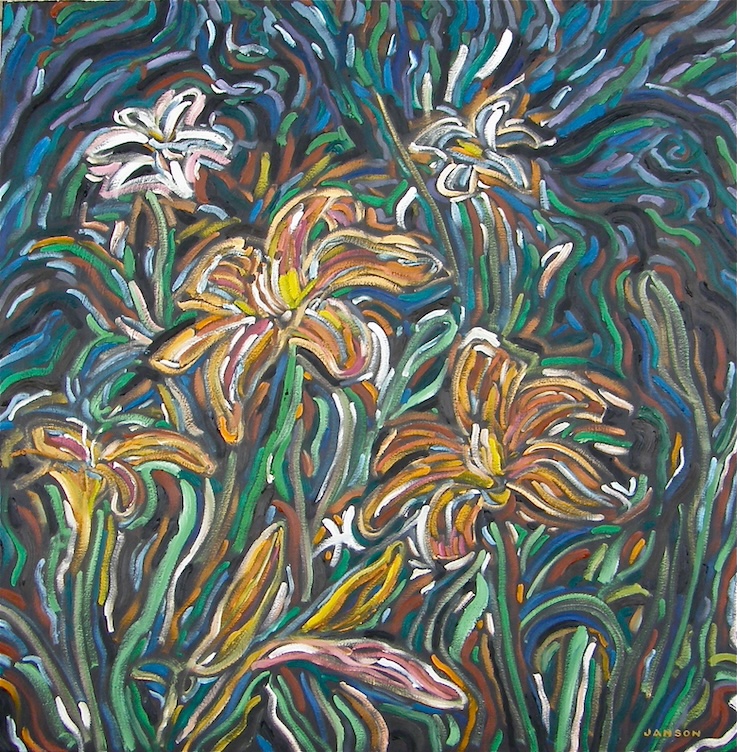
Answers: 1. Obliquity (c) / 2. Thaumaturgy (a) / 3. Ekphrasis (b) / 4. Noisome (b) / 5. Quiddity (a) / 6. Phallogocentricity (c) / 7. Transvalue (d) / 8. Memento Mori (c) / 9. Axonometric Drawing (a) / 10. Iconoclasm (d)
If you had fun, please share!
As usual, if you want to just look at art without all these words, click here to see my gallery. If you want to see where my work is appearing or will be appearing soon, click here.
Footnote: * While my Duolingo streak is 676 consecutive days, I did screw-up a day just after Christmas. I forgot. However, Duolingo has a forgiveness option to keep your streak going, even if you were a big dummy that day.

 Rick Janson Art Studio
Leave a reply to taleboldly237a1b8147 Cancel reply