Rick Janson Art Studio

My Art Journal

  • All ready for… 2023

    Some artists do not like themed group shows. Some insist that they do what they do and that’s it. They don’t feel that a gallery, nor anybody else, should dictate the content of their art.

    I have the opposite view — these themed shows are often an opportunity to leave your comfort zone and try something new. I should point out that most themes are so broad in their interpretation that you could submit just about anything anyway. But I like the challenge. To me the creativity starts by looking at something with fresh eyes.

    It is also interesting to see how other artists approach the same theme. How far from their normal view have they strayed?

    In the last week or so I have been working on completing a painting that is way outside my normal subject matter to respond to a call for entry. I should have looked at the call for entry a little closer — the deadline was for November 10… of 2023 — it turned out to be a bit of internet flotsam. I guess my new prescription glasses are paying off now that I noticed the year! I’ve asked the gallery for an updated submission form to this year’s theme. Leaving for Scotland October 1st, time is now scarce to create anything new.

    At first I did a painting that I thought fit the bill, on the 2023 theme of “Life’s Moods,” but by putting the emphasis on “life” I had a rethink and started to review images that had a more personal take. That led to a second painting.

    I ended up with today’s image — a rare painting taken from a photograph sent to us from family about a decade ago. It had all the elements of a story — a child running from one door to another on Hallowe’en, dressed in his favorite super hero costume. Another child dressed as a witch is at the door with her bag open. It brought back a lot of nostalgia for me, vividly remembering the excitement I had as a child, waiting anxiously for the sun to go down so we could knock on the door of all our neighbours and gather as much candy as possible.

    Nostalgia (2025) 24″ x 24″ Oil on Canvas

    The painting was a challenge given there are three light sources — the porch light, another lantern in the open doorway, and the flash of the camera. The sources of two of those light sources are off the frame, and in the case of the flash, suggest a presence in front of the frame. You know there is a parent standing there.

    The three light sources did make it interesting in determining where the shadows fell. Had there not been a flash, the running child would have been a silhouette, and perhaps thrown a deep shadow towards the viewer. Instead it was a competition between the light sources, only a small shadow flowing towards us.

    The flash also reinforces the idea that this came from a photo as a source. I have played with the framing and colour, essentially making it into a painting of my own. It is not a portrait. The flash element really brought back the idea of nostalgia, given everyone’s Hallowe’en photos tend to look like this. It feels like a snapshot.

    I did wrestle with the idea that this may be seen as kitsch given the lack of subtlety and the over-the-top emotion, but I can’t think of ever seeing a painting like this before, even among all the mass produced Halloween paraphernalia. It still remains personal, which was the original idea.

    The fate of the painting is now an open question given it is now all dressed with nowhere to go. Deep sigh. Yay to my new glasses.

    Don’t be shy — subscribe and get notification when new posts go up. It’s free. I won’t spam you nor sell the list on. Want to see some of my new work? Click here.

  • Transitioning the Seasons

    It is the end of summer. The calendar has barely flipped and yet the leaves have already begun to change, no doubt aided by a long period of very dry weather. We’re in a bit of a frantic period preparing to go abroad to the UK and taking care of all the tasks involved in making sure everything is arranged for our house sitter. I’m also making arrangements regarding picking up work from shows that are ending and delivering work to others that will start after we get back. Outside the pool company is closing us up for the season. My spouse says we should be playing taps. Meanwhile I’m fighting off what I hope is the last days of a cold that has been slowing me down lately.

    I always look forward to travel. There is something about being taken out of my normal environment that awakens my interest in capturing new images — conversely, likely why it is so difficult to paint what’s normally around you.

    In honour of summer I decided to post an older painting I did from a very short visit to Bayview-Wildwood Resort on Sparrow Lake, near the Muskokas.

    I wasn’t there on holiday, but always did like it when I got asked to speak to and with groups in places that just feel like summer in Canada. It beats a downtown Toronto ballroom. I was familiar with the area — having spent summers just to the south in Wasaga Beach. One of my sisters worked at a resort near Bracebridge when I was young, prompting a family trip to check in with her.

    On this particular work day, as I was coming out of the main building at Bayview Wildwood, I caught this view of one of the small cabins that were on the site at the time (these cabins may be still there). I liked the way the light was dappling through the trees and the view of the lake beyond. Even the style of the deck in front of the cabin was reminiscent of a different era.

    Bayview Wildwood (2011) 14″ x 18″ Oil on Canvas

    Given the nature of the view, I wanted to tackle this loosely, having fun with the paint application as I tried to capture the remarkable light through the trees.

    This is one of the works I signed on the front of the painting — a practice I have long gotten out of. The consensus now is that it is better to sign the back. It does help get around compositional issues of having writing on a corner of the painting — a distraction. I did try as much as possible to use colours that would blend into the work but still retain some readability. Now I’m happy to not have to contend with the issue, happily signing, dating and titling the piece on the back.

    It’s always sad to say goodbye to summer — it is my favorite season. But the autumn has its own character too. It’s this time of year when the changes between the season are dramatic.

    This October it will be a very different experience for us abroad. I’m sure I will be posting paintings from the trip later in the year and early into 2026.

    Don’t miss another post — subscribe for free. Meanwhile, if you want to look at some of my more recent work, click here.

  • The Rewards of Boredom

    When I was at the Nova Scotia College of Art and Design, everyone was aware of US conceptual artist John Baldessari’s work at the college. In 1971, unable to afford to bring Baldessari to Halifax, students from the college worked on an exhibition based on Baldessari’s instructions delivered to them remotely. The idea was simple: during the life of the show students would repeatedly write the sentence “I shall not make any more boring art.” At the end of the show the gallery would add up the number of times the sentence was written out and sent it back to the artist.

    The Whitney Museum insists Baldessari was poking fun “at the entire system of art education, which he felt encouraged students to imitate rather than experiment and innovate.”

    Ironically, prints were made as a fundraiser for the college, and somewhere in my drawers I have (or had) a t-shirt with Baldessari’s sentence on it.

    The irony is, of course, that watching students write the sentence over and over again, such as pennance for doing something wrong, is in itself rather boring.

    But can boring art be good art?

    A friend sent me a link to post (Aesthetics for Birds) which discusses this issue and offers up an answer: yes.

    The essay written by John Gibson and Andreas Elpidorou argues that in more than just a few instances that art can be good precisely because it is boring: “boredom is the pain of emotional and intellectual discontent.”

    Curiously most of their examples are of films, such as Andy Warhol’s 8-hour plus Empire, which is a single shot of the Empire State Building shot in slow motion over that period of time. Warhol said he wanted to document time going by.

    Where they really build their argument is over Chantal Akerman’s 1975 film Jeanne Dielman 23, quai du Commerce, 1080 Bruxelle, which documents in tedious detail over three and a half hours the minutae of the character’s life, small variations eventually leading to a shocking ending. Akerman, incidentally, was inspired early on by the filmwork of Canadian artist Michael Snow, who most people have likely encountered his public sculptural work at the Rogers Centre and Eaton’s Centre.

    “We wouldn’t fully experience the film’s point if it didn’t bore us,” the author’s write.

    Regularly the New York Times often posts a single image of an art work and asks its readers to spend 10 minutes looking at it without distraction.

    Most people would see that as boredom in itself, but if you try it, you will find that there is a reward at the end as the Times delves deeper into the meaning of the painting. Akerman’s film works like that, with a shocking bit thrown in at the end.

    To that extent, maybe all still images fit into that category. Our society is so awash in visual images, its easy to dismiss any image, or simply ignore it all as so much wallpaper.

    A painting can be an invitation to slow it down, to have a longer look, to find meaning that may not have initially been there at the surface. It can be looked at from the perspective of the representational content — what is the artist trying to say — or it can be looked at from the perspective of the action of the artist’s hand in the creation of the piece.

    When I first started painting I didn’t know what I wanted to say. The things that most upset or delighted me were hard to capture in a single image, and I didn’t want to be didactic about it. Was this really the right medium to tackle issues of inequality, for example? But being older I realize that there was content there all along, just as I never went looking for a style, it just came out of my hands and my perseverance. While many of my paintings deal with issues of travel, they are also about the act of being human and searching the globe to understand what we’re all about. Sometimes it can be boring, until you look a little harder.

    Changing Weather (Bridge of Allan)(2025) 16″ x 20″ Oil on Canvas

    Today’s painting: Changing Weather is from a photograph I took on my last day in Scotland in 2022. Its the intersection of two streets, but also an intersection in the weather. The High Street (Bridge of Allan) looks rather ordinary, but if you look harder there are stories to be told, including two school kids heading home and another shopper whose body language looks a little apprehensive. She hugs the edge of the buildings while the kids appear to be headed towards her. It’s likely a meaningless encounter, or is it?

    Don’t miss another post! Subscribe for free. If you’d like to view a collection of my recent work, click here. Come back regularly — it changes as new work comes off the easel.

  • On Kitsch

    What is kitsch? The word origins are German, but it is generally felt to describe art, objects or design that’s in bad taste because of excessive sentiment or garishness. Some Pop artists, like Jeff Koons, have deliberately played with the idea, such as his porcelain statue of Michael Jackson and his monkey Bubbles. If you take it to its extreme, somehow it becomes perceived as a valid art statement again. The question for the artist is, if you are not already recognized by the system, such as an art star like Koons, how do curators and collectors know when you are being ironic or are simply in bad taste? I personally think that much of Koons work crosses that rubric.

    Artists cringe at the idea of being labelled kitsch, so it is no surprise that they often hurl such accusations at each other. I heard the term used on Portrait Artist of the Year, the judges concerned that a portrait may be too heroic or romantic taking away any real portrayal of the subject. Just a slight tilt in that direction can create kitsch. All of that is, of course, in the eye of the beholder when you are simply discussing the angle of the portrait and the light on the face. Not sure where bad taste comes in at that juncture?

    I was shocked when I read a New Yorker feature on the 100th anniversary of the death of architect Antonio Gaudi that some considered the Sagrada Familia, his masterpiece, to be kitsch. I don’t know how that fits the definition unless you consider a tower for each of the apostles to be excess garishness. Clearly Gaudi had a unique vision for the Barcelona basilica that he has come to be most associated with. Towards the end of his life, Gaudi was said to have dressed like a pauper, practically living in his office on the site of the construction. His passion for the building continues to be evident, even though it has been challenging for subsequent architects to honour Gaudi’s intentions, especially when the anarchists during the Spanish Civil War trashed much of his original designs and destroyed the maquettes in his office. Gaudi was prone to continually changing his plans anyway, so who knows what would be correct in maintaining that vision? Started in 1882, it was originally expected to be completed in 2026, but that seems unlikely now given the work left to do, so many of its critics are taking aim at a work in progress. Could that level of dedication to a vision turn out to be kitsch?

    Inside the Sagrada Familia: If this is kitsch, then the word has lost all meaning.

    Perhaps to be kitsch in the early 21st century is simply to create something that is popular. The Sagrada Familia takes in more money from tourism than it spends annually on its construction. Does that make it kitsch? I didn’t feel it was in bad taste when I visited it in 2016.

    We see it in the music world all the time. When someone becomes successful they are seldom cool for much longer. If other people like them, it must be in bad taste.

    I’m wrestling with this question on a painting I am close to completing. There is an open competition at a nearby gallery in December based on the theme “Life’s Moods.” Of course, that could mean just about anything, but I thought I would tackle it with something more personal after I finished my initial stab at it – producing a picture with long light of an individual strolling uphill to what would likely be a work shift. I liked the painting, (click here) but wondered if it fit the bill? Instead I chose to work from an old Halloween picture of our grandson running with his pillow case bag of candy from one door to another. I liked the exuberance, but did I cross over into excess sentimentality? Oh-oh! After my sister declared that a draft looked “cute,” I went into panic mode. The painting has a lot of challenges to it, including capturing the way the porch light colours the scene. I liked the composition — from a photograph that I cropped from one that was posted by a family member. I have to finish it by the end of the month — I will post when I feel it is complete, although I may decide to submit the original painting instead.

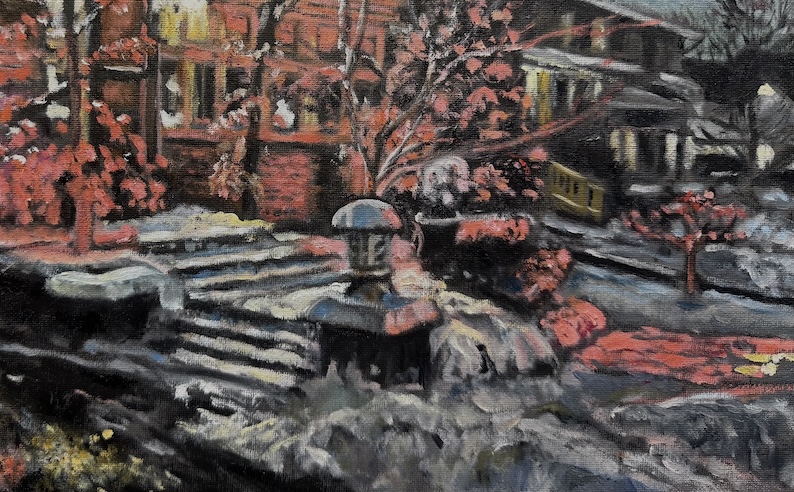
    Autumn on Mary St (2025) 12″ x 16″ Oil on Canvas

    I usually try and steer away from the cliche, if not the kitsch. I don’t often tackle subjects that are really overdone unless I can bring a new perspective to it (see my Peggy’s Cove painting here). My dental hygienist was talking today about how I must be looking forward to the fall colour given I was a landscape painter. Fall colour is a similar challenge. It’s a crowded field. Everybody has done it. It is likely the most represented season in Canadian painting. I even have an original painting from another artist in our hallway that is set in autumn. I don’t think that painting is kitsch. Nor do I think the one I finally produced early this year is either. I think I pushed the composition to the point where it does look fresh. I do have a personal connection to it — I live literally across the street from this scene. I think if you approach a piece of art honestly — without trying to fit some mold — chances are it will avoid all the inherent traps associated with the kitsch or cliche. But who’s to know? As we saw with the portrait competition, it doesn’t take much to go over the cliff.

    Keep in the loop and subscribe! It’s free. Want to see some of my recent paintings? Click here.

  • When Painting Was Dead

    The art world was in one of its “painting is dead” moments in 1987. It had been three years since New York’s Museum of Modern Art (MOMA) had last held an exhibition of contemporary painting. One of the pre-eminent gatekeepers of modern art, it would not stage another for 25 years. That alone speaks volumes of the world I stepped into.

    You might say it was an act of perversity to become a painter at that point in time, graduating with my BFA – which we cheeky students euphemistically called a Bachelor of “F-All” – from the Nova Scotia College of Art and Design. The school has since added the word “University” to the title, just in case there was any doubt. It started granting degrees in 1969 – the first art school in Canada to do so.

    Curiously, one of MOMA’s darlings of the painting world was my professor and studio advisor, British post-war artist Riduan Tomkins (1941-2009). His time at the Nova Scotia College of Art and Design was short (1983-86), likely his decision to move on spurred by a period of labour strife at the College. He is instead credited for influencing a generation of New Zealand painters after he left Nova Scotia. Those three years seldom get mentioned among his biographical details, although he remains vividly in my memory.

    Tomkins frequently reminded us that we stood on the shoulders of those that went before us. Just as I studied under Tomkins (among others), he drew a direct pedagogical line from our class to British painter Walter Sickert, who in turn was a student of Edgar Degas. Tomkins would frequently recite who was a student of who until we arrived back at Degas’ Atelier.

    One December, Tomkins was travelling over the Christmas break. With the College shutting down for a week, he asked if I would facilitate the pick-up of several of his paintings by his gallery in Toronto. I brought them back to the student apartment I shared and awaited the pick-up a few days later. It was stunning to see his paintings there in our modest living room. At the time his work featured a figure in the center of the composition, and layers of flat paint built up around it, the colours of the successive layers visible around the edges of the figure. It struck me that painting could offer a unique visual experience as the built-up layers of colour could not be easily replicated in any other medium, nor the sense of depth at the center of the canvas. To see his work on-line is a let-down after one has experienced it in the flesh.

    His advice at the time seemed clear enough to me: just add more paint. Painting is about, well, paint.

    It surprises me to see the return of figurative painting into the high end commercial galleries. Evidently the rumours of the demise of such painting were much exaggerated.

    Similarly, it was interesting to see in yesterday’s Toronto Star a story about movie fans lining up to get into the Criterion Closet, a van that stocked, well, movies on DVD/Bluray. Albeit they were 40 per cent off, a rarity for Criterion, but the fact that people were lined up to purchase what many believe to be a dead medium was phenomenal. Criterion had to set limits — you had three minutes and could only buy three movies, so you had to know what you were looking for before getting your chance. I’ve been a big fan of Criterion films (even though they are American). They are wonderfully mastered, offer a selection of rare, international and art films, and load up their discs with incredible features. We just recently finished watching a box set put out by Criterion celebrating the collaboration between Noel Coward and David Lean. The films look incredible. The insight in the extras was terrific. But again, we are talking about hard copies of feature films — something that was supposed to be over. Even on Duolingo, I noticed that one of the dialogue pieces in French spoke about a school that still used DVD as being so last century. Is DVD/Bluray about to have a resurgence like vinyl? “I love owning movies,” one fan told the Star.

    Long Lake (1999) Oil on Canvas

    Today’s Image: My last post featured a pastel drawing — a rarity for me. However, I did follow through with an oil painting of the same image — a view across the water at Long Lake Provincial Park near Halifax. You can see how I was still searching for a more vibrant way to make my brushstrokes at that time (1999). I don’t often draw and paint the same subject matter, although I have been known to return to a subject I previously photographed to get a better idea of what was going on in the shadows. It’s one of the reasons I don’t often work from other people’s photographs — a photo may be the equivalent of a thousand words, but sometimes you need a bit more.

    Don’t forget to subscribe. It’s free! To see some of my more current work, click here.

  • Happy Accidents

    Imagine creating a piece of art that resulted from an interpretation of a coffee stain? The trick may be to use good quality coffee.

    Last night I attended a meeting of the Oshawa Art Association in which artist and animator Lisa Whittick (click here) spoke about her methodology behind these coffee drawings? paintings?

    At first I wondered if she had a caffeine issue to have so much coffee dripped on watercolour paper, but as she demonstrated, she actually takes a brush and smears the coffee on, including some splashes from a paint brush dipped in a cup of coffee. I hope she remembers to stop drinking from it at that point.

    After the coffee splashes have been given an opportunity to dry — sometimes she splashes it more than once depending on the outcome — she looks for potential images in the splashes, much like one might interpret a rorchach test.

    It did occur to me that given her coffee stains were not entirely accidental, that one could do this with just about any medium, including paint. But coffee is her medium of choice — Whittick explaining that she liked the colour.

    After she works out her scheme, she downloads some drawing aids to help her visualize the picture. In this case, she had seen a porcupine and some zinnias as inspiration from the coffee splotches, and subsequently came to the presentation prepared with some computer print-outs of both.

    From there she started working into the coffee stains with a black pen, varying the size of the nib depending on the need. That included, in some cases, simply drawing a line around some of the splash marks.

    From there the process is back and forth, as she moves between a set of pens, some conte, and an acrylic wash. Worried that the conte would overpower the coffee stains, she applied it gently using a Q-Tip. After about a forty minute presentation, she had a finished drawing — well sort of. Like many artists that I have referenced in the past, deciding when it is done is always the biggest challenge, and Lisa would start to answer some questions, then realized she needed a bit more white paint, or some darkening with a thicker pen, or a little bit more of something else. We’ve all been there.

    What’s interesting is that the process is a random way to start a piece, letting the coffee stains dictate what the subject matter is, although it is clear from looking at her work that there is a fantasy genre she largely likes to work within, so while it is random, clearly her own interests are not entirely lost. She explained at the start that it got over her fear of a blank page.

    I asked if her if she ever placed a coffee cup on the page, to have the addition of coffee rings to work from. She was amused by the idea, but had never done it.

    It reminded me of my art school days when I would drink so much coffee on my studio days that I was literally shaking towards the end of the afternoon, which in itself created a certain amount of dripping. The school custodians must have hated me.

    Whittick does these drawings as a means of keeping her creativity alive and sees it as a means of relaxing after her much more demanding career in animation, where as she says, it is a team effort that precludes individual expression.

    If you want to give it a try, Lisa is delivering a workshop on September 28. Click here for more details.

    Happy accidents are not entirely new. One of best practitioners of happy accidents I have seen is Christian Hook, who won UK 2004 Portrait Artist of the Year title. The winner of that competiton won a commission to paint actor Alan Cumming for the National Portrait Gallery in Scotland.

    Hook engages in a process that involves doing and undoing, creating what appears to be a straight-forward portrait or landscape, then messes it up and works from there, taking the random scratches or slashes as new information to work with. The end result leaves a piece that is figurative but also has abstract elements about it. It’s brilliant.

    It’s a little different from Whittick is doing given the randomness can take place in the midst of the process, not just at the start.

    In the documentary (on Amazon Prime) Hook engages Cumming in the process, including giving him the materials to make his own marks.

    When we visited Edinburgh in 2022, the Portrait Gallery was a key destination for us to see the Cumming portrait. It is stunning to see in person. Photographs of it just don’t do it justice, but you can none-the-less get a peek at it on Alan Cumming’s website.

    Storm Clouds, Long Lake (1999) 8″ x 12″ Pastel on Paper

    Today’s Artwork: I looked through my files to see if there was anything that I could describe as a happy accident. Have to say that happy accidents scare the heck out of me. I’m far too much of a control freak to randomly undo my work in progress and create something new from it. Instead I offer up something else that scared me too — one of the few pastels I have ever done, this one looking across Long Lake, a Provincial Park on the outskirts of Halifax. You can tell why I’m an oil painter from this. I did use the drawing as the basis for a painting later that year. I’ll show it on the next post so you can see the difference. Always a trick to may you come back again!

    Don’t miss another post! Subscribe for free. Want to look at more of my stuff? Everything from late 2024 to the present is on my gallery, just click here. Meanwhile, consider joining your local art association. You’ll not only meet new like-minded creators, but get some good ideas too.

  • Colour the art world blue

    There appears to be a lot of hand wringing in the global art market after the first half numbers came in for 2025. Almost daily Artnet is reporting on another major private gallery closing its doors, and in turn, making it that much harder for emerging artists. These are the galleries that have made art careers. Now they are gone, some amid bankruptcy.

    The numbers that come up over and over again are an 8.8 per cent drop in fine art sales at auction in the first half of this year, the price of the average lot falling by 6.5 per cent. However, that doesn’t tell the whole story. Sales in the $1 million to $10 million price range actually rose 13.8 percent, sales of Old Masters rising by 24.4 per cent. Artnet notes it is the ultra-contemporary market that has cratered by a staggering 31.3 per cent. Wow.

    There are signs everywhere suggesting the global economy is about to take a swan dive, so it shouldn’t entirely surprise us that collectors are also stepping back, taking a wait and see attitude towards what comes next in a world turned upside down by events in the US, the Ukraine and the Middle East.

    The art market had been roaring for the last six years. It seems the party has come to an abrupt end.

    Some are suggesting there are bigger and more deep seated problems, including the lack of a next generation of collectors. Is overall interest in the visual arts in deep decline?

    One analyst suggested there was also an investor class that came into the art world seeking only to make a quick buck, which was possible for a while. The speculation is that they have rushed back to Bitcoin. I get the impression that some regard that as a “good riddance” moment.

    It reminds me of the scene in Woody Allen’s Hannah and Her Sisters when Dusty the nouveau riche rock star (played by Daniel Stern) comes to see Frederick, a temperamental artist (played by Max Von Sydow). The artist tells him that “you don’t buy paintings to blend in with the sofa.” The rock star replies sincerely, “it’s not a sofa — it’s an ottoman.”

    Galleries that do millions of dollars in annual art sales are posting meagre profits amid rising costs. A recent story suggested that a gallery needed to make about a quarter million dollars in sales to simply break even at each of the fall art fairs, the cost of the booth running around $100,000 for the term of the fair. Add to that travel, hotels, framing and all the extras associated with hosting a booth. How sustainable is this?

    In Artnet’s intelligence report, it gives the example of Sadie Coles HQ, a London gallery that represents 60 artists. It saw sales of $38.6 million in 2024 (down from $79.6 million in 2023). Profit in 2024 was $279,000, or a 0.7 per cent margin.

    It will be interesting to see what happens this fall — will art sales bounce back, or are we into a new phase in the art world? Is this just a cycle, or as many have said, is it something else?

    Blue (2005) Oil on Canvas (Private Collection).

    Today’s painting: Given how blue the outlook is in the art world at present, I thought it would be appropriate to post my painting exhibited in the “blue” show at the Eastern Front Gallery in 2005. That was my view for at least five years as I commuted down Ritson Road in Oshawa towards the westbound 401 and my job in North York. The gallery received many submissions for that show and I was happy to be selected to included by the jury.

  • But will it last?

    One of the first things I was taught as an oil painter is that you never place thin over the thick. In other words, if you are using turps to thin your paints, don’t put them atop a layer of paint that was used directly out the tube.

    The reason is simple: the net result is the paint will crack.

    So when I see oil painters dripping diluted paint at the end of a process, I wonder what the conservation issues will be around this work. It has become so overused it likely doesn’t matter.

    It is an interesting question given how much critics love to see evidence of process in the work. But what they love may be undermining the painting itself, assuming the artist didn’t have the foresight to use even thinner underlayers or work in another medium altogether.

    We likely have artists doing this thanks to Jackson Pollock and his famous drip paintings from the mid-1940s. They revolutionized the art world, but themselves are frequently the discussion of conservation issues. Not all of it is related to the paint Pollock used.

    Pollock famously used ordinary housepaint, most of it on unstretched canvas unrolled on the floor of Pollock’s barn. However, as numerous scientific analyses have shown, he often also tubed oil paint under it. Sometimes one colour would go on over another, creating intersectional points where the paints blended. Other times, he would wait for a layer to dry before applying the next. In his 1947 painting Alchemy, he also added other materials, including sand, pebbles and twine. In the 2018 restoration of Number 1 (1949) conservators found cigarette butts in the work as well as a honey bee they calculate flew in there by accident.

    Louis Menand in his fantastic book The Free World: Art and Thought In The Cold War, speaks about the reluctance of the Boston Museum of Fine Arts in 1976 to purchase Pollock’s famous Lavender Mist (1950) because it had already badly deteriorated. That didn’t stop its owner Alfonso Ossorio from selling it to the National Gallery in Washington for $2 million in the same year. Ossorio had paid $1500 for it in 1950 at the disastrous Pollock show at Betty Parsons Gallery. The poor sales at that show likely ended his interest in making drip paintings. Pollock turned his attention to figurative painting after that, and by 1954 he stopped painting altogether.

    Conservation issues repeatedly show up for Pollock’s work, and I can only speculate that the cost of conservation may have been a consideration for the Museum of Modern Art to de-accession Pollock’s Number 12 (1949) in 2004.

    In the past museums varnished Pollock’s work to try and preserve it, only decades later leading to more restoration to remove the varnish after it dulled the colours and yellowed.

    In the famous mural Pollock did for Peggy Guggenheim, the canvas supports started to sag, leading the paint to chip off as the canvas buckled (this is a more common problem that you would think — works by other major abstract expressionists have undergone this problem too). It required the entire painting to be placed on new stretchers.

    One of the issues that conservators also face is what happens with the aging of areas of unpainted canvas. If it hasn’t been primed, the canvas will brown. I was aware of this myself on the only work I did on unprimed linen. I thought it would be interesting to see how the painting changed over time. The owner of the painting still appreciates it.

    British artist Damien Hirst says that it was his intent to have his shark deteriorate as part of the process in his landmark The Physical Impossibility of Death in the Mind of Someone Living (1991). You may recall that Hirst first came to everyone’s attention by building large tanks filled with a formaldehyde solution and placing various creatures in them, the first a tiger shark. It was said by the time Hirst replaced the shark, that one could barely see it in the cloudy formaldehyde solution.

    And that, of course, raises the question of value, given the piece is no longer 100 per cent original. I’ve seen an extensive rationale on why it should retain its values, including the originality of the tank and frame. Hmmm.

    Hirst’s company says that it will replace any of the animals that are older than 10 years.

    Artists working with non-conventional or poor materials are always going to be a concern. Galleries now caution painters, for example, not to use cheap canvas. If you are going to Michael’s and getting a value five pack, that’s cheap canvas. The difference is usually the supports the canvas sits on.

    Among Canadian artists, Emily Carr is well known for the conservation issues that arise with her work, painting many of her pieces remotely using gasoline instead of turps (apparently doable, although very dangerous). She also worked on inexpensive papers that have deteriorated, or had them mounted on acidic backing boards that leached into the painting. Collectors still seek out her work despite this, and more recent criticisms that she appropriated the work of indigenous artists. I won’t offer an opinion on the latter.

    Visiting the Vancouver Art Gallery some years ago, I noticed an Emily Carr exhibition had to be shown under dimmed light for preservation reasons.

    The lesson for artists: know your materials. Don’t save $10 on a canvas to totally make all your work on that canvas valueless.

    Untitled (2019) Oil on Canvas (Private Collection)

    Today’s painting: Another of my abstracts from 2019. It sold almost immediately, I hope it has survived the rigours of time well.

    Subscribe and never miss another post! It’s free. If you want to look at some of my more recent work, click here.

  • A Change in Meaning

    When you paint something, the image sticks with you. How do you look at and consider a subject for ten or fifteen hours or more and then forget it? You remember the details, what gave you difficulty, where the magic happened in the process. It’s hard to explain, but after a painting is complete, there is almost always a feeling as if you have a deeper relationship with that particular subject, or in this case, a location. Your fingers have traced out the curves, the shapes, your eye has deciphered the colour. You’ve fit what’s before you into a meaningful composition. You’ve found a way to capture the light.

    When I was a student I used to cycle to Peggy’s Cove, Nova Scotia and regularly sketch the cove and the lighthouse. It helped me get through a difficult time financially. One day I challenged myself to draw the lighthouse and all the surrounding rocks entirely from memory. I was able to do it. The next day when I was there for real, a tourist purchased that drawing made from memory. When I go back to Peggy’s Cove, now decades later, I still feel deeply about that place. It’s hard to explain.

    In the last few days I’ve returned to today’s image a lot since I heard the news of the tragic funicular crash in Lisbon. When the first images appeared on the news sites, I immediately recognized the location. I had painted the Gloria funicular less than a year ago after a return from Portugal. A friend had stayed in a hotel beside it. He had asked me for a piece that depicted either the funiculars or the yellow trolleys which are symbols for the city. I have a T-Shirt with a trolley on it.

    In Lisbon I had taken many pictures as reference. My spouse heard me curse many times when a car popped in front of a picture as I was about to time a key moment. Or a tourist would walk in front of the camera. Or suddenly a cloud changed the light. In the end, I did capture a number of successful images, and am still thinking about going back to the subject. Curiously, we never travelled on either largely because of the lines to board. In addition to the funiculars, you can get to the top of the hill by taking an elevator. Or, as we did, you can walk it.

    For those who have been avoiding the news, on Wednesday (September 3rd) a cable had likely snapped sending a popular 140-year-old Lisbon funicular hurtling down a steep hill, derailing on a curve and crashing into a building. Sixteen people died in the mishap, and about twenty were injured. Five of those killed were Portuguese, including the driver. The rest of the travellers were from Canada, South Korea, Ukraine, Switzerland, France and the United States. The funicular can normally carry about 40 passengers, although there has been no confirmation as to how many people were aboard at the time of the crash.

    Lisbon Funicular (2024) 11″ x 14″ Oil on Canvas (Private Collection)

    Where the crash happened is a crowded spot, especially around rush hour. The crash happened around 6 pm. The area where the funicular finishes its downhill journey is a popular destination for diners. We ate in that square many times.

    That day I had difficulty getting my reference photos, hundreds of people crossing back and forth near the funicular. Even in the final work that I completed, you can still see many people walking both in front of the vehicle and beside it.

    When I completed the painting I thought it a sunny memory of our time in the city. It was very Lisbon. Now it has taken on a new meaning knowing what has happened right there, in that very location.

    Like this BLOG? Why not subscribe? It’s free and you’ll get notice whenever a new post goes up.

  • Tweaks and wrinkles

    Here we go again. As part of my path towards a formal self-portrait, here is my second study. I’m still debating whether or not it is done. Depending on the light in which I view it, it either looks exactly like me, or like me in about another twenty years.

    In this study I wanted a close look at all the details on my face, including my happy crow’s feet and some of my age spots. However, as much as I have tried to apply a light touch to these, they tend to look — at least in photos of the canvas — like they are way too pronounced. That’s why I may go back.

    However, as a painter, I love working through all those wrinkles and bulges and other signs of life my face exhibits to the world. As a painting, I rather like it, as it seems do others. I just wish it was making someone else look old!

    Among the comments thus far: it really looks like you, but it’s not exactly flattering. That I can handle. When i’m in the midst of a work jag in the studio, I don’t always look my best. It’s amazing I don’t have any paint on my face. I’m happy to look like an old dog.

    The next study I will go a bit bigger and incorporate more of my body. Perhaps I will be a little kinder on the third try. Or maybe I will find other elements to exaggerate and play with. Stay tuned!

    Self Portrait Study 2 (2025) 11″ x 14″ Oil on Canvas

    Meanwhile, this morning I had the chutzpah to apply for a solo exhibition in a local gallery. The gallery is booking a year to 18 months in advance, which suits me, although it means that a lot of my work will be tied up at least until then (assuming my proposal is accepted). Luckily I’m in no hurry to sell anything right now, although it means I’m also absorbing a lot of related costs, including framing, artist association memberships, gallery memberships, entry fees, on-line costs, studio maintenance not to mention the cost of paint and canvas. Thus the life of an artist. Thank heavens for my work pension. Behind every great artist is usually another source of income.

    It is interesting to view the application process galleries are requiring on-line. Galleries often want sample files sent in a certain way — in this morning’s case, the file had to be named with the title of the art then the artists first and last name. The file was also limited in how big it could be, although it was a bit confusing given they posted the maximum file size as 256 MB when they likely mean 250 KB. They also talk about the need for larger files for printing purposes. Then when you resize the images and upload them, they often appear larger than the size you initially set them too. Sigh. While it was supposed to accept a JPEG format, it repeatedly rejected one image which required me to send it again as a HEIC, which is usually more efficient anyway and offers better quality. Note to self– no more JPEGs.

    It was the first time I had come across a requirement to make the artist’s statement in “first person.” I’m so used to putting out material in the third person it took me by surprise. I was half way through writing it when I noticed the requirement. Galleries seldom give you a lot of space for your blah blah blah. I am beavering away on a book that I had initially thought of printing this summer, but I may postpone it until next year, hopefully closer to the date of a show. Given my proposal is for a show about all the issues around travel, I also want to do postcards of several of the works.

    As difficult as it is to often follow all the detailed instructions galleries post, participants were warned on a recent webinar hosted by the Artists Network (Toronto) to pay attention to those details. If you paid $45 to enter a painting into a competition, the last thing you want is to be disqualified over a small technical issue. The presenter noted that it is easy for juries to simply take you out of consideration if you haven’t labelled your digital files correctly.

    If my bid for a show is accepted, then there will be additional fees and requirements, including signing a contract and presenting them with an inventory of the artworks for the show in advance.

    If I am successful I will post the dates/location on the Recent Exhibitions page. I also have some other planned group shows I’ll be applying for in the upcoming season.

    Meanwhile, if you read yesterday’s post, you’ll notice that I discovered a small tweak was needed to the painting that I was using to show the process of how I make my work. The tweak is done, and the painting now in the gallery section (click here).