Rick Janson Art Studio

My Art Journal

  • Nazis looted 650,000 works of art

    Some Of It Is Still Being Recovered Almost 90 Years Later


    A recent court case over a $25 million painting by Modigliani resulted in its return to the estate of the Jewish art dealer who had originally owned it prior to fleeing Paris from the Nazis in 1939.

    Nearly 90 years later, we are still seeing cases of art stolen by the Nazis run through the courts. In this case, it was a 17-year pursuit by the grandson of the original owner, Oscar Stettiner, to return the painting, Seated Man With A Cane, a portrait of Modigliani’s friend and chocolate merchant Georges Menier.

    Recovery of Nazi-stolen art is still a major pursuit. With works valued in the millions of dollars, it is not a surprise that there are companies like Monex that still exist specifically to recover stolen art.

    The Nazis looted an estimated 650,000 works of art in Europe, much of them from Jewish art collectors, although to complicate matters, unscrupulous French art dealers traded legitimate works for pieces considered by Hitler to be “degenerate art.” While the Nazis disliked modern art, they had no problem using it to barter for other works or to ship pieces by Picasso, Matisse, Modigliani and others to Swiss auction houses for sale, the proceeds to fund their war.  Under the occupation, French art dealers shipped stolen work to clients around the globe, in some cases their wealthy clients undermining the war efforts of their own countries.

    A recent book by Michelle Young about French curator Rose Valland speaks about her brave efforts to document the looting during the Nazi occupation and after the war, to recover about a tenth of that – or 61,000 pieces. It is estimated that there are still 100,000 Nazi-looted art works still unrecovered. Make that one less with this recent court case (maybe).

    What seized “degenerate art” the Nazis couldn’t sell or swap, they simply destroyed. Valland was witness to the cutting and burning of valuable artworks on the grounds of the Jeu de Paume, the museum the Nazis used as their clearing house in Paris for seized artworks. The Jeu de Paume would set up exhibitions for Hermann Goring, then considered the second highest ranking individual in the Nazi hierarchy, to select pieces to send back to Germany.

    While Valland was doing her best to document what the Nazis were doing – and subsequently putting herself at great peril – many were suspicious that she was instead collaborating with the Nazis, which has been since debunked (Valland is one of the most decorated French heros from World War II). The 1964 Burt Lancaster movie The Train is based on Valland’s book about the period, including the race to stop the last train loaded with Nazi plunder from leaving Paris. Valland was a secret member of the French resistance and had alerted them to the urgency of stopping the train.

    Curiously, the whereabouts of the Modigliani was confirmed by the Panama Papers, which, according to Artnet, led Swiss authorities to raid a storage facility in Geneva in search of it. The work had first surfaced in 1996 at a Christie’s auction in London, purchased by a billionaire’s holding company.  Marcel Phillippon, an administrator working for the Nazis, sold the Modigliani in 1944 to John Van der Klip, who had claimed he had sold it on to an American military officer, although the provenance lists a J. Livengood as the owner, but Livengood was the work’s consigner and Van der Klips heir and grandson. “It would seem he lied to the court about having sold the painting to avoid returning it to Stettiner,” writes Sarah Casone on Artnet.

    Seated Man With A Cane (1918) by Amedeo Modigliani. A recent court case determined it had been stolen Nazi loot and was ordered returned to the estate fo the original owners.

    The Artnet story states that billionaire David Nahmad initially denied that he owned the painting until the Panama papers suggested otherwise. His lawyers then argued in an American court that there was no evidence that it was stolen Nazi loot. Nahmad had tried unsuccessfully to sell it on at Sotheby’s New York for $18 to $25 million. The Sotheby’s researcher had contacted the Wildenstein Institute in Paris looking for information related to provenance. The Wildenstein provided a photograph of the painting from its archives that included, according to Artnet, notes reading “Famille Stettiner” and “vole” (French for stolen).

    The case is still fresh, and there could yet be an appeal. It does underline the difficulty of restitution almost 90 years after the German army walked into Paris and began looting collections throughout Europe.

    One of artists who didn’t flee the Nazis was Pablo Picasso. Michelle Young’s book (The Art Spy) repeats the often told story of the Nazi’s arriving at Picasso’s Atelier and seeing a picture of Guernica on the wall. Guernica was Picasso’s famed depiction of the horror of the Nazi bombing of the basque town of Guernica in support of the fascist forces during the Spanish Civil War.   It is still considered a strong anti-war statement and likely Picasso’s best-known painting. A German officer, spotting the photo, asked Picasso if he did that? Picasso purportedly replied, “no, you did.”

    Meanwhile, war continues to put the world’s heritage at risk – the recent attacks on Iran have impacted a number of UNESCO World Heritage sites, including the 16th-Century Golestan Palace, The Sotoun Palance and the Jameh Mosque.

    Sometimes we forget the importance of art to the world, but then you look back at the enormous efforts to plunder the art of another nation and realize that it plays an outsized role in our culture.
    In Canada that is sometimes hard to fathom. This week the Kingston Prize, the predominant portrait competition in the country, has just moved from biennial to annual. We couldn’t previously run this competition more than every other year?

    This week I am toiling away in preparation for two upcoming events — the annual Oshawa Art Association show at the Robert McLaughlin Gallery in Oshawa, and the Scugog Studio Tour. I’m still aiming for eight new 12″ x 12″ paintings for the tour, numbers seven and eight well advanced. I’m also looking at applying to show at the culture hall outside the City of Oshawa Council chambers. Given how few opportunities there are for this space, I suspect competition will be great. The City has been advertising its call for entries for weeks now on Facebook.

    Meanwhile, if you want to see my latest work, click here on the gallery section. Yes, these works can be purchased, although with two events on the horizon I’m not spending a lot of time pushing sales right now.

  • A Monk on a Stock Exchange?

    I took Sunday off. That is a bit of a rarity for me since I started down this path back to art. It helped that there was a Blue Jays game on during the afternoon — time I normally spend in the art hut. Art is a consuming exercise, the painting activity only half the work. It was nice to recharge my batteries, and yes, on Sunday the Blue Jays did win.

    I also spent a part of Saturday revising my book project after a sample was sent to me from the printers in Montreal. It looked a bit smaller than I expected. My last book project was done on an A5 paper size, but it was hardcover and as such had a slight overlap on the inside pages. The paper was also a bit heavier on that project. Somehow This All Pertains To Me runs at 144 pages. It does have substance, including more than 90 images in full colour. The main body of the text runs to about 8,000 words.

    Today I am following couriers who are delivering more framing towards two upcoming events — the annual Oshawa Art Association show at the Robert McLaughlin Gallery (April 24 – May 10), and the Scugog Studio Tour (May 2-3). Both are juried events — I won’t get confirmation that either of my two submisisons will be part of the RMG show until April 18. I’ve known since last fall that I will be a guest artist on the studio tour. There have been a lot of call for entries lately, but so many have overlapped, making it difficult to allocate resources.

    For the first time I have placed an order with Kolekin, a Montreal-based framing company, which did dispatch my order quickly. The first batch has already arrived and the second expected shortly. I’m still hoping to get back into the studio sometime this afternoon.

    Yesterday I finished my sixth 12″ x 12″ painting for the Scugog Studio Tour. I’m aiming to have eight new “smalls” ready by the time the tour takes place. I also began the 8th, a much more traditional landscape based on a view from the train between Dundee and Dunblane, Scotland. Number seven got started last week and is from Pickering — not the one down the road from here, but the one in Yorkshire.

    The Greeters (2026) 12″ x 12″ Oil on Canvas.

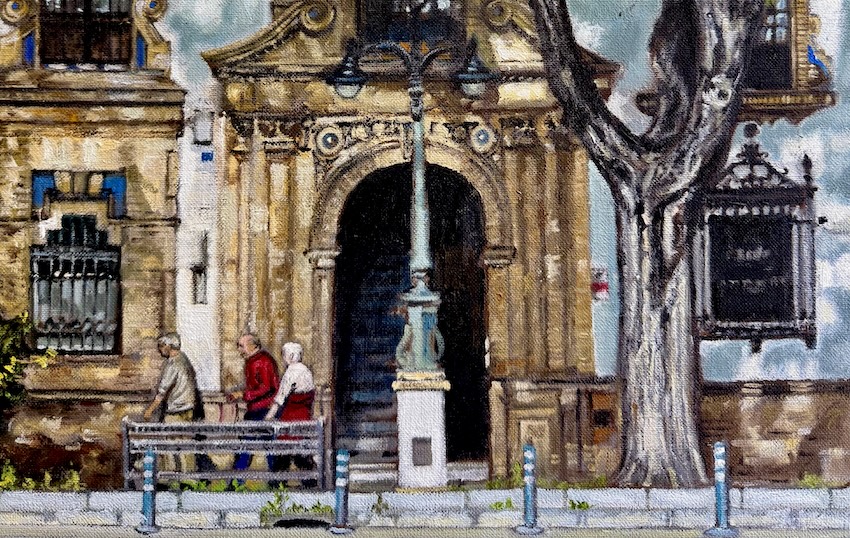
    The latest painting is a bit of a departure for me, although I had been thinking about taking it on for some time. It is of an entrance to the North Face shop on Buchanan Street in Glasgow. I’ve been since trying to find out more about what I call “The Greeters.” but most of the literature on the building only talks of the sculptural figures, not who they are or are supposed to represent. The building was not originally a retail destination — it was built in 1875-77 as the city’s stock market. Architect John Barnett used a distinctive Venetian Gothic style which makes the building such a head turner in Scotland. The use of the figures around the doorway are common to his work, Barnett having utilized numerous well-known sculptors in his day, although none are attributed to this particular building. The figure on the far column looks like a monk — a bit of an odd choice for a stock market. I thought Barnett may have used figures of workers, much as you can see on the frieze of the old Toronto stock exchange, but there is nothing about the character in the foreground to suggest that, although his hair and moustache do look distinctively modern (at least for 1875) and working class. I just don’t understand why, if he was a worker, he is not wearing any visible clothing? Then what is the status of the female figure on the far side of the same column? She looks more like someone drawn from antiquity than from the streets of Glasgow. If anyone knows the background to these figures, I’d love to hear from you.

    The North Face logo was visible in the doorway, but I decided to edit it out as it didn’t fit compositionally. I was tempted to reflect the now modern status and use by including it, but I just couldn’t make it work as a painting. That was a long conversation with myself.

    What was challenging is how the light changes the colour of the stone, depending on how it hits. Much of it has a warm tone, but I also noticed that on the far right it looks distinctly blue too. I do wonder if repairs were made that shifted the colour?

    As anyone who has followed this BLOG knows, I have been challenging myself by taking on new subject matter and genres, and this one definitely did challenge me despite my normal affinity to architectural-based subjects. With all the detail around the stone work, and the more subtle colour changes, it was difficult to keep it painterly too. Thank goodness for all the imperfections and stains.

    Painting old buildings is like painting older people — there is just so much more life lived in them.

    Want to avoid all the palaver and just look at pictures? My gallery, which includes pricing, is here.

    Want to learn more about the Scugog Studio Tour, click here to see the participating artists (including me).

  • Finding Colour in Yorkshire

    When I titled this painting I wasn’t a hundred per cent sure of where it was. I took a picture en route to Grosmont, where we were to take an hour ride aboard the Flying Scotsman along the North York Moors Railway. Yes, that was one of the trains used in the Harry Potter movies — when we boarded the train we were told that people often dress as characters from the movies at the next station, which was also used in the film. The camera data tells me it was Whitby-Grosmont. We passed Whitby, but only got a glimpse from a great distance. Whitby it wasn’t. Although when I look at other people’s photos of Grosmont, assuming you can find one that isn’t of the historic train station, the buildings don’t look like this.

    This row of houses particularly stood out given many of the buildings in the region are of stone, so the overall impression is of brown and gray buildings. This was different. While the colour stood out, so did the odd ornamentation on the buildings, including the Palladian quoins, the triangular corbels and the medallions. It struck me as unusual that such modest houses would carry the weight of such ornamentation, especially off in the in Yorkshire countryside.

    So far what people respond to is the colour. Between the green and pink pastel colours, there was a brilliant blue sky to work from, which I built up in layers.

    Yorkshire (2026) 12″ x 12″ Oil on Canvas

    I’ve been reluctant to get into the reference images I brought back from Yorkshire given how different they are from those in Scotland.

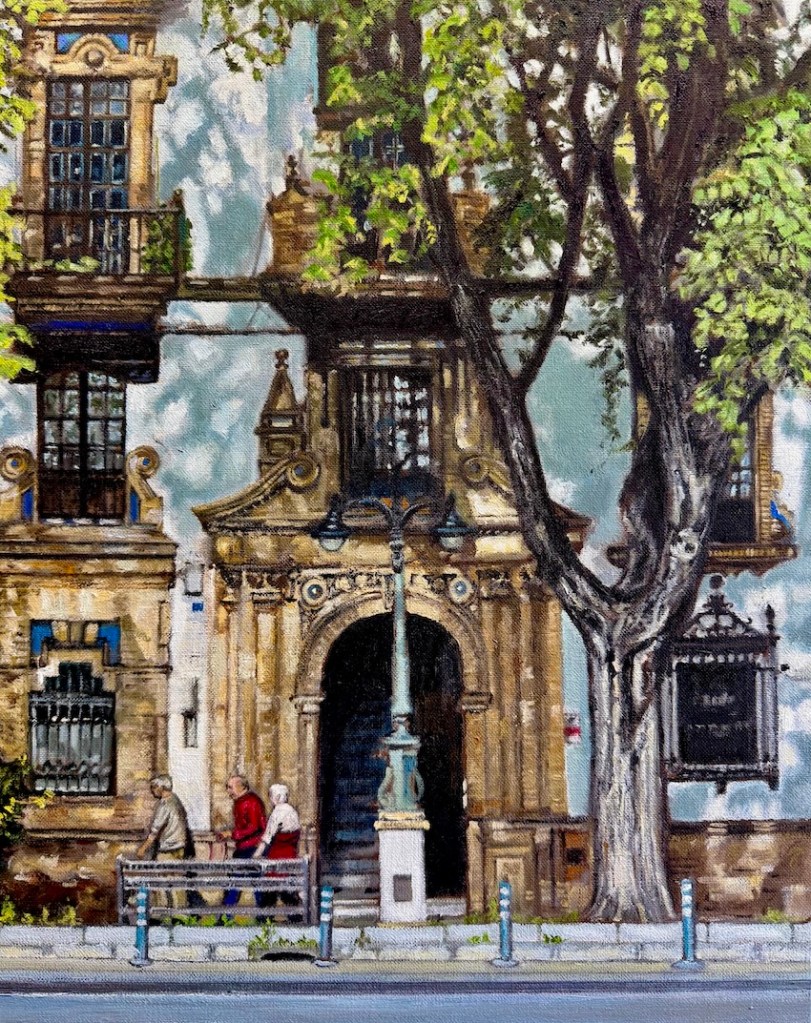
    This is another of the eight “smalls” (12″ x 12″ paintings) intended for the Scugog Studio Tour May 2-3. So far I have five completed although I just underpainted two more yesterday. The next is not far from completion (maybe today) and goes into far more detail on building ornamentation — this one an entrance to a grand building on Buchanan Street in Glasgow.

    Last night TVO aired an episode of Fake or Fortune that came to Canada. Back in the UK, someone in the UK had purchased a painting purported by Canadian impressionist Helen McNicoll for two and a half thousand pounds. Lately the world has rediscovered McNicoll. The prices are hard to gauge given very few ever make it to auction, but the record appears to be $653,755 paid by a Canadian billionaire that Mould unusually interviews in the show. The collector asserts that he has more paintings by McNicoll than anyone else, including collections in museums and galleries. He says that one day he will pass his collection on to a public gallery. McNicoll died young, having only produced about 300 paintings in her lifetime. The painting in question had been folded over, hiding her signature to make the canvas smaller. It also had a label on the frame that incorrectly spelled her name, and likely did not get the title of the painting correct either. Art dealer and Fake or Fortune co-host Phillip Mould travels to Quebec City, Toronto and Hamilton, the latter where he discovered that McNicoll unusually used a bright pink underpainting in select areas to warm up features, such as a subject’s face. They were also able to tell him the weave count on the canvases McNicoll used, both of which corresponded with the painting in question back in London, England. Having identified that the painting was of bean harvesters, they were able to find a corresponding title in exhibition records in Canada and the UK. The painting had been listed as lost. The National Gallery of Canada is exhibiting a touring show of McNicoll’s work later this spring. To learn more about McNicoll and see some of her work, click here.

    Want to see more of my work? Click here.

  • Listed buildings, a new book and a really dumb marketing strategy.

    When I was young I briefly toyed with the idea of as a career as an architect. Then I laughed when someone told me about the level of math I would need. I never knew if that was true or not, especially when I look at the scribbling of somebody like the late Frank Gehry. I sometimes think I am way too undisciplined anyway to bring the order a career in architecture requires. But it doesn’t mean I don’t know a good building when I see one.

    This commercial building on Portland Street in Troon, Scotland, looks like it has seen some better days. It doesn’t help when the tide goes out on the economy and some stores and services shut down.

    Curiously, I did check out a real estate listing for one of the upstairs offices. Inside you would have no idea that this was a turn of the century (20th) building. The offices were all efficiently drywalled, all the interesting stuff smoothed out. That was a bit of a surprise given the building is listed (C-designation), which is supposed to afford a degree of heritage protection. To read the full heritage designation, click here.

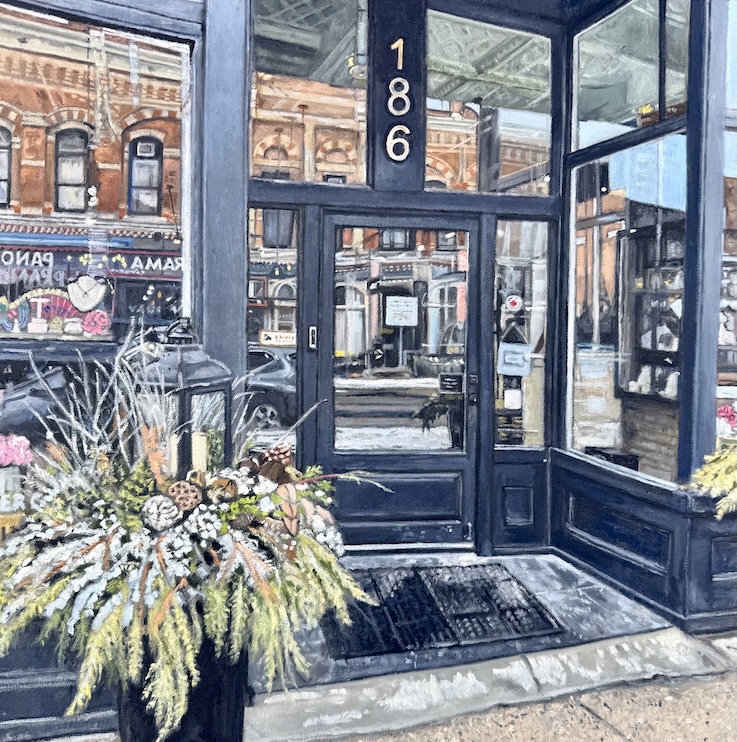
    The red sandstone building is circa 1905 (hence my title) done in an Edwardian Baroque Art Nouveau style. Of special note are the decorative cast iron shopfronts, which was tricky to capture on the small canvas.

    I was happy with both the level of detail and the loose rendering on this painting. Working small, surprisingly, has given me the opportunity to be much more free with my brushstrokes — not what I would have anticipated. Maybe I should be working with bigger brushes on my larger canvases? I also liked how the light catches the building and the warm tones from the sandstone exterior.

    1905 (2026) 12″ x 12″ Oil on Canvas

    I posted this recently on the Landscape Artist of the Year Facebook page and it appears to be generating both controversy (is it really a landscape?) and “likes” and “hearts”. A lot of people seem to find beauty in it even if it doesn’t depict an idealized sylvan forest or a rolling farm field or handsome looking coos.

    The painting is another of the “smalls” that I have been prepping for the Scugog Studio Tour, which is about six weeks out.

    With the studio tour approaching, and a call for entry in the Annual Oshawa Art Association show at the Robert McLaughlin Gallery, it has been a bit hectic lately. And on top of it all, we had the grandchildren out for part of March Break. I am tired.

    Somehow All This Pertains To Me

    One of my objectives is to have my first Monograph of my work complete in time for the tour. Yesterday I shipped the files off to a printer in Montreal minus its ISBN number. When I applied for the number February 7, I got a quick email reply telling me to expect it within the next 30 days. Um, its March 19 and no ISBN yet. I do wonder if all the layoffs in the federal public service may be impacting this function? Funny how that works when you layoff people? After asking about it, I did get another form email that said they are still processing ISBN requests from January. Oh-Oh! The printer is supposed to send me a draft copy of the assembled book within about a week, so there is a bit of time to add the ISBN. If the ISBN is still lost in the process by then, I may have to add it as a sticker later on (at my own time and expense). The best laid plans… For those who are unfamiliar, an ISBN is an International Standard Book Number. Every edition of a book has a unique number, so a softcover and hardcover editions could have different ISBN numbers. If I revise this book for a second edition, it too would need its own ISBN. The ISBN is usually found on the barcode at the back of the book. The code helps retailers scan your item and price it.

    The book is called “Somehow This All Pertains To Me.” It is softcover, 144 pages, trimmed to A5-paper size (a bit smaller than a typical coffee table book), and has 93 colour images, most of them of my painting and drawing work. For those already familiar with my work, they will likely see new art that has never been displayed before, including one piece that has never left my studio. At present the book is priced at $25 (CDN), but I will be offering a very good deal on it for those who show up in person during the studio tour. I will likely eat some of the retail profit on delivery costs too, but until I get my draft copy, I won’t be able to calculate shipping. Stay tuned. My hope is to break even, or at least come close.

    Worst Marketing Plan Ever

    Meanwhile I also ordered a retractable banner for the studio tour. I calculated that if people are walking in to the shared studio space (I am a guest in another artist’s studio) they may want to know who I am. Who is that old scruffy guy? I went to VistaPrint, given I have been happy with the quality of the work in the past. Their turnover is also very fast. However, the day I ordered the banner I got an email saying that I forgot something. The email had a link that took me back to the website, of which there was a message that I hadn’t completed my transaction. I thought that odd given they had already sent me an email with the receipt for the job. As the day went on the notification kept popping up again, but when I did return to the site I could find nothing I had left undone. Eventually I went to the chat function, and they confirmed that my banner was already in production (it has already shipped as of this writing). So why the emails? The person on the other end of the chat asked if I wanted to opt out from further marketing emails? WHAT! I had spent at least an hour searching for what I had done wrong, and all this was is more marketing. Basically, it was a lie to their customers to try and get them back and order something else. I was furious. Given the relationship with the printers I have engaged with is typically one of trust, I found this very disturbing. The marketing team at VistaPrint should understand that blowing up that trust is not helpful in generating more business. I have already started looking at other companies for materials I may need in the future. Sorry Vista, that was really dumb.

    The next day the banner did arrive, and looks great.

    As usual, if you want to avoid the palaver and just look at pictures, click here.


  • Reworking Connaught Park

    I don’t varnish my paintings precisely because I have a habit of reworking pieces in my studio. I’ve previously spoken of Edouard Vuillard’s itch to rework his paintings, and have to confess, I often have that itch too even if our work is completely different. Last year I decided to return to the easel two very old pieces that I was unhappy with. This year I decided to revisit one of my efforts from early in 2025.

    Connaught Park is one of those run-of-the-mill community parks that features a baseball diamond, a soccer field, a basketball court and a kiddie play park. Oshawa’s Starr trail also runs through it. A few years ago everyone paid attention when a homeless camp appeared on the trail close to the park.

    A common theme of my work is marginal spaces — the kind of locations we often take for granted, although with Connaught Park, it is a favorite of our grand kids who often go there to kick a ball or throw some hoops while visiting us from Toronto. When they were small they also enjoyed the kiddie play area until they discovered the impressive new mega-playpark on the waterfront.

    I often walk through the park as part of my rambles around the neighbourhood, and on this day in particular there were some impressive cloud formations overhead. I took a picture. Then another. I returned another day and took another picture to see what it looked like minus the clouds. I really wanted to understand what I was looking at, although the park already risked being over familiar to me. When it comes to painting, I usually prefer a clean visual slate, hence the travel paintings.

    The first go-around in 2025 I focused on the drama of the sky, although in retrospect felt I’m not sure I got it entirely right. It was subtle enough and way too brown. I must have run out of steam by the time I got to the bottom of the picture in 2025, finding the observation to be not quite as meticulous as the upper regions of the painting. So, this past week it made it on to my easel for about eight hours of new work, bumping up and getting more meticulous about the sky, emphasizing more of the colour, and paying much more attention to the bottom third. I spent about an hour just reworking the curb.

    I’m going to post both for you to look at.

    I always have ringing in my head the fear of overworking a painting, something I hear all the time from the judges on the Artist of the Year shows on Sky Arts. But there is that itch, and I can’t say there has been a painting that came out worse after putting it back on the easel. Also ringing in my head are the voices of my long deceased professors who wanted me to stick with a painting until it was fully resolved.

    Meanwhile, I have entered it with another painting into the Oshawa Art Association 58th Annual Show at the Robert McLaughlin Gallery. It is a juried show, so I’m not expecting both paintings to make the cut, but hey, you never know. I generally do not try and predict what juries will or will not do, nor take it personnally one way or another. If successful, it will be the first time I have showed an Oshawa picture in Oshawa since my solo show at the Oshawa Little Theatre in 2006. Unlike some of the other non-profit shows I have participated in, the public will have an opportunity to make purchases from the OAA Annual Show at the RMG.

    Connaught Park (2025-26) 24″ x 24″ Oil on Canvas — Revised in 2026. There is likely not an inch of this painting that didn’t see new work.
    The original version of the painting in 2025.

    This coming week I will be continuing to prepare for the Scugog Studio Tour, having ordered some new frames and prioritizing work I want to be ready for the beginning of May, including a selection of 12″ x 12″ “smalls” that I am listing for a special price. It’s not a solo show, but it feels that way given I will have many pieces on display. I will also have my monograph book which is nearing completion. I hope to have it to my Quebec-based printer by the third week of the month. I am also starting to look at opportunities to appear in group shows over the summer. It seems all the calls appear to be around April and May, of which would be a stretch at this point with the OAA Annual Show and the Scugog Studio Tour on tap.

    Meanwhile, if you want to look at my work, click here. I have added prices to the work now that I have the means to accept card and electronic payments (Visa, Master Card, Debit, Apple Pay).

  • My Hopper Moment

    I knew I was going to paint this the moment I saw it. It somehow reminded me of an Edward Hopper painting as a shaft of sunlight cut between the buildings and illuminated a lone person. I’m sure the lone person was probably on his way to the butcher shop or to take in a pint at his local, but in the art world that brief moment does captures a certain amount of alienation. Oh, how clever we are.

    We were touring around the Clyde coast in Scotland when we arrived at Saltcoats. They say you can tell how the local economy is going by the number of Charity Thrift Shops on the High Street. Saltcoats had a lot of them. It is a kind of cyclical economy, where people give up their old stuff, buy new to them old stuff at prices they can afford, and the profit goes back to charities that in turn support the community. Mind you, Saltcoats also has an awesome Aldi, which we dropped in on. (Please please please Aldi: come to Canada. The feeble competition in the Canadian grocery business is ripe for toppling with a decent chain of good priced and well-managed supermarkets).

    I have to confess I did manipulate this image by more than just the choice of what to include in the frame. In the original, my proximity to the image meant that the buildings tilted away from me looking up. I did manipulate that image on my iPhone to straighten out the corner building so that it is perpendicular to the roadway and creates a visual box with the opposite white building. And I waited until the pedestrian entered the light. That is one of my favorite party tricks. I once won a national award (CALM) for a picture I took of a group of demonstrators just as they reached a similar shaft of light.

    And for all the people who claim to be inspired by Hopper, I have to say that while the light and the individual did remind me of his work, Hopper is also very specific to his era and has a certain style that is missing from my own efforts.

    Saltcoats gets its name from the harvesting of salt here since the 1200s, using a nearby coal seam as fuel to heat up and evaporate the sea water and leave behind the salt. It was granted the status of “burgh” in 1528, expanding its economy to include agriculture and fishery products. Hand looms meant local production of muslins for nearby Glasgow and Paisley. Several shipyards operated out Saltcoats, one of many along the Clyde that started disappearing as early as the 19th century. While once a bustling seaside holiday destination, Wiki notes that cheap flights to the Mediterranean put an end to that too. There are many notably individuals from Saltcoats, including Men At Work singer Colin Hay, who was born there in 1953. We had last seen Colin with Ringo Starr’s All-Star band in 2024.

    Saltcoats, Ayrshire (2026) 16″ x 20″ Oil on Canvas

    Its always sad when a show comes to an end and you have to retrieve your work. Yesterday the You Do You show concluded at the Leslie Grove Gallery in Toronto. Fortunately, directly across from the gallery is the Nola Eatery. Its an intimate restaurant with terrific food and reasonable prices. The menu is limited, but there is likely something on there for just about everyone. I had a spaghetti mariniere that was generously portioned with mussels — yum. Looking for a great afternoon? Why not visit the gallery then step across Queen St. E to Nola?

    My next focus is on submissions to the juried Oshawa Art Association annual show at the Robert McLaughlin Gallery in Oshawa. The submission process asks for two pieces, which likely means the jury is looking for one.

    I’m hoping to also put prices up soon on my website for the first time since I established it nearly a year ago. I have now the means to take credit and debit card payments for my work, which should come in handy for the Scugog Studio Tour May 2-3. At the moment I can take credit card numbers over the phone if there is not in-person contact. I do have considerable space to show my work on as a guest artist on that tour, so I’m hoping to bring a lot with me (save the one or two pieces that will be at the RMG — the two overlap).

    Meanwhile, want to see more? Click here. There are also many older works peppered throughout this site.

  • You too can be an art collector. I am.

    Recently attending an on-line workshop with the Artists’ Network in Toronto, there was considerable discussion about marketing our work. If there was a point that needed underlining, it is that artists are not just creators, but we are collectors too. Who loves art more than an artist? By gathering our colleagues within our digital circle it not only serves as a source of support and inspiration, but it may result in some sales too. I have always found group shows to be supportive environments. As artists we all understand the struggle, and we all cheer each other. I have never experienced an unkind word from another artist in such a setting (group crit sessions in university were a bit different).

    Over the weekend I picked up a piece by Stephanie MacKendrick I had purchased serveral weeks ago at the Kent Farndale Gallery in Port Perry (detail above, complete painting below). It is usually good etiquette to leave your purchase up for the duration of the show, and then retrieve it afterwards. Some galleries will insist upon it to keep the show whole. MacKendrick shares much of my interest in making observations during her travel, albeit with a slightly more romantic interest that my sometimes quirky takes on my fellow tourists. There was one little painting (12″ x 12″) that depicted the Thames at Richmond. I felt it had not only been well observed, but that it was perhaps her most consistently executed piece in the show. It also had a feeling of serenity. I won’t say what I paid for it, but suffice it to say it was affordable to a retiree on a pension. (You can see more of her work by clicking here.)

    The Thames at Richmond by Stephanie Mackendrick (12″ x 12″)

    After the Artists Network discussion, I was curious about how much work by other artists I actually owned, reluctant to affix the title “collection.” That was what rich people called their haul. Excluding other forms of craft, such as ceramics, I counted 36 pieces by other artists, tallying only those that are originals or signed and numbered print editions made directly by the artist. It sometimes surprises people who visit our home for the first time to realize that the majority of work here is not mine. I’m sure even Picasso wanted to get away from his own work from time to time.

    Walking around Art Toronto with its blue chip galleries it is easy to get freaked out by the price tags, although if you look hard enough even there you can find affordable art. When I think about where all this work in our house comes from, it is from a variety of sources. None of it ever broke the bank.

    Two of the pieces in the house came from the Art Sales and Rental Gallery at the Art Gallery of Nova Scotia — often a great source for first time collectors. The sales and rental galleries of the major art institutions often have rent-to-own options too. One of the two I purchased from the AGNS had been one I almost arranged a swap for while attending Paint The Town in Annapolis Royale. At the time the artist declined, correctly assuming that it was likely a piece to earn her a pay cheque, which it did, albeit from me about a year later. The painting had been on display with one of mine in a storefront as examples of the event’s participating artists’ studio work. The fundraiser was a plein air event where we painted in the streets during the day, then our day’s output was taken to the local gallery for a silent auction in the evening — still wet. One year I was not just a participant, I also was a collector, coming away with a small watercolour that still hangs in our house.

    A lot of my pieces have sold at silent auctions raising funds for various causes. In the early 00s I used to participate in The Little Art Show in aid of the Riverdale Art Walk. It was quite the enjoyable and well-attended annual event. While my own efforts found new homes, I also came away with more work than I had brought to the event, enjoying the game of guarding my bids as the clock clicked down . At least four small paintings in the house come from that fundraiser, including one by Kellie Jobson (below), who is a children’s book illustrator and animator. Oddly one small portrait that I had acquired managed to freak out our grandson, who insisted he couldn’t sleep in the same bedroom as that painting. We had to move it each time he came to stay. Somebody told me once that they thought it was based on a photo of Sarah Jessica Parker, although I didn’t know that at the time.

    Twin Delphinians by Kellie Jobson, Acrylic on Canvas, 7″ x 9″

    Our travels have been a big source of artwork in our house, from a watercolour we bought on the streets of Rome to a small artists’ intaglio print of Shakespeare and Company in Paris. There is also an acrylic street scene from Cuba and a pastel from Arizona, that turned out to be of buttes in Idaho. In the dining room there is a larger oil painting and another artists’ print from Maine. In our kitchen is one of Sa Boothroyd’s funny artist prints about how to make toast. We bought that on Granville Island in Vancouver.

    Local Art Association shows are also a source of affordable art. There is a winter scene in the hall we swap out for the Rome watercolour when better weather arrives. That came from an Oshawa Art Association group sale at Camp Samac, which this year is the same weekend as the Scugog Studio Tour, of which I am participating as a guest artist. Heavens! A scheduling conflict! The Camp Samac show is a big annual event in our community. Similarly, the Toronto Outdoor Art Show in front of the iconic Toronto City Hall is a great source, attracting many fantastic emerging artists, some establishing their first sales. I bought a whimsical print by Christopher Hutsul there on one of our trips to the show.

    Don’t assume that because something is hanging in a gallery it is unaffordable. I was chuffed to find a watercolour of a swimmer by Monica Forrestall at a gallery on Halifax’s Grafton Street in the 1990s. Forrestall has had a career as a writer-editor south of the border with many well-known magazines both in print and on-line. Her father is the late Tom Forrestall. I still look at that watercolour and it makes me think of summer.

    By far the largest number of pieces in the house are from artist Robert Spurll, who I have known since we were teenagers in the east end of Toronto. For years Robert maintained a studio on Kingston Road, where he did a little framing and made a lot of art in various media. At one point Robert was a court illustrator. He once showed me his watercolours of some of the most noteworthy criminal trials in Canadian history. Recently he attended with me the opening of You Be You at the Leslie Grove Gallery, where we encountered Kelly Crowe, a former journalist for CBC’s The National who had worked with Robert during one of these trials. Kelly is now an artist and has a piece in the same Leslie Grove Gallery show. Robert was also a regular at the Outdoor Art Show for many years.

    The work by Robert includes a large painting he did of the Beaches at sunrise, framed unusually in olive wood (see below). We did purchase that one, although Robert has been kind to give us a number of pieces that we are happy to show in the house. Having artist friends helps.

    Lake Ontario Sunrise by Robert Spurll (20″ x 24″) (2002) Oil on Canvas

    Collecting art is not just for the super wealthy. If you look hard enough, you’ll find plenty in your community that is affordable and will likely stick with you through a lifetime. Many patrons who have purchased works by me have given the feedback that the piece actually grows on them over time. It gets better. How many other items in your house can you say that about?

    At the beginning of May I will be participating as a guest artist on the aforementioned Scugog Studio Tour. You may have noticed that I have been painting a number of 12″ x 12″ paintings recently. The idea is to make sure there is a sufficient stock of affordable art in my space for the tour. I will also be premiering my first monograph — a book that looks at my art career and contains many colour plates of my work. Hopefully some visitors will come away with both! I am also making arrangements to be able to accept payment by card — credit and debit. See you around the galleries!

    Wow these are great pieces by other artists. Want to see some of mine? Click here. Want to know where to find my work? Click here. And don’t forget to subscribe to this BLOG.

  • Mining the Past

    And now for something completely different, well, almost. I wanted to challenge myself with a painting that would be as much from my imagination as it was from reference sources (eg. photos). I also, as usual, wanted to keep it loose and painterly. Digging through my parents collection of snapshots, I found one of Wasaga Beach that brought back a lot of feelings and a certain amount of nostalgia.

    Back in the early 1960s Wasaga Beach was the Coney Island of Canada. Huge numbers of people would jam the highway north from Toronto every summer in search of sand, sun and fun, including our family and various guests. We often would rent a cottage for our summer stay, sometimes on the beach, sometimes back towards the Nottawasaga River, notorious for its undertows where it meets the lake.

    At the time visitors could drive their car on the beach, many families setting up next to their vehicle for the day. It is hard to imagine now, especially given the sensitive nature of the dunes and the bird life that lives there, that this could have ever happened. Eventually the province moved in, expropriated many of the businesses set up along the beach, restored the dunes, and established a park. Wasaga has always claimed to be the largest freshwater beach in the world with its 14 kilometres of white sand and still draws beach-goers each summer. But good or bad, that past is definitely gone.

    The car was not only handy to organize your stuff, but gave you somewhere to hang your towels after a swim in Georgian Bay. It also gave you a degree of privacy between you and the next family over. The only problem was all the cars and the traffic it generated. To go from our rented cottage to the water meant crossing a makeshift road on the sand that was filled with cars and motorcycles, some doing little more other than cruising the beach. Not the most peaceful environment. But hey, it was the 1960s.

    The original black and white photograph I worked from shows my father’s 1957 Chevy parked right up to the edge of the water. It looks to be late in the afternoon, although many swimmers are still out in the bay. The clouds have come in, making the photo my father likely took possible — with the light coming from across the bay, the two figures (my Aunt and Uncle) would have otherwise been in silhouette had their been direct sunlight. It also meant a lack of shadow. The actual photographic print is quite small, the picture a little overexposed and damaged, a number of creases criss-crossing the image. I thought, could I paint this?

    Wasaga (2026) 30″ x 40″ Oil on Canvas

    I really liked the chaos at what looked like the end of the day, the wet towels drying on the car, various cushions, cups and a six-pack on Canada Dry Ginger Ale on the sand. There wasn’t enough detail to make a serious run at a double portrait, although the figures do somewhat resemble these family members, likely from the way they are standing, my uncle’s hands, as ever, in constant motion. Even on the larger canvas, their heads are a little less than three inches in size. But it didn’t matter.

    The bigger challenge was the lack of colour references in the original. To that end I went looking for other beach pictures to get some clues, and I happened to have a model of a 1957 Chevy Belair that would give me some idea of how the reflections would look on the blue-teal surface of the vehicle. In the original over-exposed photo the sky is simply white. I searched through my images for a cloudscape that would amp up the interest but also be faithful to the light sources in the image. From memory I tried to figure out the colour of the umbrella — somehow I remember there was a large green one that often lived in the storage of our basement. I tried to use period specific colours for the bathing suits and the towels.

    I’ve had this painting in my rotation since last fall, it finding its way on to the easel most weeks. Oddly, despite the lack of detail to work from, it felt like I was connecting with my Aunt and Uncle who have long passed.

    Will I return to it? I’m not sure. No painting is safe from reworking as long it remains in my possession. But for now I will move on.

    Last year I did another retro piece, mistakenly believing it would fit a theme I had gotten wrong. That one was of a grandchild out on Hallowe’en. Neither paintings were taken from photographs I took, although there was some fiddling with the images to make both work.

    While many of pieces deal with issues around travel, I find that time is another form of travel worth exploring. At least for the winter months, it was good to spent a day at the beach most weeks, even if it was only in my head.

    Want to see more? Check out my gallery page by clicking here. The current show I am in at the Leslie Grove Gallery is in its final week. Check it out if you haven’t already. Other exhibition dates are listed as they are confirmed here.

  • The Art Hut

    When we first moved to our present house slightly less than 20 years ago, the intention was to set aside a room I could use as my studio. The house seemed enormous to us at the time, although when we started allocating rooms it was clear that the studio would be an issue. With grandchildren on the way, we knew that one spare bedroom would not be sufficient for family visits, and another of the four bedrooms had become an office/library.

    In the previous house I had used an unfinished room in the basement. It had low ceilings and a lot of concrete. Light was poor, although a worklight was used to illuminate my work area. At the time I painted seated at a drafting table, most of my paintings smaller in size.

    Visiting the Canada Blooms marketplace in 2009 we came across a booth by Duro-shed. The wheels started spinning and an order was placed before we left the show. After it was delivered and set up, an electrician was contracted to run a line out first to the garage then on to the shed at the back of the garden. We hired a colleague’s husband to lay some left over flooring, insulate and drywall the interior. A hole was cut out in the rear for an air conditioning unit we had brought from the previous house. I made sure there was sufficient power for electric heat in winter. There is a small fridge to keep myself lubricated. Voila, a studio.

    The view across the yard in winter to the “art hut.”
    Inside the art hut.

    The studio is about a thirty second walk from our back door. Unless it is subarctic, I don’t usually bother taking a coat. It does mean that I do have to regularly shovel a path through the snow to get there. In the summer time the issues are different. The 20-year-old air conditioner is starting to show its age and is extremely loud when it is on. With a deck directly in front, it is also mere feet from the swimming pool. Last summer I would spend days in there, then at 5 pm, put on my bathing suit and jump in the pool, sometimes with a drink in hand. Sometimes my sessions would be interrupted by a few minutes taking in the sun.

    The outside structure is 8 feet by 12 feet, making the interior slightly smaller than that. The biggest painting I have ever done in there is six feet across, and that practically went from wall to wall.

    Two years ago I attended a panel discussion by three emerging artists at Art Toronto. They spoke about the challenges of working in a small studio, often a corner of a bedroom or a living room alcove. That meant if you wanted to work large, you had to work in diptychs and triptychs not by design but by necessity. I haven’t gone there yet, but suspect that I will need to get larger at some point.

    I am always thinking about how to better utilize space. I normally work on about four paintings at a time, which makes it difficult to place them somewhere to dry where I won’t be tripping over them. I recently ordered a drying rack, but I need a little less winter to rearrange things and set it up in there. When rearranging takes place, often items get hauled out to the yard until I can figure out how to fit them back in again.

    Lately I have come to refer to my studio as the “art hut,” the term “studio” or “atelier” being a bit grand for what is essentially a glorified shed. Lately I have been thinking about the problem of storage as full-time art practice now means I am running out of space for canvases. Albeit there are a number of indulgences also in there, including piles of CDs and a good stereo system — some components of it acquired from thrift shopping. We also store other items in there, including our giant screen and projector for showing movies outdoors in the summer months. Fortunately the screen folds up into something about the size of a hockey bag. I also have my Where The Wild Things Are figurines and lately art books have been piling up too.

    The commute to work is much nicer in the summer. At 5 pm its time to put down by brushes and jump in the pewl.

    At one point I did change the orientation owing to where the light comes from. Having sunlight on your easel can be problematic. That meant having to go out and get another worklight, the nice bank of lights the electrician originally installed is now oriented too far away from my easel.

    Having a peaceful spot at the end of the garden is ideal, if not a bit cramped. Today it has been blowing a hooley, and I thought that for the first part of the day maybe I’ll stay inside and contribute to this BLOG. I’m told there is a rather important hockey game on too.

    Feature Photo (Top): The shed when it was first installed in 2010 prior to the arrival of the swimming pool in 2016.

    Want to check out some of my work? Click here. Want to see my work in person? Here’s where I am exhibiting (presently I’m in a group show at the Leslie Grove Gallery in Toronto). Don’t forget to subscribe so you won’t miss another post.

  • Can you speak art?

    I got notice today that it has been two years since I subscribed to Duolingo, an on-line language tutorial app. At first I was using it to prepare for an upcoming trip to Portugal, then once we returned, decided it was time that I get over my difficulty with the French language. Oddly, the first French class I ever took was as a kid in the UK. It is a bit embarrassing to be in France as a Canadian and have no functional French. Its even worse in Quebec. In Europe it seems everyone you meet is a polyglot, so why is this so darn hard? For my fellow Duolingo fanatics, the site tells me that over the past two years I have spent 14,240 minutes learning, done 3,127 modules and am currently on a 676 day streak.* My current French level is 99 out of 150. Likely there is another year to go.

    My understanding is that there is now a Duolingo-like program for learning about art. I’ve given it a pass, but that doesn’t mean that I haven’t been refreshing the art language I learned while a student at the Nova Scotia College of Art and Design (University). That means I am working on two languages. At NSCAD I took a Readings in Contemporary Art course, in which each class would be about dissecting a new essay, often with the essay in one hand and a dictionary in the other. Like all professions, the art world has established an elevated language to, for no other reason, protect our status as professionals. Damn!

    I recently found such an art readings book at Indigo, of all places, on one of the remainder shelves. It seemed to be a duck out of water in such a mainstream bookstore, especially alongside other discount books about vintage cars and World War II. Who did Indigo think was going to buy this? Titled Forms of Enchantment: Writings on Art & Artists (2018), it is a collection of essays by Marina Warner, a professor of English and Creative Writing at Birkbeck College (London), President of the Royal Society of Literature and an Honorary Fellow at the Royal Academy.

    Its been a long time since I read anything like this, but thought it might help with my own thinking process around art making. Now finished the book, I can say it actually did clarify a number of things for me and open some unexpected doors. I particularly like the idea that art has an aura. I think it’s something most gallery go-ers have experienced at one point or another when face-to-face with the real thing. With painting in particular, coming into point of contact with art is to experience some of the action that made such a work. You can see the mark making, which is not always apparent in reproduction. I also appreciated that some of the words themselves opened up new concepts to think about.

    Like my class about 40 years ago, I did have to look up a lot, but thankfully we now have smart phones to accomplish that task. No need to flip through a dictionary any more.

    For fun, dear readers, I thought I would take a selection of words from the book and put you to the test. Like my favorite kind of test, each is a multiple-guess question. Three are made up. At least one is silly. And one is real. Answers are at the bottom passed the painting — don’t cheat by scrolling ahead. Have fun!

    1. Obliquity: a. Difficult to see through. / b. Obscured antiquities / c. A tilt from the vertical or horizontal / d. The equity of licking
    2. Thaumaturgy: a. Art of performing miracles / b. A hot religious service / c. A European spa / d. Trauma from a biblical passage
    3. Ekphrasis: a. Words to describe poorly prepared food / b. Art description as a literary device / c. Period of Greek art / d. Ecumenical art
    4. Noisome: a. A big mouth lout in a public art gallery / b. Something offensively smelly / c. A cluttered image / d. A Swedish art critic
    5. Quiddity: a. A distinctive feature / b. Someone with a lot of sterling / c. The art of playing Quidditch / d. A fluid brush stroke
    6. Phallogocentricity: a. Of a phallic and sexual nature / b. Study of ancient phallic towers / c. Philosophical privilege of male viewpoints / d. Concentric circle of penises in art
    7. Transvalue: a) A fluid evaluation / b. Shipping of large artworks overseas / c. Assigning value to trans positive art / d. Represent something in a different way
    8. Memento Mori: a. A souvenir of Weekends with Morrie / b. A New Zealand Meme / c. An object to remind one of the inevitability of death / d. The Grim Reaper’s Autobiography
    9. Axonometric Drawing: a. A 3D representation on a 2D surface / b. A human anatomy drawing illustrating location of organs / c. A drawing of someone with smell lines after using too much Axe / d. A portrait of Axel Rose
    10. Iconoclasm: a. A study of regligious icons / b. A clasp designed to incorporate an icon / c. A chasm between period icons / d. Destruction of religious images as heretical
    Day Lillies (2019) 26″ x 36″ Oil on Canvas Rick Janson

    Answers: 1. Obliquity (c) / 2. Thaumaturgy (a) / 3. Ekphrasis (b) / 4. Noisome (b) / 5. Quiddity (a) / 6. Phallogocentricity (c) / 7. Transvalue (d) / 8. Memento Mori (c) / 9. Axonometric Drawing (a) / 10. Iconoclasm (d)

    If you had fun, please share!

    As usual, if you want to just look at art without all these words, click here to see my gallery. If you want to see where my work is appearing or will be appearing soon, click here.

    Footnote: * While my Duolingo streak is 676 consecutive days, I did screw-up a day just after Christmas. I forgot. However, Duolingo has a forgiveness option to keep your streak going, even if you were a big dummy that day.