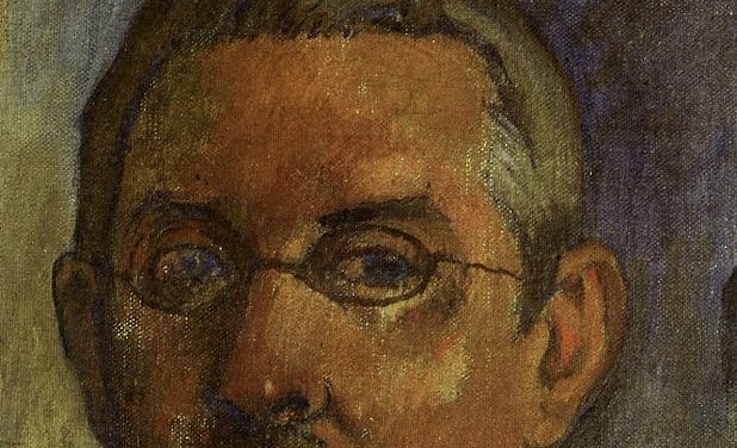
One of the New York Times recommended books from 2025 was Sue Prideaux’s Wild Thing: A Life of Paul Gauguin. Gauguin was an artist who influenced many of the most important figures in 20th Century Art, including Picasso. He was championed by Degas and his relationship with Van Gogh has been imprinted on the public’s imagination. Yet stylistically he was difficult to pin down, at first exhibiting alongside the Impressionists, then later regarded as a Post-Impressionist and a Symbolist. In addition to his painting, he is well known for his pottery and his writing. His 1892 painting of two Tahitian girls set a record at auction in 2015, selling for $300 million US, an irony given much of Gauguin’s later life was spent in financial struggle and debt. When he died, the official in charge of selling his remaining property stated that he was already “convinced that the liabilities will considerably exceed the assets, as the few pictures by the late painter, who belonged to the decadent school, have little prospect of finding purchasers.”
Having just read Prideaux’s book, I have put together a pop quiz on the life of Gauguin to wet your appetite for this excellent biography. How well do you really know this important 19th Century painter?
- Paul Gauguin’s early childhood was not spent in France. His father was an anti-Bonapartist journalist who fled to exile when Gauguin was a little over a year old. What country did the family flee to?
A) Italy
B) Peru
C) Mexico
D) Tahiti - Throughout his life Gauguin was fascinated with a painting by Manet that he carried with him, pinning it up on the walls of his studio, never able to replicate it despite many efforts. Was the Manet painting (titles translated to English):
A) A Bar At The Folies Bergere
B) Luncheon On The Grass
C) Olympia
D) Execution of Emperor Maximillian - Gauguin returned to France and spent his late teens in Paris where the city was undergoing a massive Second Empire transformation under Georges Eugene Haussman. About 350,000 people were displaced as narrow medieval streets were replaced with Haussman’s wide boulevards. About 10% (35,000 people) among the displaced were…
A) Immigrants
B) Labourers
C) Prostitutes
D) Artists - Gauguin wrote publicly about this artist under a pseudonym: “When you want to discover how many hairs a donkey has on each ear and determine the colour of each, your place is in the stable rather than the studio.” Was Gauguin referring to:
A) Seurat
B) Courbet
C) Degas
D) Himself - Gauguin had seen an exhibition by the Painters of the Petit Boulevard at a restaurant on the Avenue de Clichy. Among the group was Vincent Van Gogh. However, the exhibition was short lived because:
A) There was a fire at the restaurant
B) The group was offered a better venue at Boussod, Valadon and Cie
C) Vincent got in a fight with the dinner patrons
D) The paintings were putting the patrons off their food. - When Vincent Van Gogh cut off his ear in Arles, Gauguin was…
A) Already back in Paris
B) Initially accused by the police of Vincent’s murder
C) In the brothel where Vincent delivered his ear in a box
D) Staying with Theo Van Gogh - About how long did Vincent Van Gogh and Gauguin famously share the yellow house in Arles? A) Two Months
B) Six Months
C) One Year
D) Two Years - In the late 1880s Gauguin painted a number of images of Jesus while in Brittany, including the now famouse Yellow Christ. His image of Jesus was based on the likeness of…
A) Vincent Van Gogh
B) Theo Van Gogh, his art dealer
C) Himself
D) His disciple in Brittany, Meyer De Haan - When Gauguin represented indigenous Tahitians as Biblical characters, such as the 1891 painting la orana Maria (Hail Mary), the Catholic Church viewed it as blasphemous. It remained that way until a Papal encyclical reversed that decision in what year?
A) 1904
B) 1939
C) 1951
D) 1973 - In February 1895 Gauguin had planned to return to Tahiti after a stay in France to show his Tahitian paintings, but the slow recovery of a leg wound and one other reason delayed his departure until July. What was the second reason?
A) He needed to also recover from a dose of venereal disease
B) He needed to raise more money for the voyage
C) He needed to finish selling off his effects in Paris
D) He awaited a ship that would take him on as crew - The leg wound which would torment him for the rest of his life was the result of …
A) A beating from a group of locals in Concarneau over an incident with a child
B) A fall from a horse in Brittany
C) A fall off a cliff near Pont Aven during a plein aire outing
D) A failed operation in Paris to fix his unequal legs - Gauguin left Tahiti in 1901 to go to the Marquesas Islands because:
A) He was fleeing debts in Tahiti
B) The French authorities were pressuring him to leave
C) Tahiti had become, in his opinion, too Westernized
D) To flee a paternity suit in Tahiti - Unable to afford canvas, one of his epic masterpieces, Where Do We Come From? What Are We? Where Are We Going? (1897-8) was painted on…
A) Cardboard
B) Sack Cloth
C) Wooden Siding
D) Table Linens he had brought from Paris - Gauguin died in 1903 just prior to a prison sentence of three months for…
A) Sexual abuse of a minor
B) Libel of a police officer he accused of taking bribes
C) Unpaid hospital bills incurred on Tahiti
D) Stolen Property (a chicken)
Scroll down to find the answers and see how well you did.


Don’t forget to subscribe!
The Answers: 1 (B); 2 (C); 3 (C); 4 (A); 5 (D); 6 (B); 7 (A); 8 (C); 9 (C); 10 (A); 11 (A); 12 (C); 13 (B); 14 (B)


Leave a Reply