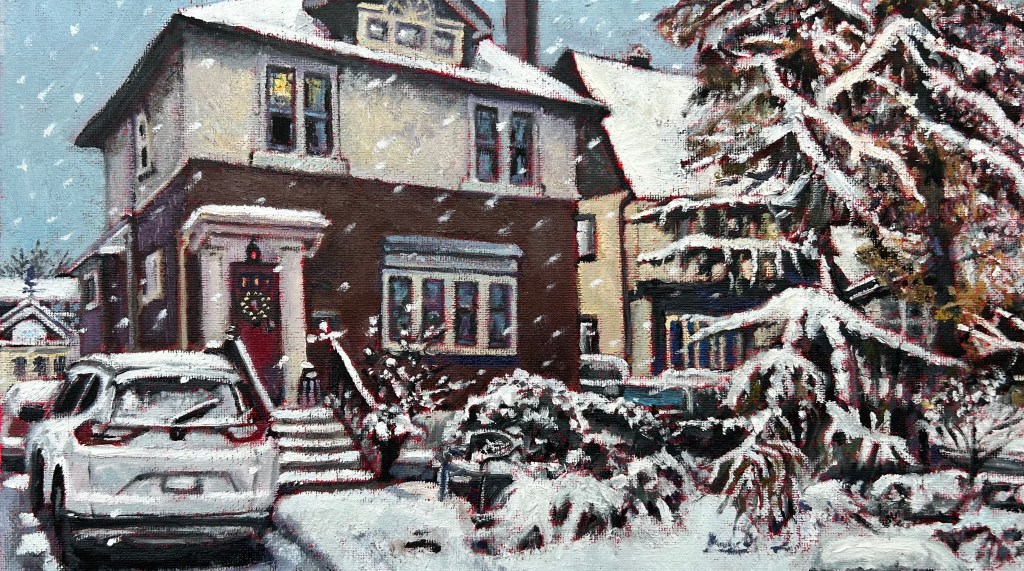
Our house will hit the century mark in 2028 — less than two years away. On the weekend we started discussing what we should do to mark 100 years of its existence, almost a fifth of that time in our care and stewardship.
Of course in Europe this would be a new build.

We spent Saturday touring houses of a much older vintage in Port Hope, Ontario, about a half hour drive to the East of here. The Port Hope house tour has been going on for about sixty years, and this one wasn’t our first. The money raised from the 1200 tickets sold for the tour goes to the Port Hope Heritage Foundation, which assists home owners conserve buildings that make the town unique.
Hats off to those who open up their homes — having 1200 people tromp through your bedrooms, kitchen and living spaces is a daunting prospect. One of the home owners told us that she stuffed her car (a Mini!) with items she didn’t want to leave out for the tour. I’m sure others did the same. At one house Geraldine asked the owner where they kept their clothes given all the closets appear to have been renovated into en suites.
What struck me the most was the extent some of these houses vibrated with a well-chosen art collection. At the first stop of the day, on Ridout Street, the owner had left information sheets on the artwork in many of the rooms. That included two very dominant pieces by Newfoundland artist Anne Meredith Barry, who I had met and had lunch with while a student at the Nova Scotia College of Art and Design in the 1980s. At the time Barry had an incredible show on at the College’s art gallery. Barry’s work heavily abstracted the landscape, in this case of these two images, a night sky and scene involving whales. Barry passed away in 2003 after leaving an indelible mark on the Canadian art scene. I also noticed a piece of another celebrated Canadian artist — Graham Coughtry — whose abstracted figures have found their way into many large public collections.
Sadly, I can’t share those images — one of the rules of the tour is no interior photography. Understandable, but darn!
The Ridout Street house was not the only one on the tour with a remarkable art collection. I noticed an original print by another Newfoundland artist — David Blackwood — at another location. The only house that didn’t offer up its art — a large attractive Romanesque Revival Home on Bedford Street — was lightly staged by Southebys who were listing it for sale — a cool $1.55 million CAD if you are in the market for a 4500 square foot house from 1850. The house currently belongs to Canadian Nuclear Laboratories.
To say that it was a let-down was an understatement. While one could see the real estate potential in the building, the things that animate a home — including an art collection — were absent. As a result, despite its size, it had the smallest line to get in, and certainly people were emerging quite briskly after winding their way through it.
One of the last stops of the day was at two condominiums in a converted school built in 1905. I really didn’t know what to expect, walking through the door of both and being bowled over by what had been done, including the addition of a mezzanine and a sunken living room. Both also had extensive art collections — at the first one the owner informed us that two of the older portrait studies down the hall were of family members. One of the paintings, a female figure in a light dappled landscape, reminded us of the Helen McNicoll show we had seen over the summer at the National Gallery of Canada, and judging from the style of dress of the figure, possibly either a contemporary or it was created shortly after McNicoll’s passing in 1915. In the bedroom of the first condominium we met the last principal of the school prior to the conversion. He said he was sitting where his office once was. We had wondered about ties to the school by former students and were later informed that several had decided to set up house there. The principle told us stories of kids sneaking up on to the roof to play pranks on their fellow student. He said his wife had initially sold many of the units as the real estate agent. The second condo we visited the owners informed us that they had only been there for two months — to get ready for the show must have been a huge task, but they looked well settled in, including the placement of a baby grand piano in the living room.
After touring 10 homes (we passed on the church that was added to the home tour, the house of God, perhaps?) we made our way into Port Hope’s commercial area to browse the shops. It wasn’t hard to see where much of the decor emerged from in many of these beautiful homes, including the Michael’s Penny’s shop, Atelier on John and Gallery 34 on John, where it turned out one of the two gallery owners (both artists) had her house up on the tour that day. We recognized some of her work that had been visible in the circa 1860 Charles Street house. The downtown was buzzing after the tour with 1200 people suddenly set free in its proximity — we were surprised to see line-ups at the cash of many of the shops we stopped in. There were also people lining the Ganaraska River as the salmon were spawning. Politicians forever underestimate the power of tours like this and the arts in general on economic development. Every time I visit Port Hope I always wonder why I don’t spend more time there? It’s close by and is among the most charming of Ontario towns.

This week it is back into the studio. I have two stubborn signature paintings that refuse to get finished, but I think I’m getting close. I am also likely to finish the first of a series of Saint John paintings I am hoping to turn into giclee sales. I did hear back on my entry to the Kingston prize — as expected, I didn’t make the cut to the final 30. They had about 400 entries this year, so the odds were not all that favourable. The painting I originally wanted to enter is still incomplete on the easel in my studio. Hopefully it will be a strong entry into the 2027 prize. I have also been making some initial contact with commercial galleries in Ontario to try and move some of my work out of the studio and into places where people can see them.
I’m fighting my impatience to get stuff out there sooner than it should be. After about two years of working close to full-time on my art career, I find it is starting to pay off given I think I am seeing better, which is a big part of the battle. I’m also thinking more about my work from a conceptual point of view.
If you haven’t seen it already, my recent profile in Fine Arts News is still up at https://fineartsnews.com/2026/07/rick-janson-emerging-in-late-career/
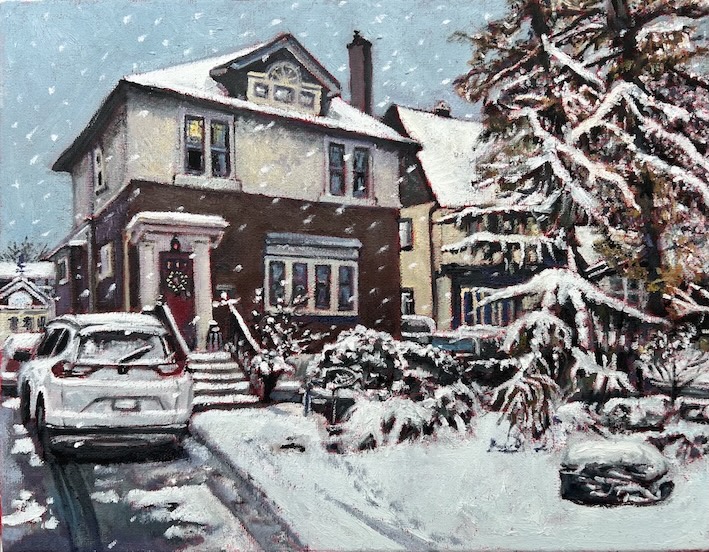
Today’s feature image is a detail from a winter painting of our house. The full image is below.


Leave a comment