Rick Janson Art Studio

My Art Journal

  • Recycling 2

    I started this painting in 2015. It was from a photograph I took at a family reunion the previous summer in New Brunswick. At 36″ x 48″ it was extremely awkward to work on in my tiny shed studio.

    I never got very far with it at that time beyond a very loose rough-in, getting in place the various elements of the picture and seeing if the colours would initially work together. I’m not entirely sure what happened to halt that work — I have vague recollections of being overwhelmed trying something this ambitious while juggling the responsibilities of my day job.

    There is a certain satisfaction in doing smaller pictures that can be completed within a relatively short time frame. This, by contrast, was going to be a long slog.

    So it sat for a decade, the image facing the wall.

    While most of the adults at that reunion roamed around the cottage and deck overlooking the river, the kids were all down at the dock, no doubt hoping that they would get another spin on the tube. To me the image captured the summers I so loved in my youth.

    Belle Isle New Brunswick
    Summer (2025) Oil on Canvas, 36″ x 48″

    Our granddaughter, who is at the center of the tube, was eight at the time. She just recently graduated from high school. I was starting to get pointed remarks about finishing it before she retired. Not that this was ever meant to be a portrait. My spouse says the kids are not recognizable, which suits me just fine. It’s about adventure and summer, not about the individuals. We had a brief discussion on the difference between figurative work and portraiture.

    Working in a shed studio that’s eight by twelve feet, I found new tricks to get perspective on this piece as I moved to finish it. That included taking pictures with my phone to see what I might see had I had the ability to walk back about ten to fifteen feet.

    I also bought a better overhead work light, which helped to be able to see what I was doing in a pure white light. I no longer take a painting out into the daylight to be disappointed by all the flaws I couldn’t see from working in a more subdued light.

    The opportunity to work larger also meant that I could play a lot more with the painted surface, giving it a bit more energy than would be otherwise possible with a smaller canvas. There were numerous challenges, including the intertwining and positioning of all the kids as well as capturing their colourful swimsuits.

    I knew that when I came back to putting serious time into painting, that I would initially start small, get some paintings complete, then gradually work into some larger pieces, including finishing this one.

    Working on this painting also got me out of the habit of using tiny brushes. I have a bad habit of taking on an image with the smallest of brushes then wonder a) why it is taking so long and b) why I’m wearing out these brushes so quickly.

    Tomorrow we’ll look at the third painting that I resurrected from my past — this one an actual portrait from 2006. While I have had several good sessions on it, I’m not convinced it is there yet.

    If you like this BLOG, please give me a like, leave a comment or feel free to share in on social media. Use the buttons below.
  • Recycling

    What to do with a painting that’s a little meh?

    There are numerous paintings that I undertook that I thought would be amazing when I applied the first few brush strokes. Somehow they often just get away from me and get shuffled somewhere in the back of my studio often never to be seen again. Overworked? Underworked? In retrospect, sometimes I have no idea what I was even looking for? Some artists just toss these canvases out. Some paint over and start anew. Art history is littered with good but lesser paintings underneath masterpieces.

    When I was an art student I completed a large square canvas of a firehouse in Halifax. I really liked the light at the time as it caught the edge of the red fire trucks parked in the open garage bay. Upon completion I decided I really disliked it. A friend offered to take it off my hands. Did I have a price? I suggested the cost of the materials would be sufficient. Years later I saw the picture at his house and realized it was amazing. It was a lesson in judging a work too soon.

    This year I have been pulling out a number of my unfinished paintings, or paintings I thought had been finished but never got up to my expectations. With a lot of time in-between, I thought I could apply fresh eyes and do something with them.

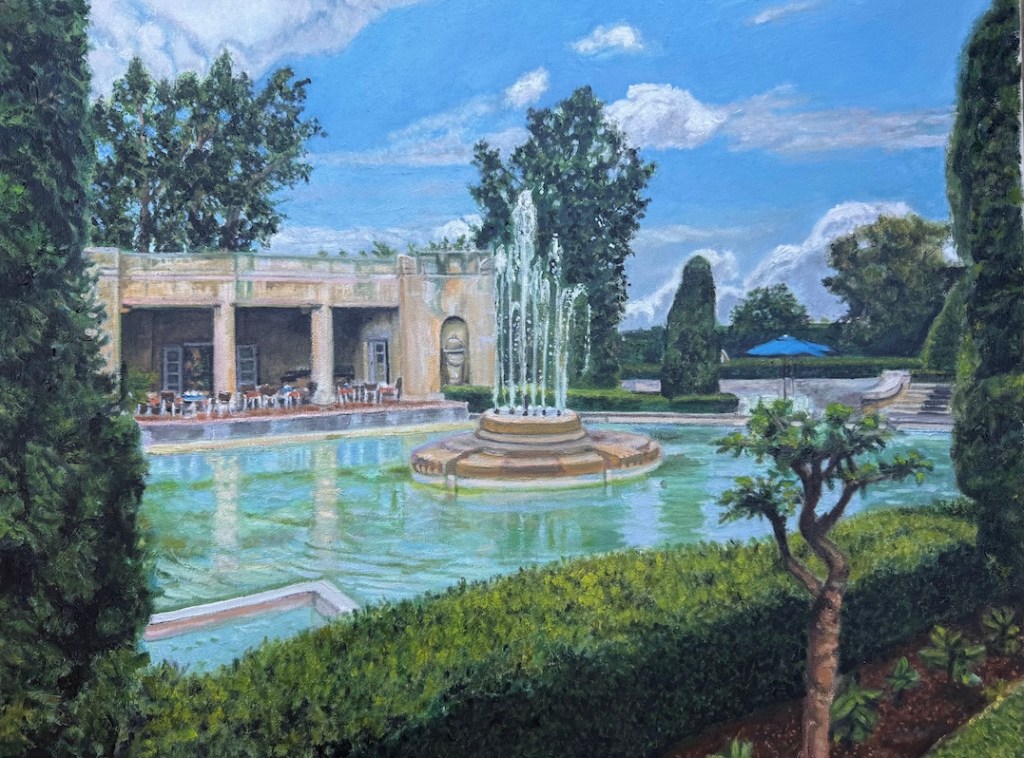
    Parkwood Estate Oshawa Ontario
    Parkwood (2025) Oil on canvas. 18″ x 24″

    Sometimes the original composition is so off that it is unredeemable without wiping the canvas and completely starting over. Last year I spent an incredible amount of time on a painting of French River, PEI, only to determine the composition was too clipped and the lighting a little too overcast to bring out the shapes of the boats and buildings, and ultimately, it did have boats.

    For those who have ever watched the BBC series Landscape Artist of the Year, the judges are very down on boats, sometimes even when the assignment is to paint a harbour scene. I believe the suggestion is that boats make an artwork a little too “twee.” In future blog entries I’ll show you some of my boats and you can decide. In this case, yeah, it looked twee.

    The first abandoned painting I put back on my easel this year was of the formal gardens at Parkwood Estate (above), which is within a short walk of where I live in Oshawa, Ontario. Parkwood Estate was the home of Colonel Sam McLaughlin, the first president of GM Canada. When the good Colonel shuffled off into the great beyond at age 100, he left almost his entire estate to Lakeridge Health, including all the furniture, art, books and even the Colonel’s collection of pipes. The exception? Paul Peel’s painting After The Bath was donated to the Art Gallery of Ontario, and a replica was subsequently put in its place in the dining room. McLaughlin did have daughters, but being quite elderly themselves, they weren’t interest in his stuff, just as the next generation in our family would be horrified at the prospect of inheriting any of ours.

    As a result, Parkwood is one of the most incredible historic sites of its kind. Whereas many historic American homes had to find the furniture and artworks that had formerly belonged to these estates (such as the mansions at Newport, Rhode Island), everything here was intact.

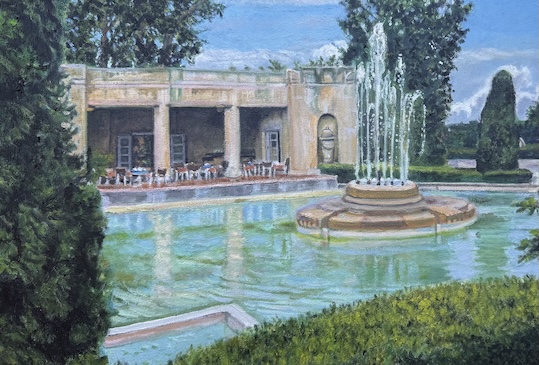
    This was not my first painting of Parkwood. Previously I had done one of the pond in the Italianate garden closer to the main house. I had good intentions of a series, but those good intentions are usually replaced by ideas about something else.

    The reference photo I took of this view was a bit odd. The colours seemed to be strange in retrospect — perhaps something to do with the ominous clouds in the distance.

    Walking through the formal gardens one feels as if you have entered another world, and I don’t necessarily mean that of the fabulously wealthy, which the GM President likely was. Looking at it, I felt as if it could be the setting for a mythical play.

    Parkwood Estate is used a lot for movies and TV, and the formal gardens you may recall from the Mini-Series The Kennedys.

    The classical-looking building in the image is a tea house in the summer.

    I initially started this maybe 15 years ago. Looking at it with fresh eyes, I realized it needed the colour and contrast amped up. I also did a poor job of addressing the water in the pond, which looked decidedly green (call the pool company!). This year I spent quite a bit of effort in improving that part of the painting. I also decided to emphasize the odd colourization rather than try and return it to something a little more expected. I think that contributes to the other-worldly quality of this picture.

    In the end, the entire painting did get painted over, but because paint is more transparent that most people think, the old image contributes to the new. This quality of layering I think is what makes painting continually interesting, at least when you see it in person. You just don’t get that with a photograph.

    Is it done now? Maybe.

    Reworking old paintings is not new. Apparently the French painter Edouard Vuillard called for changes to paintings in the room as he lay on his deathbed. We remain our greatest critics, and its hard not to pass our own work without thinking it needs just a little bit more or a little bit less.

    Tomorrow we’ll look at another of my recycled paintings.

    Support my BLOG! Feel free to leave a comment, give me a like, or share this on your social media account or sign up to get notice of new posts.

  • Here We Are At Last

    Is there such a thing as a re-emerging artist?

    In the early 1980s I was showing at two downtown Ottawa galleries, one of them embedded in the Simpson’s Department Store. At the time I was creating work using technical pens and prismacolor pencils. Much of it involved mind-numbing little dots on the page that resolved into a larger representational image, much of the visual content dealing with my day-to-day life. An image of a bunch of friends on the street playing ball hockey. A portrait of an artist colleague at a diner. The places I regularly walked by. And then there was some of the sadness I witnessed on Yonge Street, the images originally part of a photographic essay I had done for a TVO series called Electric Essays.

    I eventually went on to study at the University of Ottawa’s art school, then later to finish my BFA at the Nova Scotia College of Art and Design in Halifax. Around the time of my graduation I was flying high, having just received considerable attention for the work I had exhibited at Ecphore ’87, a large artist-run show involving more than 200 of us.

    At the time I had completed a large abstract painting called “Ecstacy While Eating A Banana” which was hung at the end of a long corridor in the derelict building we had taken over for the show. The Kandinsky-inspired painting had been on display at the Brewery Market a few weeks earlier, kind of a promotional taste for the main Ecphore show. One family stopped to consider the painting, the parents struggling to understand it, grasping at what the images might be. But their toddler clearly got it, revelling in the shapes, texture and colour of the work.

    That got me to thinking about the nature of representation. Given there was a room available next to the corridor where my large abstract painting hung, I decided to create a walk-in environment based on that abstract painting, using painted styrofoam pieces cut out in the approximate shape of the elements of my painting. I hung them at various points in the room to give the illusion that the audience just walked into my painting. In the interviews I did, I spoke about the representation I did of my abstraction.

    The painting was sold to a producer from Salter Street Films, the installation dismantled and discarded. Sadly, in all that euphoria, I never documented either with a photograph.

    So what was next? That was dictated by my bank account and the need to pay rent. I ran into the author Eleanor O’Donnell on the street shortly after the Ecphore show had finished, and she mentioned that the Halifax Library was looking for a graphic designer. I had previously helped Eleanor with the design of one of her books, and was certainly game to work at something that would at least use the visual education I had just completed. One could hold on to a full-time job and still make art, right?

    And thus began my career that started with graphic design and finished by negotiating labour contracts and representing workers at grievance hearings.

    While I have never stopped painting, there were years when my day job demanded so much out of me that I had little time or energy to be creative. That was certainly true during my last days of work during COVID. It’s hard to sustain anything when you are able to only go at it in erratic intervals. Obviously there was something still there by the encouragement I got from others, including the occasional commission, not to mention sales at fundraising events for which I had donated work.

    In 2023 I decided I had enough of day jobs, and slowly got back into the studio, where I presently work most afternoons. I say slowly not because there was not an interest, but because I had madly gone off in all directions upon retirement and really needed to focus. That included spending much of my time practising for and with a band instead of making art. It was at least fun.

    In 2024 I attended Art Toronto (as a spectator) and spoke with a corporate curator about what it means to be starting up my art practice again. I proposed that while Art Toronto held a special place for emerging artists, that some of us really should be classified as “re-emerging” artists.

    For about a year now I have been hunkering down and exploring various genres of painting, including many I had never done before. I painted a vase of flowers that looked like they were made of rubber. Sadly, that was not intentional. Looking at Van Gogh’s painting of his room in Arles or his pool hall interior, I decided to have a go at painting our Oshawa living room. I painted from some reference photos I had from various concerts I had attended too, including one couple from a park in Brussels to which I never did discover the name(s) of the performers.

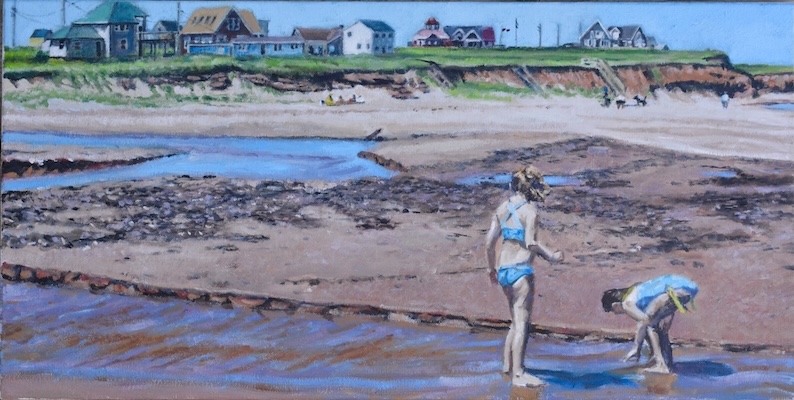
    Beach PEI Sea View
    Ola’s Beach (2023) Oil on canvas. Private Collection

    I have also done a lot of travelling in the past decade, much of it encountering some of the great art museums of the world. In the Louvre I recalled the slides of Mr. Samatoka, my Grade 9-10 Art Teacher at Scarlett Heights Collegiate Institute. I felt I was standing in his steps a lifetime later looking at many of the paintings he had described to us in his class and that first inspired me to take up this crazy activity.

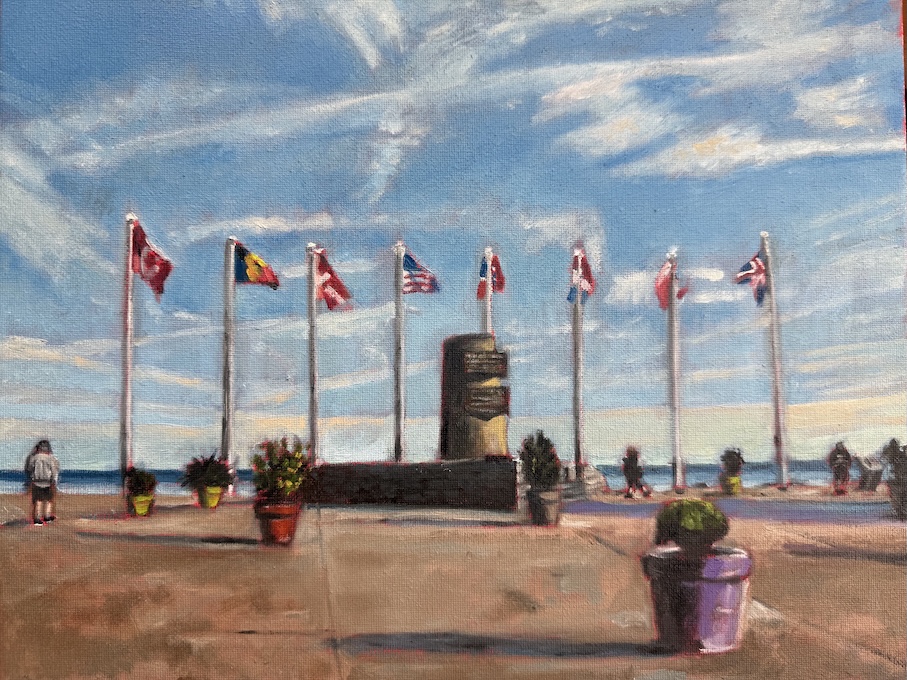
    I have started to exhibit again, one of my paintings hanging as part of the Oh Canada! show at the Station Gallery in Whitby. I’ve taken out a membership in the Oshawa Art Association, and am looking at many Call for Entries, including one aimed at Seniors in the region. It’s time to get out there again.

    The Distant Shore (Juno Beach) (2025) Oil on Canvas 11″ x 14″ — Part of the Oh Canada! show at the Station Art Gallery, Whitby.

    As part of that returning to the art world, or re-emerging, I decided I needed a website where people could see my work. The emphasis is not on sales right now — I’m still feeling my way. However, if there is something you see that you must have (assuming its still available) maybe we can work something out.

    Meanwhile leave a like, post a comment or feel free to share this with others in your social network. Use the buttons below.