Rick Janson Art Studio

My Art Journal

  • Circle of Fantasy

    Women make up 80 per cent of fiction sales, according to statistics from an opinion column in today’s New York Times. “The fiction gap makes me sad,” writes columnist Maureen Dowd.

    Me too. It also explains a lot.

    Dowd quotes author (and man) Richard Babcock: “Not to blame the current cultural landscape on Ronald Reagan, but I think the obsession with money and wealth that arrived in the 1980s may have encouraged the false idea in men that there was little to learn from a novel.”

    Fiction goes a long way in helping us see “the other.” You can’t read a book without stepping into the shoes of the author’s protagonist for an extended period of time. Is it any wonder that we seem to have an extreme shortage of empathy these days?

    This divergence in our culture may also go a long way to explaining why we are seeing a widening gap in how women and men vote.

    I can’t say this surprises me as much as confirms my worst fears.

    And I don’t think its limited to published fiction. I’ve noticed during visits to most large public art galleries that the majority of visitors are also women, and I suspect many men there were dragged along by their partner (except me and the other shaggy-looking art-types, of course). Tip for single hetero men: maybe you should hang out at the art gallery a lot more.

    It used to be the oldest and funniest pick-up line cliche: “Would you like to come upstairs to see my etchings?” That meant: “would you like to come up for some sex?” The likely (and thankful) disappearance of that cliche owes its explanation to the fact that men likely don’t have any etchings anymore, and quite possibly, he may not know what an etching is?

    I was once romantically linked to a woman who gave me a gift of two etchings. She broke up with me shortly after, which made me wonder whether she was just helping me along on the road to the next romantic encounter.

    In 2007 I attended the summer leadership school put on by the National Union. Among the presenters was a singer-songwriter by the name of Tom Juravich, who spoke about how using the tools of culture had more ability to “stick” with the public than simply presenting the facts of the case. I took that to heart, including sponsoring a theatre company who I assisted to tour Ontario doing readings from a play about Canada’s tainted blood scandal. At the time a private for-profit company was setting up in areas of the province where individuals may be more desperate to be paid for their blood plasma. It would be direct competition for the not-for-profit Canadian Blood Services and posed debatable risks of contamination. The for-profits were setting up in direct conflict with the recommendations of the Krever Inquiry set up to look into Canada’s tainted blood tragedy. After our tour, all three political parties agreed to shut the for-profits down.

    After that successful campaign, rather than be patted on the back, I was put on the hot seat, my immediate boss at the time likely having never attended Tom’s session at leadership school. Who gave me approval? The union board. Where did the money come from? The union board and NUPGE. I had to point out that unlike many campaigns that spent much more of the union’s funds, this one was a success, sweating out the grilling by two managers who clearly didn’t get it, or maybe didn’t want to get it. Our unionized members at Canadian Blood Services certainly did.

    On that tour we met with many tainted blood survivors, many of them hemophiliacs. They had their lives upended from the lack of diligence around the use of tainted blood from the United States exported to Canada. It turns out that much of that tainted blood came from the American prison population. The play catalyzed the survivors to speak up. Just in case the politicians still didn’t get it, we also did readings at Queen’s Park and the Canadian Parliament.
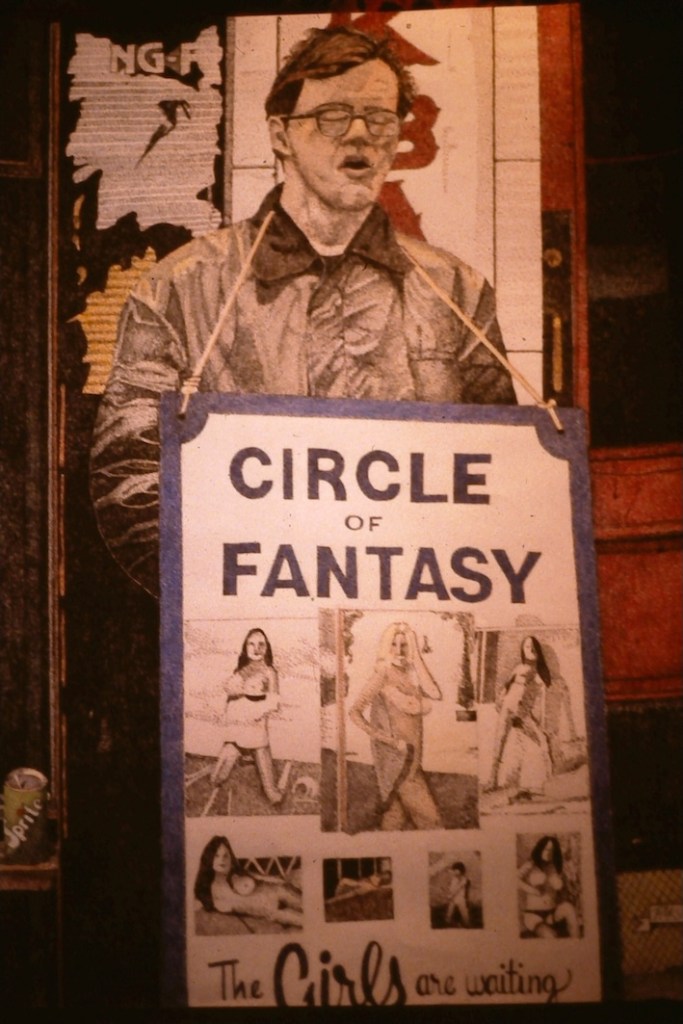
    Circle of Fantasy (1978) Ink and Prismacolor Pencils on Paper.

    The arts can make you feel deeply about issues, helping you to see something from different points of view.

    When I was in high school I was invited to submit an entry to a TVO series called Electric Essays. I entered a slide show (with musical accompaniment) called Selling Out To The Bare Walls. It was about the sad dehumanization I found on Yonge Street, the central commercial artery running through the city of Toronto. There were no words, only images. It was not the finest of times for the city’s grand old street with blocks of peep shows, strip bars and porn cinemas. One of the street pictures I took (with permission) was of a young man hustling to get patrons into a strip bar. That picture stuck with me, and later I did an ink and Prismacolor drawing from that image.

    To me, it was more effective that a dozen editorials.

    Want to read more? Subscribe — it’s free. Just use the black box on this page. You’ll get a notification every time a new post goes up. Likes and comments are always welcome too.

  • Way way way back

    I used to walk by here all the time when I grew up in the south end of Ottawa. The marina was on Mooney’s Bay, somewhere between the beach and the Hog’s Back falls, where the Rideau Canal picked up for its final run through to the Ottawa River.

    At the time in the mid-to-late 1970s I was studying at the University of Ottawa and working at the Fulcrum, the English-language student newspaper that used to print back-to-back with La Rotonde, the French-language counterpart. At the time there was an artist who regularly contributed cartoons to the paper consisting of tiny little dots made with a rapidograph pen. I was hooked watching him at work.

    I was taking drawing classes in the University’s Art School and decided that this might be something for me. The only thing was, I would make these drawings on a far larger scale and would eventually add colour with Prismacolor Pencils.

    I remember literally laying down on the floor of my parent’s basement and making endless dots while letting my mind drift sideways. The dots would go over a loose pencil drawing I used to navigate the image, any traces of pencil erased once the ink had been applied. It helped to have music on. Looking back, I don’t know how I did it. One would think the repetitive strain alone would do in my hands, let alone my head.

    Hog’s Back (1978) Ink and Prismacolor Pencil on paper.

    While most of the image came together this way, I did make exceptions where I could wildly make a line, such as the tree branches in the image.

    I made quite a few of these drawings, some making their way to two commercial galleries which were intrigued, but really didn’t know what to make of it. Neither ever sold a drawing for me and I got left on the hook for the cost of framing. It was clear that the economics of spending a week or more on one of these just wasn’t there.

    In the end, I didn’t get my BFA from the U of O, but through the Nova Scotia College of Art and Design, where I embraced oil painting, requiring a very different approach to my art making. I literally had to re-learn how to draw using a paint brush, although having made few lines and instead embraced tone in these early drawings, the transition was not as difficult as I had first feared.

    Recently I bought some watercolour pencils that really reminded me of this period. But unlike the prismacolor pencils, these require water and once wet, look more like a watercolour painting. I will post one of these once I get over my present fear of making new marks this way.

    Help me build my audience! Give me a like, subscribe to the blog using the black box on this page (it’s free and always will be) or leave a comment. A comments are moderated, so it may not appear right away.

  • Humming Petula Clark

    There was a lot of renewed attention paid to celebrated Canadian pianist Glenn Gould after he passed away in 1982. One of the biographical details I recalled was his habit of driving around while humming a Petula Clark song in his car. He actually did a radio documentary about this, documenting a drive to Thunder Bay from Toronto in search of the technical qualities of a singer he called “Pet Clark.”

    I’m not sure why that came to me at a time I was experimenting with more abstract forms of painting in art school, perhaps I was playing some of Gould’s work in the studio at the time? His recording of Bach’s The Goldberg Variations was among my new collection of CDs. CDs — how exciting! Or perhaps I was once again linking music to visual art. Like many artists, I can’t paint without some form of music playing in the room.

    A larger work, this painting was towards the end of my time at NSCAD. Short of money, I started painting on linen, finding it an interesting substitute for canvas. Linen cheaper than canvas? It is if you are buying sheets from the army surplus store around the corner from your one room apartment near Agricola Street in Halifax.

    Glenn Gould Driving Around Toronto Humming A Petula Clark Song (1987) Oil on Linen. About 60″ x 40″ Private Collection.

    This was actually my second piece on linen. The first I had gesso’d over and painted conventionally. This one involved painting directly on the linen. No gesso.

    I found it really worked with the softer side of my work. No hard edges. I liked the way the paint floated on the surface.

    I don’t spend a lot of time on painting titles, but it helps me to delineate them a little better than simply applying numbers or universally applying “Untitled” to them. Art history is littered with examples of confusion over badly titled paintings, or artists who had given more than one title to the same painting.

    With my abstract art, the titles are often a clue to what I was feeling when I made the painting. They often bring a smile to people who read titles, as if I gave them a key to unlocking the work. Maybe I did?

    This one? It’s called Glenn Gould Driving Around Toronto Humming a Petula Clark Song. It may account for the map-like parts of the painting, and I swear, some people can see traffic.

    The question is, looking at it, should one be playing Glenn Gould or Petula Clark?

  • Mystery Performance

    One of the most moving live performances I’ve experienced was by a duo for whom their identity remains a mystery to me. He played a stand-up bass, using a looping machine to build up the sound for each song. She sang with the confidence of someone with extensive classical training. I found it the kind of emotional experience that only the arts can achieve.

    I had come across the pair in 2019 at a free festival in a Brussels park opposite the Royal Palace. I looked for some indication of who they were (such as a posted sign with a line-up for the festival), assuming that the worst case scenario would be I could look it up later, knowing the date and location of the performance.

    No such luck.

    Years later I started thinking about the relationship between music and painting. I had previously written about the family that tried to figure out what one of my abstract paintings represented as their toddler clearly demonstrated an understanding that it was about form, texture and colour. I wouldn’t recommend that you let your toddler rub their fingers across anyone’s painting, but I appreciated the nod to the work.

    I often talk about how painting can be like music — it doesn’t have to be about something. When people listen to an instrumental piece, it make evoke feelings or remind them of something, but it is essentially abstract. They may enjoy the melody by itself, or the combination of melody and rhythm or even the way the arrangement works. Yet nobody comes away from a Beethoven symphony and says, yeah, but what did that mean?

    I recall seeing a video posted on-line of Jeff Tweedy (Wilco) doing a cover of a Black Eyed Peas song. Emphasizing the lyrical content, it made the song look ridiculous. For much of pop music, its not about the content of the words but about all the factors that come together to make a song enjoyable, ridiculous lyrics or not.

    That can also apply to representational work. While some people may be absorbed with the representation, often the real effort is about how the paint sits on the canvas. After a period of doing abstract art, it changed how I painted when I returned to more representational content. I didn’t want my paintings to look like a photograph. I wanted them to be about the paint.

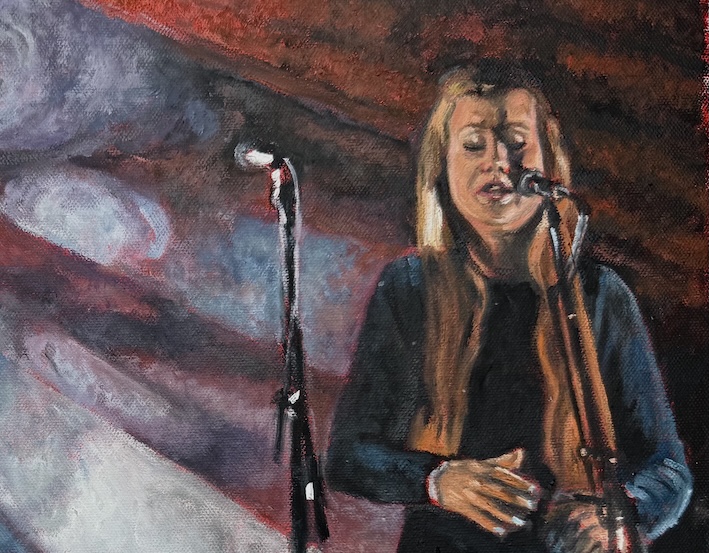
    A Concert in Brussels (2025) Oil On Canvas. 16″ x 20″

    Artists have painted musicians throughout history. I thought about the duo I saw on stage in Brussels and decided to render it from the photographs I had taken. The light and smoke machines made for a very abstract visual experience, a rare experience for a band that was not a headliner (don’t get me going on the insecurity of headline acts who deny the tools at hand to enhance the performance of the opening act).

    This is not my normal jam, but I am trying out new genres as part of my return to full-time art making. But I still wish I knew who these two performers were.

    If you like this post, please give me a like, or better yet, use the buttons below to share it on social media. Or leave a comment – the platform I use requires me to approve it, so depending on what I’m going that day, it won’t be immediate.

  • Oh Canada Project

    It wasn’t long after signing up with my local art association that I got a call for entry from the Station Gallery in Whitby. “Great,” I thought, this would be a chance to show locally. “How much time do I have?” It was Tuesday. The deadline to submit on-line a digital image and form was Friday. Yikes!

    It was clear from the call that this wasn’t the first notice, just the first notice to me. Could I do something within three days? Given I initially only had to submit a digital image of the work, an oil painting would likely be dry before I had to physically get it to the gallery. That was doable, especially after watching Landscape Artist Of The Year, the UK TV series where artists were given a mere four hours to create a painting. I would have more time than that.

    The call was for The Oh Canada Project, which was wide open to artists to submit something that either had the Canadian flag in it, or that was inspired by it. Given the anger generated by Donald Trump’s threats to our sovereignty, this was timely.

    But the question is, what would I do?

    I thought back to 2022 when we decided to take a tour of Juno Beach, the World War II landing zone for Canadian soldiers on D-Day.

    We had made arrangements to take a small tour to Normandy, arriving via the Paris Metro around 6:30 am near the Arc de Triomphe to meet up with our guide. At first I was amazed to see dozens of people there pre-dawn, only to realize that almost all of them were Americans headed for Omaha Beach. We were instead going to Juno. It turned out that there would be only six of us on this tour, our travelling party of four plus a former St. FX professor and his partner.

    Juno Beach D-Day Canada
    The Distant Shore (Juno Beach) (2025) Oil on Canvas, 11″ x 14″

    This is the view that met us upon our arrival at Juno. It was a clear day. We stopped across from a small plaza ringed by an arc of flag poles surrounding a concrete pillar. On that pillar in English and French it was written: “Here on the 6th of June 1944 Europe was liberated by the Allied Forces.” Among the flags, on the far left, was Canada’s.

    The plaza sat adjacent to a building now labelled Canada House — a private home that had the distinction of being the first house to be captured on D-Day by any of the Allied Forces. We were told that it is still under ownership of the same family. About 100 Canadian soldiers lay dead or wounded by the time it was captured from the Germans, who had used it to defend against the invasion. Jonathan, our guide, told us that it was still common for Canadian veterans to return there and apologize for the mess they made. How Canadian! Retired members of the Queen’s Own Rifles had even donated money for its restoration after the war, knowing its historical importance.

    It was an odd feeling being there knowing what had happened at this location. There weren’t many people around — the biggest group of Canadians we came across was to be later at the modest interpretive centre built with donations from the private sector. We were the last of the major combatant countries to do so.

    Oddly, the plaza had these colourful planted pots spaced around the monument at odd intervals. It would be interesting for the locals to live in such a place, to remember what happened but also to do what the Allied forces had intended for them to do — to live on in liberty. Maybe that was the point of the pots. Amid all these dreadful memories there was still colour and life.

    The monument itself looked as if it has arisen from one of the concrete bunkers built along the shore, some since covered by the ever-shifting dunes.

    What few people that were there walked around individually, as if lost in their thoughts. It was quiet except for the surf rolling out on the beach.

    The tour gave us an in-depth perspective of Canada’s efforts on D-day, including visiting this plaza. We toured the interpretive centre a short distance away. We also were taken to the furthest point the Canadians had reached inland on D-Day (thanks to their foresight in bringing bicycles, they had gone farther on June 6th than their UK or US counterparts). We also were given ample time to wander through one of two peaceful military graveyards where so many Canadians remain so far from home. Our last stop we were taken to a site where a number of Canadian soldiers captured on D-Day had been executed by the Germans against the wall of a church. Those responsible were convicted of war crimes, but eventually pardoned after a short time spent in prison. Pictures of those Canadians are still mounted on that wall.

    My painting of Juno Beach is on display in the lower level of The Station Gallery (Whitby) with about 50 other contributed works by Canadian artists until October 19th. Admission to the gallery is free.

    If you liked this story, feel free to share it on social media using the buttons below. A “like” is always appreciated.

  • Giverny

    Claude Monet’s gardens and home in Giverny see a succession of tour buses arrive daily, including ours which had left early morning from Paris. Curiously, outside the compound, the town is full of artist studios, all proclaiming to be modern-day impressionists.

    A few days earlier we had been to the L’Orangerie in the Tuileries Garden to see the water lily paintings in person. It was like visiting a shrine. Surprisingly, it wasn’t as crowded as the impressionist galleries at the Musee D’Orsay, and we had plenty of time and space to take it all in. It felt like being in a church.

    In person, seeing the house and gardens was like literally walking into his paintings. Monet’s eyesight was an issue of national concern towards the end of his life and it made me wonder how much it contributed to the almost abstract look of many of these paintings.

    Monet hadn’t always been celebrated in France and was not particularly wealthy. When Monet first moved to Giverny in 1883, he had to borrow money to attend the funeral of his mentor, Edouard Manet, who died shortly thereafter.

    Breakthroughs in optometry are attributed to what turned out to be a national effort to restore Monet’s sight. After undergoing cataract surgery, and with the aid of a Zeiss lens made specifically for him, his eyesight was sufficiently improved that he destroyed much of the artwork created during that period. It was said many of these paintings were very dark in pigment as a result of his inability to see properly.

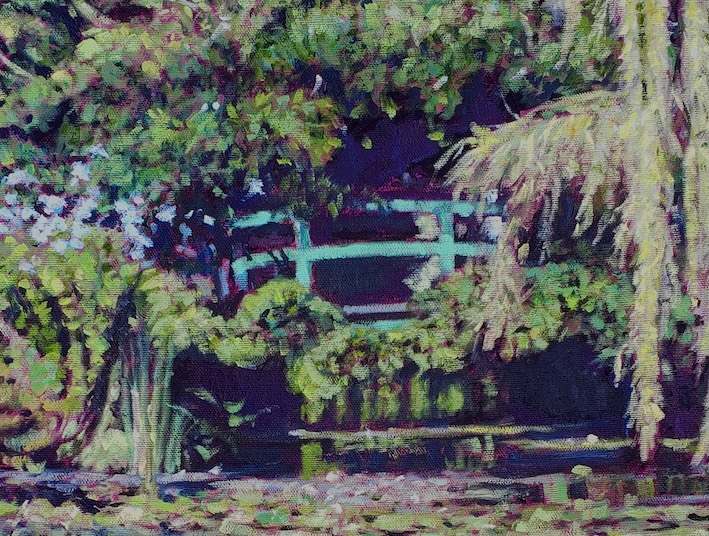
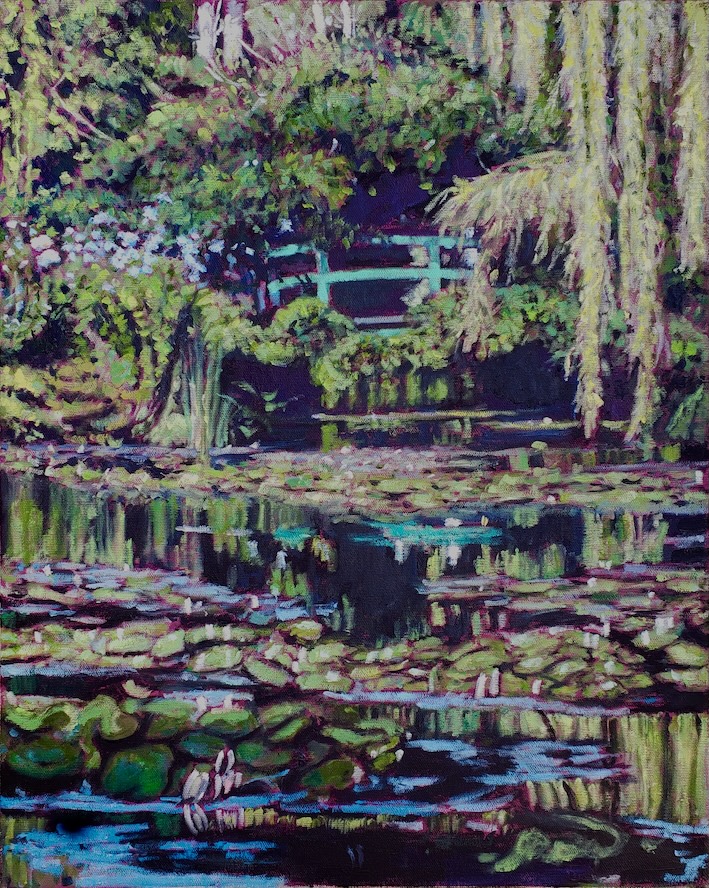
    Giverny (2023) Oil on Canvas. Private Collection.

    Bringing back a lot of material from our trip to Giverny, I decided to have a go at making my own painting to get a feel for what I had seen, but of course, in my own style. I was self-conscious that this may have been just a little bit nervy.

    I kept the brush strokes loose and did my best to reflect what I was feeling walking down the same garden paths as Monet had a century earlier.

    It was also unusual for me to tackle a picture that was almost entirely made up of natural elements. While I have painted many landscapes, they tend to be based more in urban environments. In this painting there are no buildings or people. I suppose there was Monet’s Japanese bridge to anchor the picture.

    I deliberately avoided looking at Monet’s water lily paintings while doing this. I didn’t want to create a weak copy.

    Sadly, the massive gift shop at the site is Monet’s former studio. It might have been interesting to see it set up as a studio as he had experienced it, but then again, we all had to get our souvenirs.

    Like this post? Give me a “like” or feature it on your social media feed. Use the buttons below. If you want to leave a comment, be aware that all comments require me to approve them, which can take a little time. They won’t show up right away.

  • Free booze and art history

    There were no mortar boards and gowns when I was awarded my BFA in the summer of 1987. It was a small graduating group, and instead of being held in the auditorium, NSCAD held the ceremony on the patio in the middle of the school, which at that time was housed above a block of shops facing on to Granville Mall, a pedestrian street in the heart of Halifax. The speeches were short, the dress was summer casual, and short on pomp and circumstance, it was long on the open bar.

    After the presentations, everybody mulled about and chatted amid the complementary drinks. The school registrar approached me with a confession. She told me that they were glad that I graduated when I did. Had I taken one more art history course, the school would have been forced to consider awarding me an art history major — something they didn’t offer. Had I known that beforehand, I might have done so. Instead I graduated without a major but an art history minor that, as it turned out, was almost a major. Darn.

    Not that it made any difference in my future employment prospects. None of my employers ever raised the lack of a major on my CV.

    I got the bug for art history not at NSCAD, but much earlier in Toronto attending Scarlett Heights Collegiate Institute (the story goes it was called that because the acronym of Scarlett Heights Institute of Technology would have been SHIT). But the high school did have a lot of technical courses on offer, including a class I took on shorthand — the only male among about 25 teenage girls in the class. But SHCI did have an amazing art program that came down to Mr. Samatoka (I’m still not clear if that spelling is correct). He travelled to some of the world’s great art museums and took an incredible number of slides which he shared with us as part of the art history portion of the class. I couldn’t believe my luck, being in grade nine and at least twice a week got to look at amazing works of art, and better yet, frequently works of art of naked ladies.

    By the time I got to NSCAD, after a false start at the University of Ottawa Art School, I was already familiar with many of the movements that dominated Western Art.

    But I loved the lecturers NSCAD had on its faculty. I still recall a lecture on performance art where the erudite speaker spoke about artists and the act of autocorprophagia. He looked out at a sea of rather blank stares. “Does anybody know the meaning of autocorprophagia?” he asked. One student raised his hand. “Sir, to eat your own shit.”

    That turned out to be the correct answer. 20th Century modern art certainly came a long way from the works of Michelangelo, although art historians have made the case that his David did have a nice bum. If you are going to Florence, make sure you walk all the way round.

    Art history has dominated my thinking on art making, although I have not been tempted to eat my own poo, thankfully.

    When I was in Arles in 2022 it was hard not to notice all the signs pointing to places that Vincent Van Gogh had painted. The river boat we were about to sail on up the Rhone River was docked at the place where Vincent had painted his Starry Night Over The Rhone. There was another nearby in a green space to indicate where the house had been that Vincent had shared with Paul Gauguin. Apparently the house was destroyed during Allied bombing of the town in World War II (and thus highlighting the need for the Monument Men).

    At that moment I thought it would be interesting to revisit some of these locations and make my own interpretation, following in the footsteps of the masters.

    Dublin Square, Paris (2024) Oil on canvas. 16″ x 16″

    By the time we got to Paris I decided to look for the location Gustave Caillebotte had used for his Paris, Rainy Day, a large canvas that draws visitors to the Art Institute in Chicago. I found that many of his locations were in the neighbourhood near the Gare St. Lazare, which itself was a favorite subject for Monet and other impressionists.

    The difficulty of finding anything by Caillebotte is his reputation for exaggeration and invention. That is the prerogative of artists, not just modern-day Russian trolls and MAGA activists. I passed over the Europa Bridge, another of Caillebotte’s locations used for Le Pont de L’Europe. I had to laugh given the large girders on the bridge that tower over the pedestrians in his painting are actually below your waist. Similarly, by the time I found Dublin Square, the location for Paris, Rainy Day, I recognized the buildings, but the immense square was somewhat diminutive compared to the painting.

    And of course, the modern world also happened. Instead of couples walking in their finery amid the sprawling square, I saw delivery people parking their vans up on the sidewalk, bicycles chained to a fence, advertisements and motorcyclists passing through. I thought this would be fun to paint.

    Unlike Caillebotte’s massive canvas, mine is quite small.

    What I did have in common with Caillebotte was the weather. Clearly I needed to get in and out quite quickly as the clouds were threatening rain.

    Tomorrow we’ll look at my take on Monet’s water lily garden at Giverny.

    Help me grow my audience! If you like this, give me a like! I’m always thrilled to see people share my posts on social media using the buttons below. And don’t forget to subscribe — its free and you’ll get notice every time I put up a new post.

  • Dispersing of a second life

    There is a sad story in the New York Times today. As an artist, it made me stop in my tracks. Could this be me some day?

    Author Alissa Quart writes about having to sell and give away about 400 paintings by her 90-year-old mother, who was a literature scholar up until her retirement 30 years ago. After taking some art classes — “a whole new second life” — she began painting every day. Some of the paintings got exhibited in group shows, but she never had a solo show. Quart hints that perhaps her mother didn’t feel worthy of a such a moment, nor did she now want a gallery show based on pity. Four months ago she was diagnosed with cancer, of which Quart has been helping her with her chemo appointments.

    “Finding homes for the paintings while she is still with me has taken on a strange urgency — I want to know where they will dwell,” she writes.

    Quart speaks about how the paintings gave shape to her mother’s way of seeing.

    “A painting is the promise that our consciousness can persist beyond the hand that picked up the brush.”

    Earlier this year I started collecting together images of my life in painting, realizing that there are many more that are simply missing. Some friends and family were able to let me know about the work they had in their possession, sending photos of the paintings still hanging in their homes. In one instance, I discovered that one of my student works had been damaged and disposed of. That’s happened to me too — I certainly never took offence. What’s remarkable is how much of it has survived.

    I am still hoping to put together a little book, a summary if you will, of what I’ve spent a lifetime doing. A record should anyone care about my work sometime in the future. Perhaps that will open the door to advance my art. More likely not. Quart points out that only 20 per cent of artists will exhibit their work in their lifetime. It’s even worse for women.

    I’m a bit obsessed about documentation. Every year I print about 15-20 books that document my life with my spouse, distributed before Christmas to family and friends. The books are photographs and stories about our activities as well as my view of the changes in the world about us. We use those books now as a substitute for memory. What year did we go to Washington? When did we renovate our basement? When was the last visit by my Dad before he passed away?

    The art book would be a little more focused.

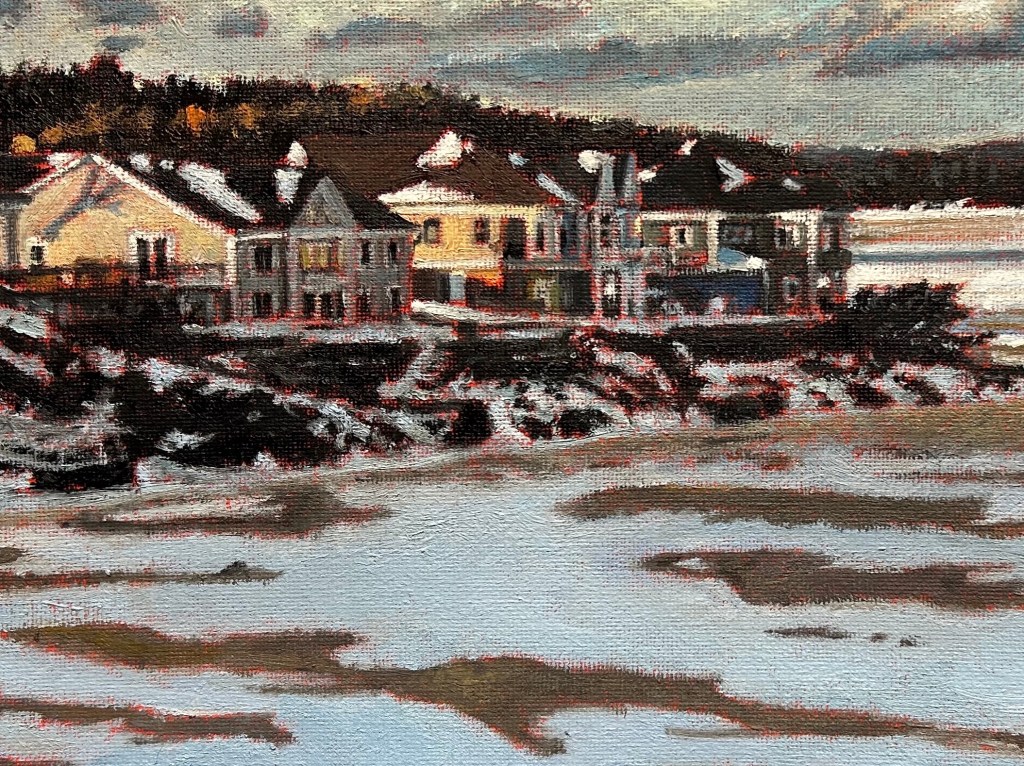
    Fortunately, many of my paintings have already found homes. Some were given away — particularly when our moving van from Halifax simply didn’t have any space left and some were given away on the spot to friends who had helped with the move. Some of my paintings have since been sold for a modest amount, mostly to friends and family. Some were placed in silent auctions to raise funds for charities, such as today’s image which helped raise funds for a hospice in Saint John, New Brunswick.

    Milligeville New Brunswick
    The Dimming Of The Day (2025) Oil on Canvas, 12″ x 16″

    My spouse’s sister sent us a picture from a house she had once considered purchasing in Saint John. Did I recognize these? she asked. Hanging in the house were two of my paintings. Turns out a local doctor had been collecting them at the same annual hospice fundraiser. It was his house that was listed for sale.

    The fact that so much of my work is still out there makes me believe that perhaps this was more than just a fool’s errand. Sometimes my reaction is, “you kept that all this time?”

    The difficulty I am having with the “little book” is when to stop? Almost daily I am spending 3-4 hours in my studio with my brushes and paint. Not surprisingly, my art is changing.

    Many artists strive for consistency in their work. Some, having success with a certain kind of painting, appear frozen in their creativity and churn out essentially the same work over and over. I could never do that. When I was in art school, it was not hard to notice those who were experimenting less and instead seeking to create within a small window permitted by the demands of consistency. I think we all thought that was what the art world demanded of us.

    I never sought to do that. Instead in my final year at art school I think I started to frustrate my fellow classmates as I swung from conceptual art to figurative work to large colorfield abstracts. I didn’t think I ever found a style.

    Then a few years ago someone told me they liked the style of my painting. Gathering my images together after that, I realized that there was more consistency to it than I had ever thought. The style found me, I didn’t find it.

    I feel as if I am still in that experimental stage, putting a lot of thought into where my work goes next. Having to put it down in words is actually a help.

    But I do fear that in twenty years somebody else will be trying to find homes for the work left behind in my studio, or worst still, have these canvases find their way into the skip. Quart speaks about another person from her mother’s art group for whom their caregiver had donated his canvases to an art school to be painted over. She didn’t want to do that. For me, that would feel like being erased.

    Hopefully the New York Times article will help spur the distribution of those paintings by Allissa Quart’s Mom. She noted that she had found homes for 35 paintings so far. With 400 in her mother’s apartment, there’s a lot more to go.

  • The Wrong Way Down The Road

    Prior to moving to Oshawa in 2002, my only experience of the city was hurtling by on the 401 at a hundred kilometres per hour (or so). I always remembered seeing the onion dome of the church at the corner of Ritson and Bloor from the recessed highway.

    I initially landed a job in downtown Toronto in September of that year. It took us a little while to sell our Halifax house, and then it was off to find something we could afford in the GTA. I like to tell people that I continued to drive east until I found something we could afford. In fact, I really did that virtually via the on-line MLS listings, then turned over my ignition key and made the trek.

    I grew up in Toronto, my restless parents having set up house in boroughs both east and west as well as in the city proper. Arriving in Halifax for what was a temporary position, I used to like to say to my Nova Scotia friends that I went the wrong way down the road. People were supposed to migrate the other way, after all.

    But eventually the need to make a living prompted me to come back to Ontario, as have many native Nova Scotians before me.

    I knew nothing about Oshawa at the time, but driving around it looked… well… rather nice. At the time it had a reputation for being a rough industrial town down on its luck. GM had once been the main employer, but between automation and competition in the auto industry, the workforce got a lot smaller. And given the shift in employment, the nature of the city changed.

    We purchased a home just south of King Street, and settled in. It didn’t take me long to set up a space in the basement where I could make art. Oshawa being new to me, everywhere seemed to be good subject matter for painting. I made a point of making Oshawa-specific work. Nobody else appeared to be doing so.

    It didn’t take long before I had enough material for a show, and the Oshawa Little Theatre offered up the walls of its lounge to me for the run of one of its plays. The reaction? Nada. Nothing. No comments. No inquiries. No interest in a purchase. It’s like I got shunned. It’s like the home grown audience turned its back.

    Oshawa has the kind of problems many cities have, including a visible homeless population, but it also has a lot going for it. GM is not what it once was, but we have a significant health and education infrastructure, including Ontario Tech University which has undergone rapid expansion. It also has great community facilities, including swimming facilities, terrific parks and libraries.

    Being affordable, I thought it would be one of those places where artists would also flock. There does appear to be an active visual arts community, but its not reflected in how people see the city. Nobody says, “Oshawa, what an arts hub.” The Oshawa Art Association’s shows at Camp Samac do draw a lot of people. The Robert McLaughlin Gallery (RMG) is a terrific space and has an important permanent collection, including notable work from Toronto’s Painters Eleven group. The building itself was designed by Canadian architect Arthur Erikson. There is an artists workshop on Simcoe Street, but beyond that, there are no commercial galleries in the city, and only one that I am aware of in Durham Region. That’s an area of nearly half a million people. One commercial gallery?

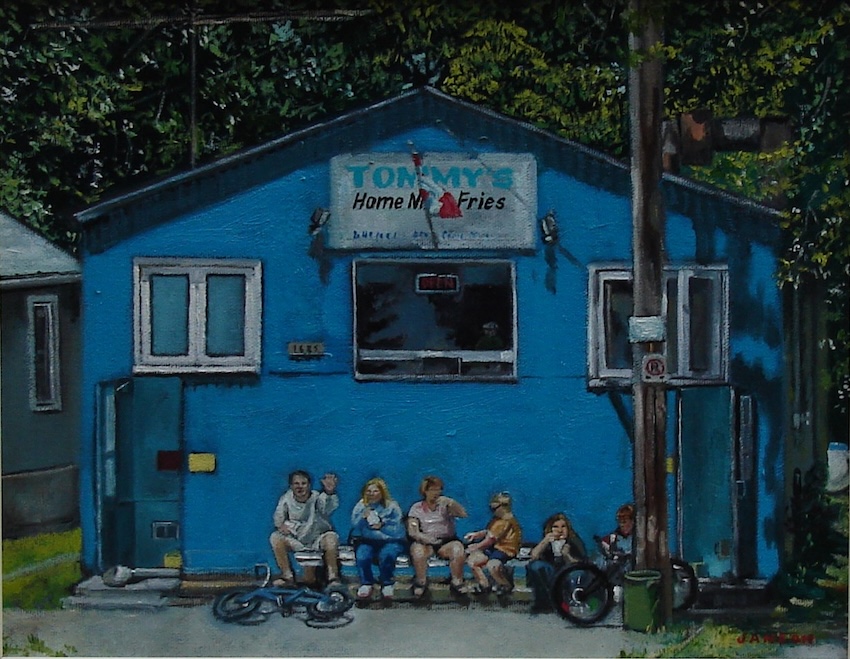
    Tommy’s (2006) Oil on Canvas. Private Collection.

    The RMG does a good job of connecting with the community, hosting group exhibitions where it invites participation from various segments of the population, including shows by local high school students and members of the art association. I noticed a call for entries for an upcoming exhibition/competition among seniors (I’m one). They also have hosted RMG Friday nights, which attract surprisingly large crowds for the art, music and food. The first time I ever saw the local band Professors of Funk was there.

    When I first arrived looking for a house, I spoke with a real estate agent operating a kiosk at the Oshawa Centre mall. Discreetly she told me that Oshawa wasn’t for me. It’s very blue collar, she said. I should instead look at Whitby.

    The funny thing is I now live in a neighbourhood where many of my neighbours are either professionals or high skilled trades. With a large health care complex, a university and a college, who is living here is rapidly changing, not that there is anything wrong with being blue collar.

    But I have noticed that Oshawa is slow to shed that sad industrial reputation. On-line it has many critics, making we wonder why so many of these people continue to live here given the level of vitriol they hold for the city.

    One of my relatives told me that the city surprised them — that it was a lot nicer than they had previously thought. One of their sons enrolled in post-secondary education here.

    After the disappointing show at the Oshawa Little Theatre, I backed away from making Oshawa-specific work. But I have started again, although this time out, I’m making work about the specific community I live in. If food can be about going local, I was going to take it to an extreme. You might say it is hyper-local. More on that in a future post.

    One of the early Oshawa paintings I really liked is one I did of a french fry stand down near the beach. A colleague of mine from Oshawa chose it for a retirement gift some time ago. Every time I look at it I feel cheerful.

    Unlike many of my paintings, this one was not laboured. It came quickly. I didn’t overload the detail. The colours sang to me. I loved that in the original reference photo someone waved back at me. To me, this is the Oshawa I wanted to paint.

    Like this BLOG? Help me promote it. I’d appreciate a like, or even better, a “share” on social media. Use the buttons below.

  • An Elusive Portrait

    There was a time when I thought being a portrait artist would be desirable. Get to meet new and interesting people, rise to the challenge of capturing their personality on canvas and at the same time make good art that the sitter or commissioner would cherish.

    Ha, if only.

    Getting a likeness is really the easy part. Capturing their personality a bit harder. Making a good piece of art harder again. Making a portrait that someone would actually want, harder again.

    Recently TVO aired a series on Australia’s Archibald Prize, which honors the best portrait works every year. In the series, actor Rachel Griffiths tracks down many of the paintings in consideration for a 100th anniversary exhibition featuring the best from the Archibald’s history. The Gallery of New South Wales had no idea where many of the paintings were at the time. That’s where Griffiths came in.

    The first place to look is usually the sitter, many of whom still had their paintings. It was obvious from the documentary series that many also never liked their portraits despite their status as among the best work the country’s artists had to offer that year.

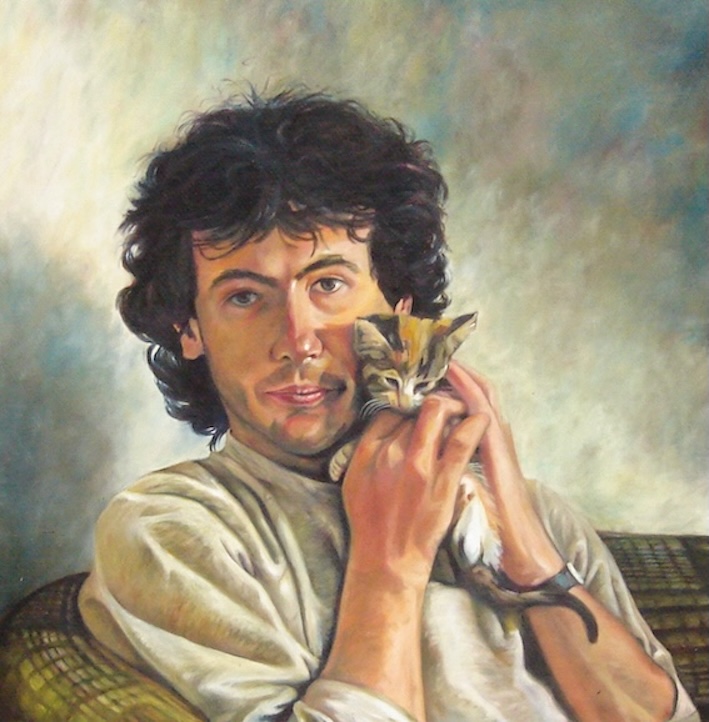
    The other thing is, some people get really self-conscious about hanging a portrait of themselves in their homes, concerned perhaps that others would see it as an act of narcissism or ego. An early self-portrait of myself is currently being stored in our garage, likely to its detriment. It’s so big I don’t know where else to put it. But I do feel self-conscious about it, especially given I painted it. At least I gave it a cheeky title.

    Self Portrait Except For Cat (1987) Oil on Canvas, 54″ x 54″

    My spouse’s parents commissioned a pair of portraits of themselves. His was cherished and upon his passing giclees were made with the permission of the artist. Hers, she hated it. If it ever hung in the home, it wasn’t for long. I did eventually see it. The likeness was not quite there, but as a painting, it was amiable. Nobody asked for a giclee.

    The most elusive portrait I have ever tackled is of my spouse, who remains kind about it. I think it is also the canvas that has the greatest number of layers on it by now. About five or six years ago I took it down from its place in our hall and moved it into my studio, where I brooded about it for some time, unhappy with it. Yes, it looked like her, but did it feel like her? Not really.

    Geraldine (2006, Revised 2025) Oil on Canvas, 11″ x 14″

    I initially worked from a photograph I took in Cobourg, Ontario. We had a late lunch sitting outside on a cafe before heading home that day. What appealed to me was the way the late afternoon daylight landed on her face. I also liked the casual attire and her smile.

    I’ve taken dozens of photos like this, but for some reason this one compelled me to take it on as a portrait. My initial go-around seemed to go back and forth between it being took dark, then too light, too washed out, too saturated. I got the likeness, then lost the likeness. Then I found it again, but only just.

    This is the third old painting I’ve put back on my easel this year. Surely, since I originally painted it in 2006, that I would have enough distance to be able to finally bring this one around.

    Nope.

    My spouse says she doesn’t look like that anymore, which is true. But had I got this right in the first place, that would still likely be true. Others who have seen it have recognized her immediately, although to me there remains something plastic about it.

    She recently came into my studio and saw it on the wall as I was working on a painting of her daughter. Comparing the two portraits, one an interior, hers an exterior, she commented on how pale she looked next to her daughter. The daylight on her face likely contributes to that.

    This is still in my studio. I put it back in its original frame. Meh. Maybe next year.

    Like this post? Leave a comment, give me a “like” or share in on your social media. Use the buttons below.