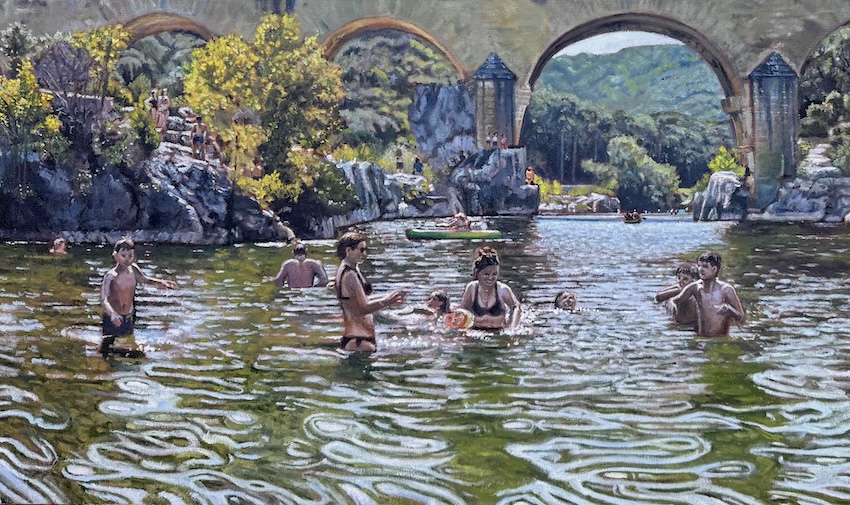
It was a risk. Visiting the Pont Du Gard I realized the view I wanted was from the river. Not beside the river. In the river. Taking camera equipment into a flowing river is always risky. You don’t know what is on the bottom, nor how you will navigate the current. One slip, the camera is likely history, whether it is my trusty Nikon or my phone. I knew I wanted this image, and that it would eventually become a painting. To me the risk was worth it.
The Pont Du Gard is one of the best known Roman sites in France. It is depicted on the five euro note. Built in one AD, it was part of a 50 km aqueduct to service the Roman colony of Nemausus (now Nimes). It was named a UNESCO World Heritage site in 1985 in part from its extraordinary preservation. While the aqueduct ceased to function with the fall of the Roman Empire, it was in continuous use as a bridge across the River Gardon. As such, after visiting the accompanying museum, we were able to cross to the other side.
What surprised me about the site was the amount of graffiti on the bridge, carved into the limestone, much of it dated from the 18th Century. If you were on the Grand Tour, it was de rigueur to leave your name behind.
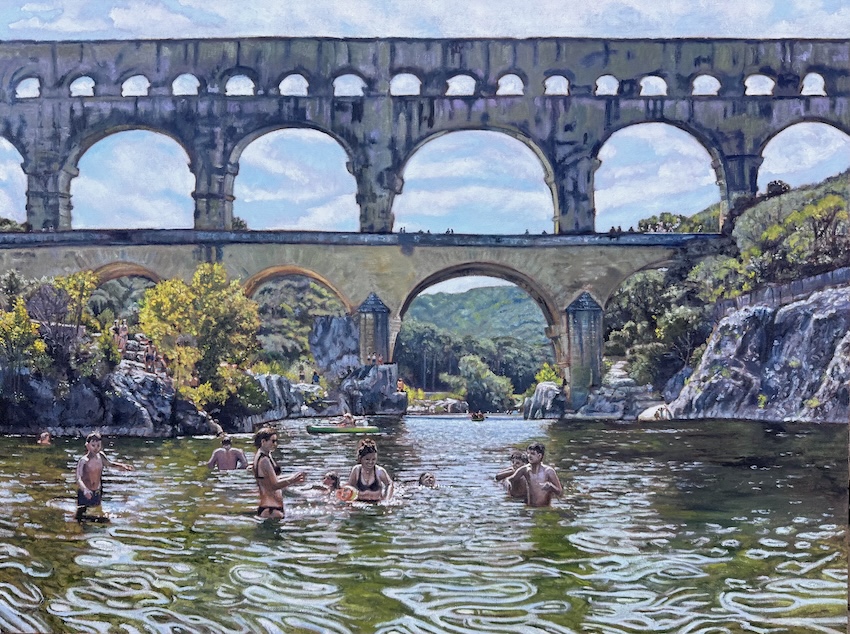
On this trip to France I constantly felt I was walking in the footsteps of many artists I had once admire. Arles, for example, is full of signs indicating where Vincent once painted. In Aix, the connection was with Cezanne. Seeing all the swimmers in the river — there were many on this splendid summer day — I decided it was time for me to do a “bathers” painting, part of my own Grand Tour of painting genres and a nod to these masters.
Fortunately I never slipped. After taking a number of photos, placing the bathers in the foreground and the Pont Du Gard in the background, I returned my camera to the shore then took a swim, feeling the temperature in the Gardon River drop as I got closer to the deeper far side.
The painting itself has been on and off my easel since last June. Deadlines for shows constantly derailed me, including my Hockney-esque self portrait which one an award in a self-portrait competition at the Leslie Grove Gallery. Normally I work on my paintings in rotation, usually four or five at a time. But with deadlines sometimes I have to shorten that rotation. I’m experiencing the same thing now as I work towards having a number of Saint John (New Brunswick) images ready for the opening of a retail shop in Rothesay in December. The shop won’t sell the originals, but instead I have been working with the Giclee Factory (Quebec City) to print a number of canvas prints of my work. As such, this large painting missed its turn in the rotation until I was finally able to wrap it up in October.
—
This weekend I got back to Art Toronto for the first time since 2024. Last October we were in Scotland and I was subsequently unable to attend. As usual I met up with my artist friend Robert Spurll, leaving the two of us to walk and talk through the massive art fair. At one point I was describing Louis Gagliardi’s new book on Peter Clapham Sheppard (Bound By Art and Time, 2026, Firefly Books), which answered a lot of questions I had after reading Tom Smart’s 2018 book on the artist, including how so much of his work was impacted by a fraud case in the 1980s. As I was telling Robert the story I looked over to the Hazelton Fine Arts Gallery booth and said, “gosh, I think that’s a PC Sheppard painting over there.” Robert thought it a total set up as we walked towards Sheppard’s 1945 canvas, Fall Fair. For those who don’t know, PC Sheppard was a dominant Toronto artist in the first half of the twentieth century, was a contemporary of the Group of Seven, and was regarded well enough to be included in a show of Canadian art at the Jeu de Paume in Paris. After he passed away, he left his remaining works to Bernice Fenwick Martin, a painting companion and friend (and Gagliardi would suggest more than that). Later Martin befriended a neighbour after he husband had passed away, and the neighbour defrauded her to the tune of more than half a million dollars after offering to manage her finances. That crime forced her out of her Rosedale home and into a Salvation Army Shelter. The fate of the PC Sheppard paintings that had been in her possession became unknown for many years until a trove of them were discovered in the basement of what used to be his studio. There is currently an effort to revive his place in Canadian Art History, including by a former teacher, Louis Gagliardi, who was a close of friend of Martin and had a part in the two books on Sheppard. Next to the large canvas were a series of smaller plein air paintings by Martin. It was the first time I had seen work by either outside of Gagliardi’s books. To me that was a thrill. I ended up speaking with another patron who was also taken with Sheppard’s painting, both of us finding it hard to believe that he had slipped out of Canadian art history in this way.

At the Canadian Fine Arts booth Robert and I started to discuss an image of Jack Chambers. While artists frequently use photographic aids, in this case the image appeared to give a nod to the photograph itself, the lens distortions evident in the rendering. We spoke with a curator who happened to have done his academic dissertion on Chambers and was able to point out a number of oddities in the painting. We also discussed Chambers Sunday Morning No.2 (not at the show) as an example of artist who painted interiors but could deal with the light differential between inside and outside. Many of the images we saw at other booths left the outside as a big white blank in the image. We were told that Chambers actually took two photographs, the one from the inside, involving his children watching TV, and the second outside, where the streetscape would remain clear. The curator told us that the outside image left a skewed view of how close the other houses in the street would have looked from inside the Chambers household. He had seen both photographs in the course of his research.
I really enjoyed this year’s Art Toronto, which remained robust despite the exit of the American galleries, no doubt concerned about the effect of Trump’s tariffs on the art trade. It gave me a chance to speak to a number of curators and patrons, a few of them walking away with a copy of my new business card.
Its back into the studio this week, today I’ll be starting my third Saint John painting.
Meanwhile, I have made some changes to my gallery page, including giving some idea of the cost of a giclee version of some of these paintings. I also responded to request to identify where the paintings are from — they are all rendered in my Oshawa studio, but the sources vary.


Leave a Reply