Rick Janson Art Studio

My Art Journal

  • Peggy Oh Peggy!

    Tourism has been in the news lately. Despite the fact that most of us are or have been tourists at one point, the worm appears to have turned in our culture. Residents of cities like Barcelona are actually using squirt guns on tourists in their city, angry that tourism has led to overcrowding and a rise in housing costs.

    Amid this sweltering summer, squirting tourists may be seen as a good thing. I’d certainly welcome it when the mercury hits 30C or more (that’s 86F for those of you who never went metric).

    But the problem of overtourism isn’t necessarily the tourists. There’s no question that Air B&B and VRBO have contributed to this situation, re-purposing what should be housing into wannabe tourist accommodation. That’s where the pressure lies. It’s their fellow locals that are appropriating housing stock to make money this way. Let’s keep in mind that while some locals are crying foul, others are happy to count their Euros.

    Cruise ships don’t necessarily increase housing rents given those travellers have a place to stay, but the ports can decide to put limits on them too, including their size, as Venice has already done. With some of these towering cruise ships, you literally couldn’t see St. Mark’s from the water. Cities like Barcelona have huge port facilities for docking cruise ships. If you build it, they will come. But then again, maybe Field of Dreams was not big in Catalan Spain.

    Emerald has introduced a fleet of smaller “yachts” to get into ports the larger cruises cannot gain entry into. When a ship docks with a hundred or so passengers on board, it barely makes a ripple on the local community. I saw this first-hand taking two Emerald river cruises. The second cruise up the Rhone River in France had fewer than a hundred people aboard. Sensitive to criticism of what they contribute to the localities they sail into, at one point they announced they would refund us a sum from our bills so we could have lunch in the community we were visiting rather than on the ship. It also meant we didn’t have to come rushing back to the ship for lunch. They also made a point of letting us know what provisions they were acquiring locally, including wine, food and entertainment.

    I’ve always marvelled how tourists enjoy travelling, but not in the presence of other tourists. What traveller hasn’t experienced this? I once remember waiting in an ever expanding cafeteria line at the Barcelona airport as an Australian woman made a spectacle of herself, arguing that her ham and cheese sandwich wasn’t made of ham. The cashier patiently explained that ham looks different in Spain, reassuring her this was definitely a ham sandwich. “No it isn’t,” she ranted, impervious to logic. She again insisted she wanted a ham and cheese sandwich, and she wanted it now. It went on. I’m sure her fellow Aussies were cringing, as we all were, as our food got cold waiting in line. In Albafeira Portugal we avoided certain areas when the bars were showing football (soccer) games on their big screens. Literally you couldn’t hear yourself think over the lager louts, even at the next bar over. I marvelled at one point how a newly arrived group of young British men dramatically increased the overall volume on the patio we were seated (with no game on the screen), all of them speaking very loudly to one another, all at once. One had to wonder who was actually listening? Given we saw them at breakfast starting to pound back the beer, perhaps it was no surprise. I’m sure somebody has a story about obnoxious Canadian travellers too. We all have ’em.

    Recently there have been a number of stories about European destinations levying fines on travellers for a lack of decorum, such as wearing your bathing suit in the town after a day at the beach, or wearing inappropriate footwear on some of the more dangerous walking paths, such as those along the shores of Cinque Terre in Italy. The Grand Canyon has put up warning signs prohibiting drones and warning of the dangers of getting too close to the edge. The stories of tourists tumbling over the edge making selfies were abundant. The guides spoke about the resources needed to rescue them.

    Into this cauldron I decided that I wanted to make a painting about tourism.

    When I was young and living in Halifax, whenever money got tight I realized I could go down to Peggy’s Cove and make a few drawings that literally sold before they came out of my pad.

    Peggy’s Cove is one of those iconic destinations in Canadian tourism. There is a small village around a working harbour for fishers, and then up the hill there is a lighthouse amid some fairly spectacular granite rocks. While the population peaked at 300 (its smaller than that now) there are multiple places to eat and to purchase souvenirs, including the Sou’Wester, which is a massive operation across from the lighthouse. Marine painter William De Garthe lived and worked in Peggy’s Cove, his studio now a seasonal gallery celebrating his life’s work. Nearby is a 98 foot De Garther sculpture in the granite rock celebrating the fishery.

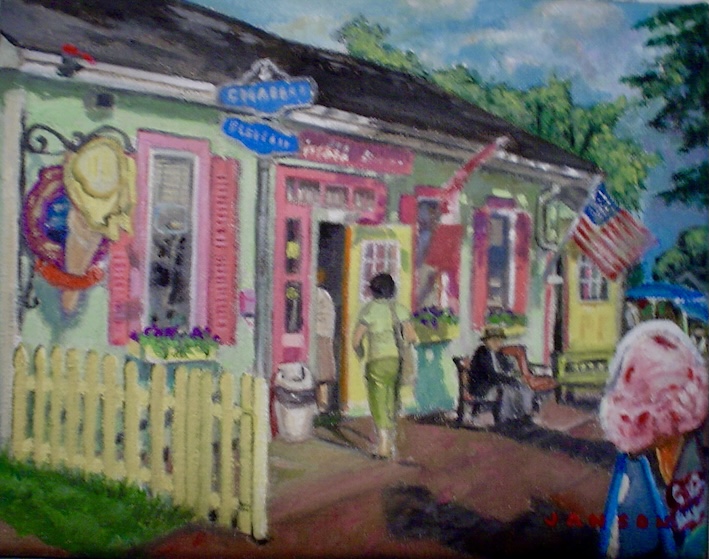
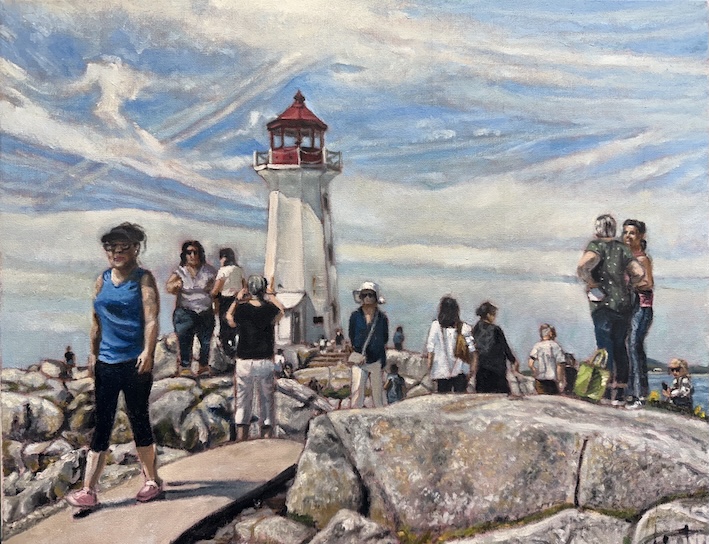
    Peggy, Oh Peggy! (2025) 16″ x 20″ Oil on Canvas

    My association with Peggy’s Cove happened quite by accident. I was there drawing one day, and before it was complete, someone was willing to offer me money for it. And so it went. When times got lean, in the summer I could get on my bicycle, travel the roughly 40 kilometres from Halifax, sketch for a few hours, and come back and pay my bills. I remember by the end of one summer I was likely the fittest I had ever been in my life, cycling 80 km a day and spending so much time outdoors. I had the time of my life.

    I remember the proprieter of the Sou’Wester running out of the restaurant when he saw me one day. A group of tourists were clustered around me. He looked at my drawing, paused a moment, then asked “How much?” He bought the piece and commissioned another drawing of his business.

    I got a kick out of the tourists there. I genuinely enjoyed their company. Generally, they were respectful and polite and interested in what I was doing. I still remember one person narrating their home video as they walked around shooting their video. “Oh, and what do we have over here? It’s an artist. Let’s see what he’s doing.” Coming down on my bike, I did get offers from some RVers for a ride back to Halifax, who would offer me refreshments en route. It doesn’t get better than that.

    I varied the drawings as much as possible. I may draw the lighthouse and rocks for an hour, then head over to the cove and draw the town. Both are iconic views. The Blue Jays used to celebrate their status as Canada’s national team, using a view of the Peggy’s Cove lighthouse as a stand-in for Eastern Canada, but many travellers are equally familiar with the view of the harbour.

    At one point I got the idea that I would track where these tourists came from, putting up a world map on-line with dots to indicate where these drawings were travelling back to. I liked the idea that those who acquired the drawings could see themselves as part of a global experience from this tiny community on the east coast. Somebody from the UK was looking at a similar drawing by the same artist as someone in Japan.

    While I have made many pencil drawings, I’ve only painted Peggy twice. The first time was in art school. My professor — Medrie McPhee — was surprised by my scene of the village, claiming that somehow I had found a different view that was “fresh.” I had made so many drawings of the village that I didn’t need to be there to do it. I did it entirely from memory.

    Recently my spouse told me that there was a call-out for artists to converge on Peggy’s Cove for a weekend this summer. I live too far away for that, but decided maybe it was time to make a second painting after all these years.

    While most people preferred my Peggy’s Cove drawings to edit out all the people, this time I wanted to celebrate them too. They were mostly just ordinary people from all over the world out having a great time. I think we all benefit by sharing our culture, and travel is one of the ways of doing that. I amused myself by wondering if any of the people I captured in the painting were actually named Peggy? Perhaps all the Peggys at Peggy’s Cove? (BTW… the village’s name likely comes from the fact that it borders on St. Margaret’s Bay. The short form for Margaret is Peggy.)

    Working from a recent photo, I was reminded of the amazing clarity of light there. The exception would be the afternoon fog that often rolls in and used to signal the end of my working day. The last time we were in Nova Scotia we went back there. I still enjoy being next to the sea, to experience the light, the sound of the gulls, the magnifient rocks, and yes, even the other tourists.

    If you like this post, why not subscribe? Just use the window on the black block somewhere on this page. Likes and shares are always welcome too.

  • No joy please, we’re British

    I’m totally addicted to the UK Sky Arts duo of Landscape Artist of the Year and Portrait Artist of the Year. As Frank Skinner, the original co-presenter of the shows said, “I love the idea that you can make great entertainment out of watching paint dry.”

    If you are an artist or would be artist, it is a masterclass in and of itself. I have made changes to my own process from watching this show.

    I feel sorry for the often amiable judges who no doubt endure ridicule and criticism for some of their decisions, albeit some of it deserved. That ridicule often comes from the co-presenters, who are sometimes baffled by their choices. Dame Joan Bakewell, one of the recent co-presenters, once suggested they may be trying to be the cool kids in their choice of winner. She looked incredulous at their pick.

    I couldn’t watch the final program of the 2024 season when a young artist named Brogan Bertie won the competition. The season concludes with the winner going off to fulfill a prestigious commission for some gallery or institution, usually for the sum of 10,000 pounds.

    Bertie struggled in the heat and the finals to capture a likeness, what should be the starting point for a successful portrait. He also appeared to have issues with perspective and proportion. Judge Tai Shan Shierenburg gushed how they had discovered an important new artist, when I think most of the world just recoiled, especially given it was by no reasonable means the best work of the competition.

    I just couldn’t watch Bertie take on the commission. It felt like a betrayal. I noticed on one art BLOG that they thought it was too early to bestow such a recognition on an artist that young, especially when what he was doing was not so unique. In each episode the sitter gets to chose one of the paintings to take home. In this final, with Andy Serkis and Lorraine Ashbourne posing together, the couple tellingly didn’t pick Bertie’s work.

    The format of the show is quite simple. In both cases a group of artists selected by a submission piece compete against each other in heats, allowed four hours to come up with a piece of work in front of the cameras.

    Each heat in both shows has one winner go forward to the semi-finals. Most choose to paint, but the show has also had print makers, collage artists and many who chose to draw in various medium, including fabric, charcoal and coloured pencil.

    In portrait artist, each episode the artists are broken into three groups of three to paint a specific celebrity sitter in a studio environment. Before a winner is decided, the celebrity sitters get to choose a portrait to take home with them.

    In landscape artist, the competitors move around Britain to paint en plein air. In addition to six chosen competitors, the landscape program also includes about 50 so-called “wild card artists,” who are present to paint nearby the official group. At each heat an additional winner is selected among the wild cards, then from that group one is chosen by the judges to join the official competition at the semi-finals.

    In both shows, from the semi-finals three artists are chosen to go forward to the finals, which also require an additional piece done with more time, kind of a homework assignment. The final winner gets the commission, of which a separate show is made about that process.

    The judges do say odd things sometimes. Last night we watched one of the older landscape series. Shierenberg has a well-known aversion to things he describes as “chocolate box,” including boats and (in landscapes) people. He uses the word “twee” often. This gets particularly challenging when they set the competition in harbours or areas with lots of people roaming around, such as the episodes set along the waterfront in Liverpool.

    In this particular episode, set at Chartwell House (former home of Winston Churchill) and its magnificent gardens in Kent, the sun was out, everybody looked happy, and the scenery was stunning. Surprisingly, one judge expressed disappointment that the watercolorist had not replicated the mood of her submission piece, feeling it could have been more creepy. Shierenberg took predictable issue with two figures in another painting that in my view gave it some scale as well as helped balance out the composition. Neither won that heat. To use one of their own overworked expressions, but what about a good honest bit of painting? What’s the point of plunking six artists plus another 50 in that kind of landscape then fault them for painting what they see and feel? One gets the distinct impression that they don’t do joy — after all, this is Britain.

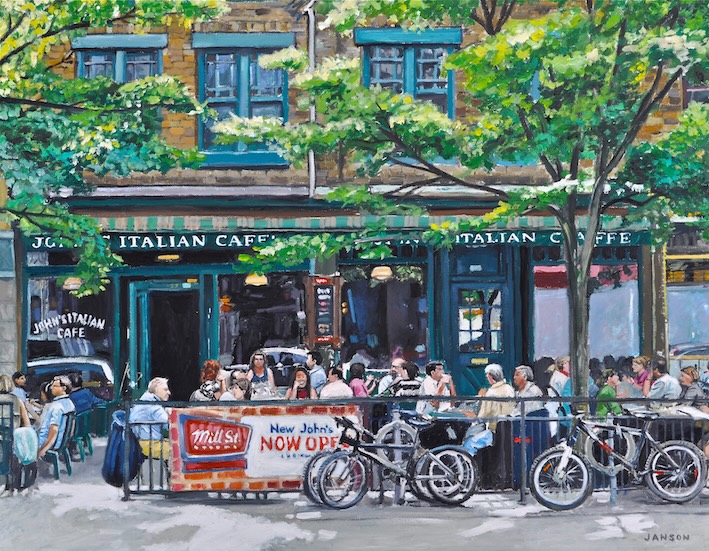
    John’s Italian (2011) Oil on Canvas (Private Collection)

    As Shierenberg was going on about the figures in the one painting, comedian Stephen Mangan humorously suggested that the painting was still wet, they could simply wipe them out with a cloth. Easy! I suspect Mangan had written into his contract the ability to take the piss out of the judges when necessary.

    These shows have been going for more than a decade now. It has crossed my mind that maybe they should be changing up the judging, but I do like the exchanges between the three judges: Kate Bryan, Kathleen Soriano and Shierenberg. They themselves are integral to the personality of the show and seem to have some self awareness when they cross the line into pretension.

    Of course it is absolutely silly for artists to compete against one another, especially when they use different medium. But hats off to Sky for bringing a lot of attention to the visual arts in Britain through these programs. It gets people talking about art.

    I have watched enough of the show now that I have a really good track record of predicting the winner of each heat, many of which I would choose myself.

    Surprisingly, despite the judges, sometimes the works that emerge are truly joyful. It may not be the choice of the cool kids, but it still speaks to many people. It doesn’t have to look like a chocolate box to be joyful.

    The other thing I like to remind my spouse, who watches it with me, is that we are only seeing the work mediated by television, not in the flesh. Most artworks looks very different in person, which is why you should still go to galleries. It also makes it more difficult for us to second guess the choices. But Brogan Bertie? Ugh.

    Speaking of landscapes, today’s painting from my archive is another from my series of cafes, this one from John’s Italian on Baldwin Street in Toronto. As an epidemic of loneliness spreads in North America, seeing people clustered together and having a great time is a tonic. You might even call it joyful (wink, wink). This painting was one of a series I did exploring Baldwin Street, which used to be my destination for lunch-time walks while working downtown on Adelaide Street East in downtown Toronto.

    In Canada you can watch both series (Landscape and Portrait) on Amazon Prime. There was also briefly a spin-off Landscape Artist of the Year (Canada) with Sook-Yin Lee. It debuted just before COVID. Say no more. You can find it on Tubi.

    Like these posts? Why not subscribe? It’s free. You’ll get a notification every time a new post goes up. And I promise not to spam you or sell the group’s emails on to any dark lords.

  • Searching for an audience

    What’s the point of making art if nobody ever looks at it?

    Yesterday I spoke about four big changes in my work within the last year. This is the fifth: starting the process of developing an audience.

    Sure, over the years people have collected my work (including the above piece) but I’ve never been able to take it to what I would conceive of as the next level. I’m wary of galleries that offer nothing but wall space, or worst still, charge you a fee for wall space. They do exist.

    To sell a piece of work you need to be able to tell a story both about the piece and the artist. That makes it much more interesting. Art can speak for itself, but its better if someone skilled helps that process along.

    The first strategy upon my “re-emergence” has been to respond to call for entries, and to anticipate such calls. Getting my work in front of curators is the name of the game, whether or not it leads to an exhibition opportunity. Yeah, I’ve already had polite letters telling me I didn’t make the cut, but to keep up the good work. Okay.

    That strategy includes finding sources of call-for-entries. They can be call-outs for competitions or for entry into shows both virtual and in person.

    Then there are calls for artist-in-residence positions. I noticed that Artnet posted a generous artist-in-residence position at a hotel in Mallorca. I dreamed about that for weeks.

    The Oshawa Art Association recently put out a call for artists to paint in their tent during the city’s annual Convergence festival. The association works hard to open up opportunities, especially in a heavily populated region with next to no commercial galleries.

    There is another site I visit regularly that looks at opportunities for public art commissions in the Greater Toronto Area, such as murals. I sometimes get overwhelmed doing a 30″ x 40″ painting, let alone a mural, but its nice to track what public opportunities are available.

    Sometimes these calls are open, sometimes they require a prior membership in a group or gallery, or sometimes it is just a straight fee for entering into a competition or show. While an individual fee may be modest, it can add up, especially when the fee is per item being entered. Usually the fees are in the range of about $35 (Canadian) for the artist. I noticed one exhibition opportunity that offered a maximum of three entries at a cost $105 with no guarantee you’ll be chosen to participate in the show. Ouch.

    Then there are the charitable opportunities, of which the cost to the artist is the painting or art work itself. By the time it is framed — and in some cases shipped — your direct costs can be in the range of about $150 or more to get in front of an audience. That doesn’t include your time. But it usually means someone will purchase the piece and hopefully take a greater interest in your work. These days I insert a promotional card in the back of the canvas to aid that process. The one drawback with charitable auctions is the bargain hunters can sometimes lower the value of your work. The price of your work is always based on what people are willing to pay for it, and a record of sales counts. Still, this is something that I have been pursuing, especially worthy charities I support that may also bring out the kind of crowd that values and collects art.

    Years ago I participated in an event called “Paint The Town,” which was a fundraiser for the local arts centre in Annapolis Royal in Nova Scotia. What was unusual about this one is that the proceeds were actually split 50-50 between the charity and the artist. Back when I was living in Halifax, it meant my costs of travelling up the valley and staying overnight were offset by my share of the sales. The event itself involved artists working en plein air throughout the town, then their works were transported wet in pizza boxes back to the gallery. At night there would be a silent auction. The organizers also made sure to serve us a dinner. Charities often forget that some of the worst compensated people in the arts are visual artists. One estimate I recently came across was the average compensation works out to be $19 per hour in Canada (I find it hard to believe it would even be that much). Paint the Town is still going more than 25 years later using that model.

    Sometimes the nod to the artists is much more modest. I used to participate in the Little Art Show, a fundraiser for the Riverdale Art Walk in Toronto. The organizers would send you a blank canvas, the show requiring all submitted pieces to be 7″ x 9″. They put on a terrific event in the BMW dealership overlooking the Don Valley Parkway but it eventually fizzled out for reasons unknown. Maybe the regular crowd had more than enough 7″ x 9″ paintings.

    While filling out the forms for call-for-entries (there are always forms), I did note that often there is a request for a website address. It had been something I had been avoiding.

    Recently reading Austin Kleon’s upbeat book Show Your Work I noticed the emphasis he placed on not only having a site, but posting to it daily.

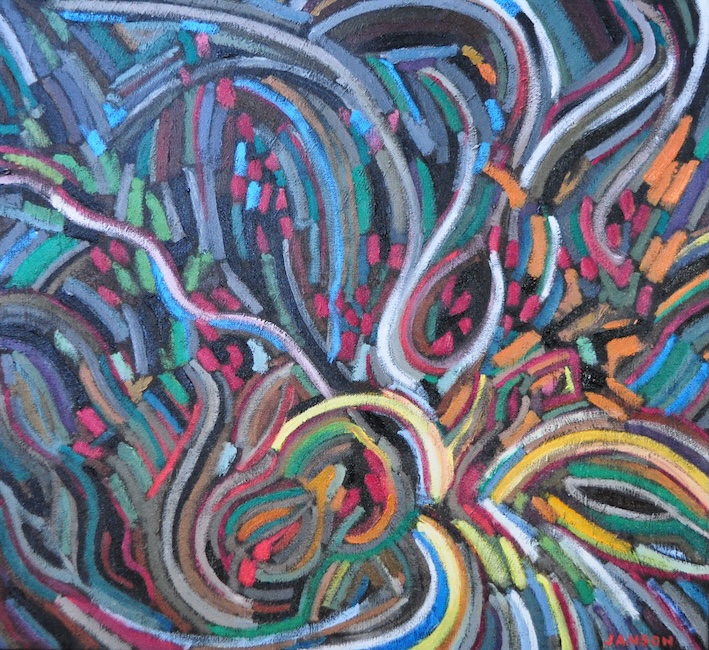
    Untitled (2013) Oil On Canvas (Private Collection)

    I used to write a BLOG in my last day job which attracted an influential audience and opened the doors to connections with new groups in the community. In this new endeavour, I didn’t want to put up a static site with a bunch of my images on it. I wanted it to tell that story both about the work, the artist and my relationship to the art community. I also wanted to be a source of information for both curators and other would-be artists as to what being an emerging artist (or re-emerging artist) is like. It’s hard, but as Kleon urges, just keep going. If you have been following this BLOG I haven’t quite hit the daily posting mark, but it has been regular.

    A friend of mine is convinced that galleries are only looking for young emerging artists. Certainly the ones we saw at Art Toronto fit that category. The inference is that I might be wasting my time. Seniors are the last group where discrimination appears socially acceptable, so he might be right.

    Looking at the initial data on hits for this BLOG, including where in the globe they are coming from, it is both encouraging and discouraging. But I know from the last time I blogged it takes some time to develop an audience, and when you do, it can be very rewarding. I’m hoping my past experience will accelerate that process at least a little.

    It’s great to make connections, including, I noticed, two individuals who have returned to this site from Norway. Us northern artists need to stick together!

    One of the things I did remember from last time is to ask your readers to subscribe, to assign likes, and if they can, post a comment (BTW: Kleon disagrees). I have also sent emails and texts to individuals who I thought might like what I’m doing and subscribe. Some have, some haven’t.

    What’s the end goal? I would eventually like to work with a commercial gallery. Listening to a panel of emerging artists at Art Toronto, it was interesting to hear them speak about the kind of relationship they had with their galleries. Again, its about more than just wall space.

    So, that’s the plan. We’ll see what transpires.


    If you would like to be notified when new posts come up, please subscribe (for free) using the black box with the window on it. And don’t forget to visit the on-line gallery: its either below (if you are on a phone) or above (if you are accessing this via a computer). Beyond the notifications from subscribing, you won’t be spammed by me, nor will I ever sell on the email list.

  • Madly off in all directions

    There were a few things that happened within the last year that made a big difference to my art making.

    The first was about commitment. When I first retired from my day job, I seemed to have gone madly off in all directions. I wanted to travel more. I wanted to improve my guitar and singing skills. I wanted to learn another language. I wanted to read more. I wanted to write more. I wanted to exercise more. I wanted to watch more movies from my collection. And I wanted to paint more. But there was no set order for any of this.

    Ever since I was a kid I made drawings. There has always been something to compel me to make pictures even though my eyes were always wide open that this was a way of life and not a viable career option. I have to say I’m allergic to poverty. Hence the day job.

    One of the complaints about art schools I have frequently heard is they never prepare students for what happens next. The answer is likely that the faculty themselves likely don’t know. I don’t know if that has changed at all in the decades since I graduated, and with more and more graduates, it begs the question how will all these people succeed, or is the policy to educate artists much like spaghetti — throw it at a wall and see if some of it sticks.

    Somewhere along the line I decided that I would really give it a go, but if I failed, that was okay too. I planned out my week so I would spend three to four hours most days in the studio, knowing there are days when life interferes.

    The second thing that changed everything was a light. Previously I had worked on canvases in my shed-studio (I’m thinking of calling it the “art hut”), taken them outside, and realized they needed a lot more work when seen in the daylight. With LED technology one can purchase a light that will better illuminate the work and give one the option of seeing it in a number of variants of white light. That was huge for me. Now I can see. Thank you Canadian Tire. I am no longer profoundly disappointed when I carry a canvas outside.

    The third is how I chose to paint. I used to work on one painting at a time until it was completed. I don’t do that anymore. I found, especially on larger paintings that required more time, that I often tired of looking at the same image, and would often lose perspective on the work itself. Problems seemed intractable.

    Now I like to work on four or five canvases, rotating them each day. That means my eyes are refreshed when I come back to one of the four or five paintings I have on the go. This also allows me to think about how those paintings respond to my various interests.

    Before I would work on the piece and think of it as the beginning of a series, then have a totally different idea by the time I got to the next painting. So much for the series. I bounced around like I had an attention deficit.

    I can now see themes emerging from my work, including perspectives on travel, a love of painting bicycles (thank you perhaps to the late Greg Curnoe) and even some experimentation with portraiture, likely from watching too many episodes of Portrait Artist of the Year. I also frequently paint cafes as they seem to be the last bastion of humanity in a world where we’re increasingly becoming isolated from one another by our dastardly phones.

    Arles (2025) 12″ x 16″ Oil on Canvas

    At present the four paintings I have on the go are:

    1. A commentary on Peggy’s Cove (Nova Scotia) and the impact of tourism. By the way, I love talking to tourists. When I finally post this one I’ll get into my long relationship with that place. Likely the commentary is not what you think.
    2. A painting of a group of tourists who are using their phones to mediate their view (in this case, of Koblenz, Germany) while seeming oblivious to the magnificent tree they are under (see above in the photo of me in my studio, um, art hut).
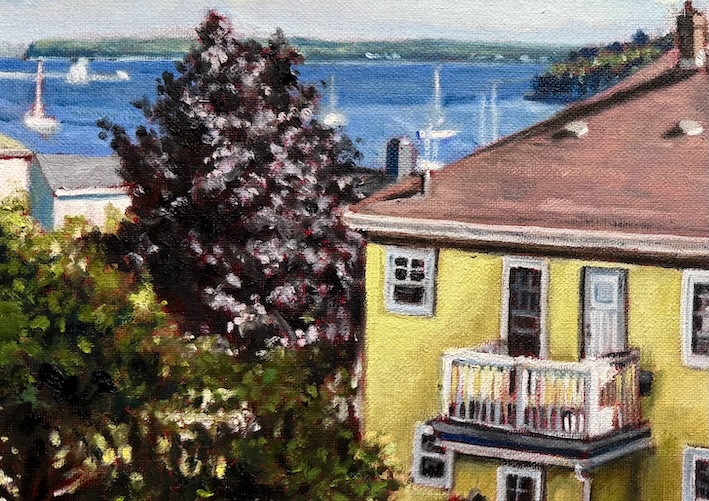
    3. A view from the town of Lunenburg (Nova Scotia) towards its harbour. I have to say that I was drawn by the sense of depth in the image as well as the late afternoon light. This is another location I have had a long relationship with. Its part of my history.
    4. A self portrait. Haven’t done one of these in many years. This is at the earliest stage right now — just roughed in with the ground showing through — and presently I look quite mad.

    By rotating them it keeps my eye fresh but also gives me time to reflect on what these paintings are really about. What is the story?

    The fourth thing I have really made a concerted effort on is to look at the work of others, both historic and contemporary. Sometimes this has the effect of making we want to give up altogether — I’ll never be able to paint that well. Other times it makes me think further about how I’m approaching these images and makes me want to work harder.

    A new focus on my work, a brand new work light, rotation on my easel, and looking at the work of others. That’s what has been driving me for the past year. There is a fifth thing, which I will talk about soon.

    Don’t miss another post! Use the window on the little black box and subscribe. It’s free. I won’t spam you (beyond the post alerts) nor will I sell the list on to people who are looking to market S&M toys or the latest diet fad. Honest! Feel free to share, post a like or show me some sign that you are there too. Also, if you are not big on words, I am posting much of my new work on the Gallery page, which if you are browsing on a phone, is at the bottom of the page, if browsing on a computer, at the top of the page.

  • Almost Canada’s Capital

    The first time I ever went to Cobourg, Ontario was for supplies. My friend Dave had invited several of his high school pals (including me) to spend the weekend at his family cottage near Rice Lake. Being teenagers, it wasn’t long after we got there that we decided we needed some stuff. The rockin’ tunes and football games amid the cow patties would not be enough.

    Over the years Cobourg keeps drawing me back. The town has a little over 20,000 residents — not exactly a sprawling metropolis. Yet at one point its promoters thought it would be an attractive location for Canada’s National Capital, especially with the opening of Victoria Hall in 1860 by the Prince of Wales (later King Edward VII). Instead Ottawa won that honour despite a Cobourg lawyer, the Honourable James Cockburn, being among the so-called “Fathers of Confederation.” What could have been!

    It may not have been chosen as the capital, but the population of the town swells on Canada Day when many people are drawn by its sandy beach, the live performances at the Victoria Park bandshell, a midway on the pier next to the harbour, and a large craft fair that borders the waterfront.

    When Canada very briefly had its own version of the UK TV series Landscape Artist of the Year (you can still see the series free on Tubi) one of the locations they chose was the Cobourg waterfront.

    For me I also frequented the community in the past for my work, negotiating labour contracts at the hospital and with the county’s ambulance services. Cobourg is the largest municipality in Northumberland County. The union I worked for was also a supporter of Cobourg’s Horizons of Friendship, likely the only Canadian international development agency based in rural Canada. Horizons does development projects throughout Mezzo-America and invites its patrons to travel with them each February to see their work first-hand. I travelled to Nicaragua and Guatemala to witness the amazing contributions Horizons was making to people in those countries. Those trips were life changing.

    Victoria Hall serves as the town hall, a music venue, and up on the top floor is the Art Gallery of Northumberland. Up until I saw the call on Facebook, I had no idea it was there atop the most notable building in the downtown. It doesn’t have much visibility from the street.

    George Street (2018)11″ x 14″ Oil on Canvas

    The call was from the gallery shop, which had the idea to include art sales among its offerings. It seems a bit weird to sell art work next to an art gallery, but what the heck! I responded, and they accepted a painting I had done of Victoria Hall — what else?

    When it was first received, the manager of the gallery shop didn’t recognize the location until I pointed it out to her. “It’s here.”

    That remained in the gallery gift shop for about six months, the gallery telling me there were nibbles but no committed buyers.

    I often try to produce work that reflects the local community when I know I’m going to show there. I likely have painted more images of Saint John, New Brunswick owing to a fundraiser for a local hospice in that city. I had a crop of Oshawa paintings I showed at this city’s Little Theatre. I wanted to do the same for Cobourg.

    What I liked about the image is that there was a looseness in the paint that often eludes me. It’s actually harder to be messy! The perspective on the hall was also different — most images of I have seen are either taken from the harbour or from King Street. Likely one of the reasons why it was not immediately evident to the shop. The view this time was looking down George Street, not far from where Horizons is located. I might have been coming from there at the time.

    Lest something actually happen with my relationship with the gallery shop (it didn’t), I produced several more smaller images of Cobourg, of which I have a supply of 8″ x 10″ giclees still buried somewhere in my studio.

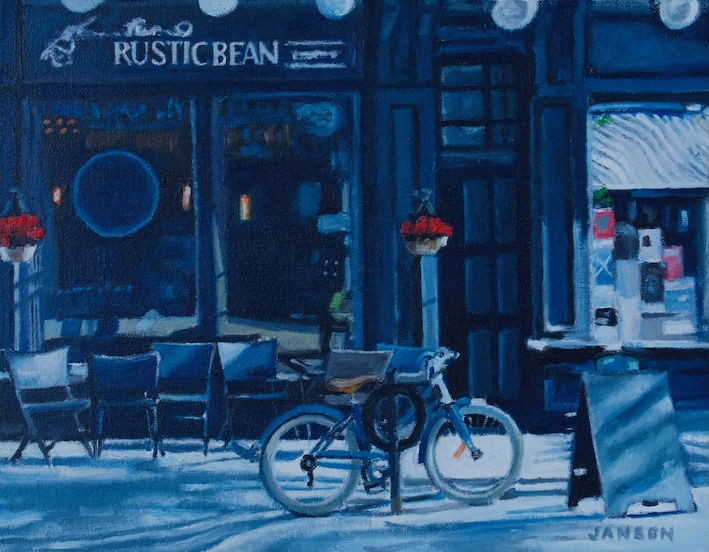
    Rustic Bean (2018) 11″ x 14″ Oil on Canvas (Giclee on canvas available at 8″ x 10″)

    If you like this post, please give me a like, or better yet, subscribe. This is a new BLOG and it would be great to see the audience grow. You can also leave a comment — be aware that they have to be approved to filter out the spammers, scammers and wham bammers , so it won’t show up instantly.

  • Circle of Fantasy

    Women make up 80 per cent of fiction sales, according to statistics from an opinion column in today’s New York Times. “The fiction gap makes me sad,” writes columnist Maureen Dowd.

    Me too. It also explains a lot.

    Dowd quotes author (and man) Richard Babcock: “Not to blame the current cultural landscape on Ronald Reagan, but I think the obsession with money and wealth that arrived in the 1980s may have encouraged the false idea in men that there was little to learn from a novel.”

    Fiction goes a long way in helping us see “the other.” You can’t read a book without stepping into the shoes of the author’s protagonist for an extended period of time. Is it any wonder that we seem to have an extreme shortage of empathy these days?

    This divergence in our culture may also go a long way to explaining why we are seeing a widening gap in how women and men vote.

    I can’t say this surprises me as much as confirms my worst fears.

    And I don’t think its limited to published fiction. I’ve noticed during visits to most large public art galleries that the majority of visitors are also women, and I suspect many men there were dragged along by their partner (except me and the other shaggy-looking art-types, of course). Tip for single hetero men: maybe you should hang out at the art gallery a lot more.

    It used to be the oldest and funniest pick-up line cliche: “Would you like to come upstairs to see my etchings?” That meant: “would you like to come up for some sex?” The likely (and thankful) disappearance of that cliche owes its explanation to the fact that men likely don’t have any etchings anymore, and quite possibly, he may not know what an etching is?

    I was once romantically linked to a woman who gave me a gift of two etchings. She broke up with me shortly after, which made me wonder whether she was just helping me along on the road to the next romantic encounter.

    In 2007 I attended the summer leadership school put on by the National Union. Among the presenters was a singer-songwriter by the name of Tom Juravich, who spoke about how using the tools of culture had more ability to “stick” with the public than simply presenting the facts of the case. I took that to heart, including sponsoring a theatre company who I assisted to tour Ontario doing readings from a play about Canada’s tainted blood scandal. At the time a private for-profit company was setting up in areas of the province where individuals may be more desperate to be paid for their blood plasma. It would be direct competition for the not-for-profit Canadian Blood Services and posed debatable risks of contamination. The for-profits were setting up in direct conflict with the recommendations of the Krever Inquiry set up to look into Canada’s tainted blood tragedy. After our tour, all three political parties agreed to shut the for-profits down.

    After that successful campaign, rather than be patted on the back, I was put on the hot seat, my immediate boss at the time likely having never attended Tom’s session at leadership school. Who gave me approval? The union board. Where did the money come from? The union board and NUPGE. I had to point out that unlike many campaigns that spent much more of the union’s funds, this one was a success, sweating out the grilling by two managers who clearly didn’t get it, or maybe didn’t want to get it. Our unionized members at Canadian Blood Services certainly did.

    On that tour we met with many tainted blood survivors, many of them hemophiliacs. They had their lives upended from the lack of diligence around the use of tainted blood from the United States exported to Canada. It turns out that much of that tainted blood came from the American prison population. The play catalyzed the survivors to speak up. Just in case the politicians still didn’t get it, we also did readings at Queen’s Park and the Canadian Parliament.

    Circle of Fantasy (1978) Ink and Prismacolor Pencils on Paper.

    The arts can make you feel deeply about issues, helping you to see something from different points of view.

    When I was in high school I was invited to submit an entry to a TVO series called Electric Essays. I entered a slide show (with musical accompaniment) called Selling Out To The Bare Walls. It was about the sad dehumanization I found on Yonge Street, the central commercial artery running through the city of Toronto. There were no words, only images. It was not the finest of times for the city’s grand old street with blocks of peep shows, strip bars and porn cinemas. One of the street pictures I took (with permission) was of a young man hustling to get patrons into a strip bar. That picture stuck with me, and later I did an ink and Prismacolor drawing from that image.

    To me, it was more effective that a dozen editorials.

    Want to read more? Subscribe — it’s free. Just use the black box on this page. You’ll get a notification every time a new post goes up. Likes and comments are always welcome too.

  • Way way way back

    I used to walk by here all the time when I grew up in the south end of Ottawa. The marina was on Mooney’s Bay, somewhere between the beach and the Hog’s Back falls, where the Rideau Canal picked up for its final run through to the Ottawa River.

    At the time in the mid-to-late 1970s I was studying at the University of Ottawa and working at the Fulcrum, the English-language student newspaper that used to print back-to-back with La Rotonde, the French-language counterpart. At the time there was an artist who regularly contributed cartoons to the paper consisting of tiny little dots made with a rapidograph pen. I was hooked watching him at work.

    I was taking drawing classes in the University’s Art School and decided that this might be something for me. The only thing was, I would make these drawings on a far larger scale and would eventually add colour with Prismacolor Pencils.

    I remember literally laying down on the floor of my parent’s basement and making endless dots while letting my mind drift sideways. The dots would go over a loose pencil drawing I used to navigate the image, any traces of pencil erased once the ink had been applied. It helped to have music on. Looking back, I don’t know how I did it. One would think the repetitive strain alone would do in my hands, let alone my head.

    Hog’s Back (1978) Ink and Prismacolor Pencil on paper.

    While most of the image came together this way, I did make exceptions where I could wildly make a line, such as the tree branches in the image.

    I made quite a few of these drawings, some making their way to two commercial galleries which were intrigued, but really didn’t know what to make of it. Neither ever sold a drawing for me and I got left on the hook for the cost of framing. It was clear that the economics of spending a week or more on one of these just wasn’t there.

    In the end, I didn’t get my BFA from the U of O, but through the Nova Scotia College of Art and Design, where I embraced oil painting, requiring a very different approach to my art making. I literally had to re-learn how to draw using a paint brush, although having made few lines and instead embraced tone in these early drawings, the transition was not as difficult as I had first feared.

    Recently I bought some watercolour pencils that really reminded me of this period. But unlike the prismacolor pencils, these require water and once wet, look more like a watercolour painting. I will post one of these once I get over my present fear of making new marks this way.

    Help me build my audience! Give me a like, subscribe to the blog using the black box on this page (it’s free and always will be) or leave a comment. A comments are moderated, so it may not appear right away.

  • Humming Petula Clark

    There was a lot of renewed attention paid to celebrated Canadian pianist Glenn Gould after he passed away in 1982. One of the biographical details I recalled was his habit of driving around while humming a Petula Clark song in his car. He actually did a radio documentary about this, documenting a drive to Thunder Bay from Toronto in search of the technical qualities of a singer he called “Pet Clark.”

    I’m not sure why that came to me at a time I was experimenting with more abstract forms of painting in art school, perhaps I was playing some of Gould’s work in the studio at the time? His recording of Bach’s The Goldberg Variations was among my new collection of CDs. CDs — how exciting! Or perhaps I was once again linking music to visual art. Like many artists, I can’t paint without some form of music playing in the room.

    A larger work, this painting was towards the end of my time at NSCAD. Short of money, I started painting on linen, finding it an interesting substitute for canvas. Linen cheaper than canvas? It is if you are buying sheets from the army surplus store around the corner from your one room apartment near Agricola Street in Halifax.

    Glenn Gould Driving Around Toronto Humming A Petula Clark Song (1987) Oil on Linen. About 60″ x 40″ Private Collection.

    This was actually my second piece on linen. The first I had gesso’d over and painted conventionally. This one involved painting directly on the linen. No gesso.

    I found it really worked with the softer side of my work. No hard edges. I liked the way the paint floated on the surface.

    I don’t spend a lot of time on painting titles, but it helps me to delineate them a little better than simply applying numbers or universally applying “Untitled” to them. Art history is littered with examples of confusion over badly titled paintings, or artists who had given more than one title to the same painting.

    With my abstract art, the titles are often a clue to what I was feeling when I made the painting. They often bring a smile to people who read titles, as if I gave them a key to unlocking the work. Maybe I did?

    This one? It’s called Glenn Gould Driving Around Toronto Humming a Petula Clark Song. It may account for the map-like parts of the painting, and I swear, some people can see traffic.

    The question is, looking at it, should one be playing Glenn Gould or Petula Clark?

  • Mystery Performance

    One of the most moving live performances I’ve experienced was by a duo for whom their identity remains a mystery to me. He played a stand-up bass, using a looping machine to build up the sound for each song. She sang with the confidence of someone with extensive classical training. I found it the kind of emotional experience that only the arts can achieve.

    I had come across the pair in 2019 at a free festival in a Brussels park opposite the Royal Palace. I looked for some indication of who they were (such as a posted sign with a line-up for the festival), assuming that the worst case scenario would be I could look it up later, knowing the date and location of the performance.

    No such luck.

    Years later I started thinking about the relationship between music and painting. I had previously written about the family that tried to figure out what one of my abstract paintings represented as their toddler clearly demonstrated an understanding that it was about form, texture and colour. I wouldn’t recommend that you let your toddler rub their fingers across anyone’s painting, but I appreciated the nod to the work.

    I often talk about how painting can be like music — it doesn’t have to be about something. When people listen to an instrumental piece, it make evoke feelings or remind them of something, but it is essentially abstract. They may enjoy the melody by itself, or the combination of melody and rhythm or even the way the arrangement works. Yet nobody comes away from a Beethoven symphony and says, yeah, but what did that mean?

    I recall seeing a video posted on-line of Jeff Tweedy (Wilco) doing a cover of a Black Eyed Peas song. Emphasizing the lyrical content, it made the song look ridiculous. For much of pop music, its not about the content of the words but about all the factors that come together to make a song enjoyable, ridiculous lyrics or not.

    That can also apply to representational work. While some people may be absorbed with the representation, often the real effort is about how the paint sits on the canvas. After a period of doing abstract art, it changed how I painted when I returned to more representational content. I didn’t want my paintings to look like a photograph. I wanted them to be about the paint.

    A Concert in Brussels (2025) Oil On Canvas. 16″ x 20″

    Artists have painted musicians throughout history. I thought about the duo I saw on stage in Brussels and decided to render it from the photographs I had taken. The light and smoke machines made for a very abstract visual experience, a rare experience for a band that was not a headliner (don’t get me going on the insecurity of headline acts who deny the tools at hand to enhance the performance of the opening act).

    This is not my normal jam, but I am trying out new genres as part of my return to full-time art making. But I still wish I knew who these two performers were.

    If you like this post, please give me a like, or better yet, use the buttons below to share it on social media. Or leave a comment – the platform I use requires me to approve it, so depending on what I’m going that day, it won’t be immediate.

  • Oh Canada Project

    It wasn’t long after signing up with my local art association that I got a call for entry from the Station Gallery in Whitby. “Great,” I thought, this would be a chance to show locally. “How much time do I have?” It was Tuesday. The deadline to submit on-line a digital image and form was Friday. Yikes!

    It was clear from the call that this wasn’t the first notice, just the first notice to me. Could I do something within three days? Given I initially only had to submit a digital image of the work, an oil painting would likely be dry before I had to physically get it to the gallery. That was doable, especially after watching Landscape Artist Of The Year, the UK TV series where artists were given a mere four hours to create a painting. I would have more time than that.

    The call was for The Oh Canada Project, which was wide open to artists to submit something that either had the Canadian flag in it, or that was inspired by it. Given the anger generated by Donald Trump’s threats to our sovereignty, this was timely.

    But the question is, what would I do?

    I thought back to 2022 when we decided to take a tour of Juno Beach, the World War II landing zone for Canadian soldiers on D-Day.

    We had made arrangements to take a small tour to Normandy, arriving via the Paris Metro around 6:30 am near the Arc de Triomphe to meet up with our guide. At first I was amazed to see dozens of people there pre-dawn, only to realize that almost all of them were Americans headed for Omaha Beach. We were instead going to Juno. It turned out that there would be only six of us on this tour, our travelling party of four plus a former St. FX professor and his partner.

    Juno Beach D-Day Canada
    The Distant Shore (Juno Beach) (2025) Oil on Canvas, 11″ x 14″

    This is the view that met us upon our arrival at Juno. It was a clear day. We stopped across from a small plaza ringed by an arc of flag poles surrounding a concrete pillar. On that pillar in English and French it was written: “Here on the 6th of June 1944 Europe was liberated by the Allied Forces.” Among the flags, on the far left, was Canada’s.

    The plaza sat adjacent to a building now labelled Canada House — a private home that had the distinction of being the first house to be captured on D-Day by any of the Allied Forces. We were told that it is still under ownership of the same family. About 100 Canadian soldiers lay dead or wounded by the time it was captured from the Germans, who had used it to defend against the invasion. Jonathan, our guide, told us that it was still common for Canadian veterans to return there and apologize for the mess they made. How Canadian! Retired members of the Queen’s Own Rifles had even donated money for its restoration after the war, knowing its historical importance.

    It was an odd feeling being there knowing what had happened at this location. There weren’t many people around — the biggest group of Canadians we came across was to be later at the modest interpretive centre built with donations from the private sector. We were the last of the major combatant countries to do so.

    Oddly, the plaza had these colourful planted pots spaced around the monument at odd intervals. It would be interesting for the locals to live in such a place, to remember what happened but also to do what the Allied forces had intended for them to do — to live on in liberty. Maybe that was the point of the pots. Amid all these dreadful memories there was still colour and life.

    The monument itself looked as if it has arisen from one of the concrete bunkers built along the shore, some since covered by the ever-shifting dunes.

    What few people that were there walked around individually, as if lost in their thoughts. It was quiet except for the surf rolling out on the beach.

    The tour gave us an in-depth perspective of Canada’s efforts on D-day, including visiting this plaza. We toured the interpretive centre a short distance away. We also were taken to the furthest point the Canadians had reached inland on D-Day (thanks to their foresight in bringing bicycles, they had gone farther on June 6th than their UK or US counterparts). We also were given ample time to wander through one of two peaceful military graveyards where so many Canadians remain so far from home. Our last stop we were taken to a site where a number of Canadian soldiers captured on D-Day had been executed by the Germans against the wall of a church. Those responsible were convicted of war crimes, but eventually pardoned after a short time spent in prison. Pictures of those Canadians are still mounted on that wall.

    My painting of Juno Beach is on display in the lower level of The Station Gallery (Whitby) with about 50 other contributed works by Canadian artists until October 19th. Admission to the gallery is free.

    If you liked this story, feel free to share it on social media using the buttons below. A “like” is always appreciated.