Rick Janson Art Studio

My Art Journal

  • Little Stories

    When I was studying at the University of Ottawa I used to regularly cross the Rideau canal to the National Gallery of Canada, which was then located in a former office tower on Elgin Street.

    Among the works I spent a particular amount of time with were those of the 18th Century Venetian painter Canaletto (1697-1768). Painting in a style known as Vedutism — a genre known for its complex cityscapes and urban life — Canaletto was popular with English Aristocrats on the Grand Tour of Italy. A prolific painter, much of his work ended up in Britain thanks to British Consul Joseph Smith, who bought Canaletto’s remaining collection posthumously for King George III.

    Canaletto’s (a nickname meaning “little canal”) real name was Giovanni Antonio Canal. His father was also a painter.

    What I really liked about his paintings, aside from the incredible level of detail in them, was the vibrancy of the city life depicted therein. It didn’t suprise me that Canaletto cut his artistic chops as a scenic painter: the figures in his work look like they could be actors in an opera. The figures not only give scale, but breathe some life into the scenes, giving us some idea of what Venice may have been like during Canaletto’s time.

    Canaletto did a lot of plein air painting. There is also debate about the extent that he used the camera obscura to obtain the accuracy of his landscapes.

    Canaletto inspired other like painters who did a brisk business painting for English tourists. Artists need to make a living. The National Gallery room with the Canalettos was also filled with other like images from the Venetian school. Having spent time in Rome and London, Canaletto’s connection to Britain also influenced artists such as Constable and Turner, the latter considered one of the fathers of modern art. We do stand on the shoulders of those that went before us.

    The Tree (Koblenz) (2025) 30″ x 48″ Oil on Canvas.

    In yesterday’s post I spoke briefly about debating whether I was a figurative artist or a landscape artist. But really, going back to those Canalettos I can see where this all got started for me. I do like to put figures in the landscape (contrary to the preferences of some art critics), and as you’ve seen in some recent posts, they can be the landscape itself.

    Today’s image is no exception, the landscape is about a remarkable tree, but the figures are much more interested in the distant landscape. It was taken from a stop in Koblenz, Germany, on a trip down the Rhine River from Basil, Switzerland to Amsterdam, Holland. We took a cable car up on the bluff on the opposite side of the river overlooking the town, where I came across this scene.

    While the view was spectacular, I was taken with the view of those taking in the other view. The father taking away the bored child. One reaching for a camera. Others aiming their phones off in the distance. Two sitting on the chairs with their feet up on the rail. There are multiple little stories here.

    By the way, if you are interested in the history of the Grand Tour, I did come across an amusing 2006 DVD series by art critic Brian Sewell where he recreates the journey of the British Aristocrats through Italy. Sewell weeps at the catafalque of Michelangelo and demonically scoffs at lesser works in churches and galleries that the grand tourists would have also likely seen in between what he describes of their insatiable sexual adventures. Sewell even includes his own anecdotes, telling the story of he and his companions scraping their vehicle on a narrow roadway between two buildings, then quickly realizing their only exit was to drive the vehicle down a steep set of steps. Sewell speaks in a very strange and pompous style that has been described as having “some intonations of Vita Sackville West.” As an art critic, he was considered “deeply hostile” to contemporary art, trashing Lucien Freud and Jenny Saville in the series despite no apparent connection to the subject matter. We were totally addicted to this series and sad when we reached the end. Sewell passed away in 2015.

    Don’t miss another post! Subscribe using the black box on this page. Subscriptions are and forever will be free. To view my gallery of recent art, click here.

  • After 950 kms, crrrrack!

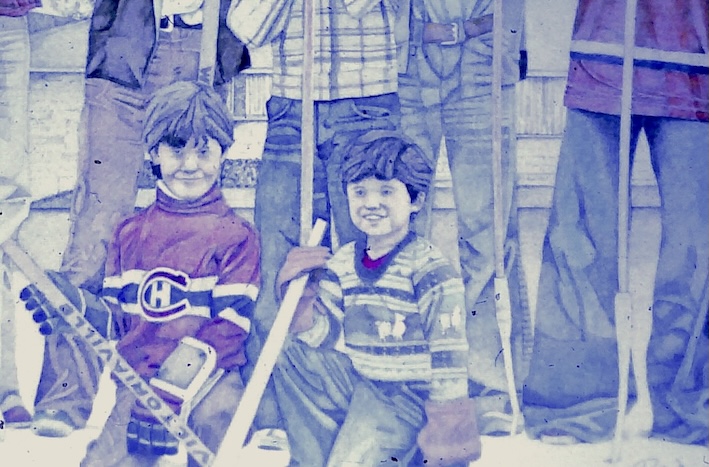
    I don’t know why I chose to do this drawing back in the mid-1980s. Being a long-suffering Maple Leafs fan, I must have choked colouring in those red Habs jerseys.

    I think it may be the largest drawing I ever did using a rapidograph pen and Prismacolor pencils. Unfortunately back then I didn’t get the importance of recording details such as a drawing’s size.

    The picture had been displayed for some time in a commercial gallery attached to the Ottawa Simpson’s Department store. Alas, there were no takers back then.

    Amazingly, despite the huge sheet of glass in the frame, it made it intact when I first moved to Halifax from Ottawa. The day of my arrival, I had placed it gingerly on the sofa, thinking about hanging it above the furniture. Then a friend arrived, and decided to sit on the couch without noticing that there was a large framed picture on it that almost covered its entire width. He leaned back and crrrrrrack! The picture had made it about 950 kilometres unscathed, but couldn’t make it another foot or two on to the wall of the apartment I shared. Ugh.

    The picture did get new glass, and I recall somebody in Nova Scotia eventually purchasing it for a modest sum. No doubt I was inspired to have someone take it off my hands rather than have to move with it again. I have no idea what has since become of it (if you have it let me know).

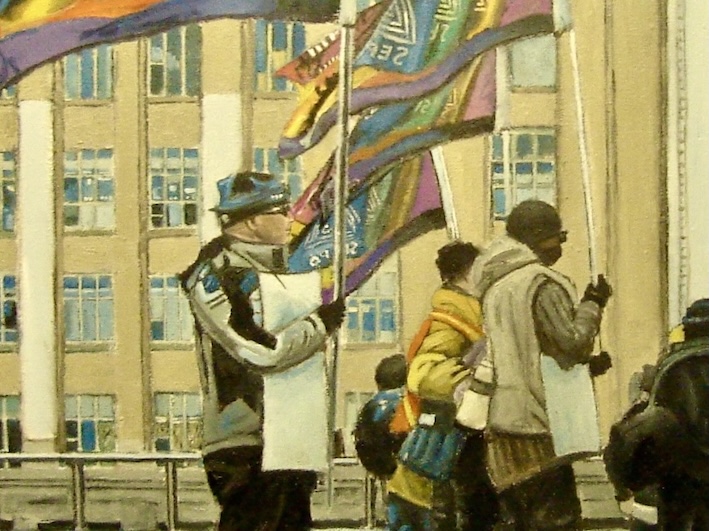
    The Habs 1987, 30″ x 40″(?) ink and Prismacolor pencil on mat board.

    This is likely one of the last drawings I did using the ink dots. I like the fact that I had simplified the background, keeping it in black and white while colouring the kids in the picture, propelling them forward.

    The photo would have originally been taken in my south Ottawa neighbourhood, the high school kids being my friends back in the day. As I recall, the smaller kids wanted to join us in a pick-up road hockey game. Afterwards I took a photo. It seemed like a quintessential Canadian moment. The original image, while never the best quality (the overexposure may have accounted for the lack of detail in the background), did call out for something more to be done with it. It summed up much of my youth, having played ball hockey on every street and parking lot we could manage with whoever was around.

    One of my friends in the photo went on to become a teacher in Texas. Another became Ontario’s first and only child advocate.

    I’ve been going through a lot of my old photos lately, thinking about taking the autobiographical subject matter in my paintings a bit further back. It does pose some interesting opportunties and challenges, including working with that strange saturated pallette of early colour photographs, or even yet, figuring out how to translate images from black and white sources. Do I make up the colour, or do I paint it using only tonal values? Or do I paint it using a saturated retro-colour palette? Hmmm.

    The more I look at this work I also am beginning to wonder whether my interest is in the landscape, or whether my direction should be more figurative?

    Don’t miss another post! Subscribe using the black box on this page. It’s free now and will always be free. What else can you get for nothing these days? Want to see some of my more recent work, click here.

  • I Will Flow

    I was walking my dog when I got the idea. We were tramping along a stream in a wilderness area amid the autumn colour. The way the water flowed over and around the rocks (and the dog), it looked very abstract to me as it reflected back the colour of the forest. I thought about paint being a liquid before it dries, and that perhaps it might be worthwhile applying it as if it were part of a stream, much as I was seeing that day.

    The funny thing about creating abstract forms of art is that somehow all these paintings tend to come back to a representation of something for me, some more than others. There have been paintings I’ve worked on, absolutely sure that nobody will figure out where the image source came from, then upon standing back, seeing clearly the image I thought I had left behind. Perspective is everything, and it is why one needs to frequently get some distance on your own work.

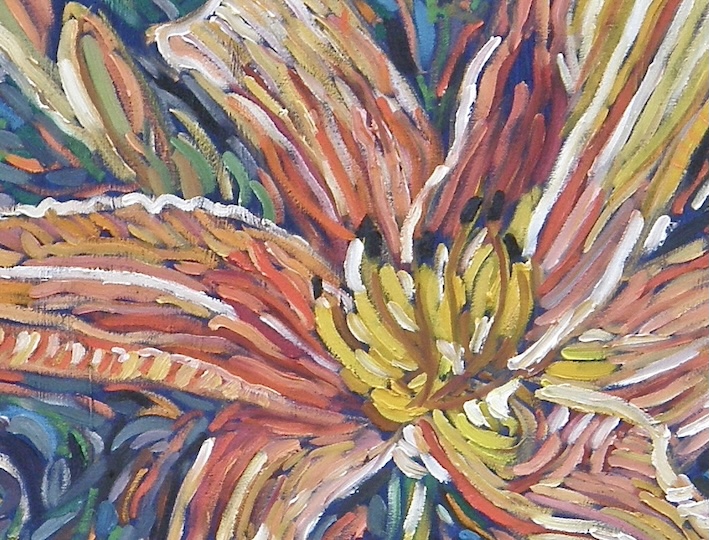
    Looking for colour cues, I often looked to my garden. In this particular painting, I pulled the colours from an ornamental pond (which has since been replaced with a swimming pool after one of the grandchildren decided to fall into it and see what it looked like from the bottom). I pulled the strokes across the canvas as if the paint were flowing over the shapes, which in this case were inspired by the water lilies in the pond (shades of Monet — see my more conventional approach at Giverny by clicking here.). Given the pond was right outside my studio, I didn’t have to look far to revise and think about the colour. Its about as close to plein air as I have been in some time.

    I’ve painted smaller abstracts before, but to me they always require a certain degree of scale, which is likely why I don’t do them any more — my studio (at 98 square feet) is just too small. But I should never say never. At last fall’s Art Toronto several emerging artists spoke of overcoming small studio spaces, some using a diptych. This is one of the last pictures I did using this approach to abstract painting. Even at three feet by five feet, it still feels small to me.

    Pond (2008) 36″ x 60″ Oil on Canvas

    It is also a different process of painting, using more of my arms than my wrists in applying the paint. There is a certain freedom in that. I also apply the paint thick, giving it a certain volume you can see reflected in the light. It was likely aided by the fact that I decided to reinforce that liquid feeling by putting a shiny varnish over it. If you look carefully you can likely see the reflection of light on the edge of the paint strokes.

    Being a former graphic designer, I’m always conscious of my abstract work slipping into the decorative. This one likely teeters, but I still like it as a work of art.

    Surprisingly, these paintings were quite successful for me, many of them ending up in private hands. This one remains in our hallway.

    Don’t miss another post! Subscribe using the black box on this page. It’s free and I’ll never sell my list on to purveyors of naughty sex toys.

  • Runner Up

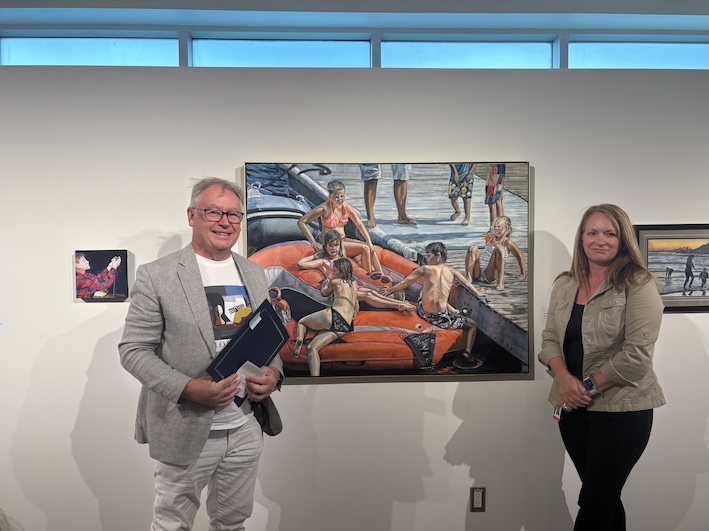
    Ah, so close. Art competitions are a way to get your work out there. In the open category, for artists aged 55+, I came second today at the Robert McLaughlin Gallery in Oshawa. Always great to see one’s work in an established gallery.

    Of course, these opportunities are a way to reach out to the community, with categories for beginners, hobbyists, and the open category for those of us who have exhibited professionally before. For artists who toil alone in their studio day after day, it’s about getting one’s work out there and making connections.

    If you would like to see this painting in person, it will be on display at the RMG in Oshawa until September 25, 2025. While you are there, check out the early postcard exhibit upstairs — it is very funny and shows how much our language has evolved.

  • It all started with a painting

    I first heard about Warkworth when I bought a painting by Lucy Manley from a craft fair in Cobourg. A plein-air painter, Lucy regularly paints around central east Ontario, including Warkworth, where she gives continuing education classes in painting. Our picture was from a winter scene in a residential part of Warkworth.

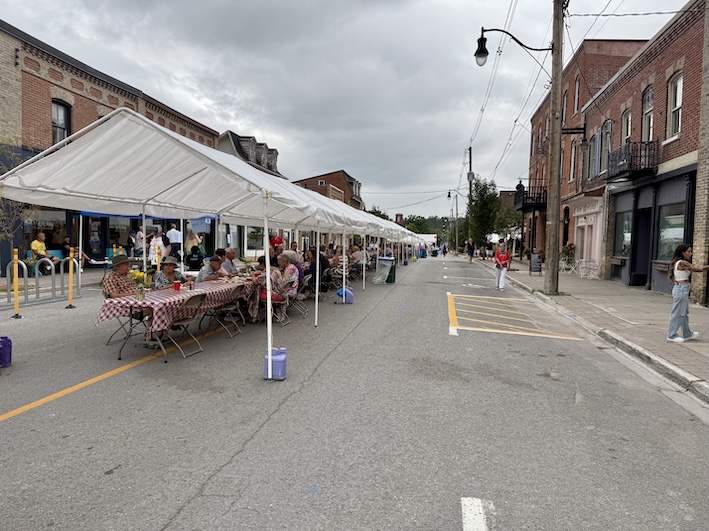
    We travelled to Warkworth yesterday for two reasons. The first being the long lunch, a special block-long dining experience along the main street (pictured above), the second being a butter dish. There is also an antique store — Weekenders Vintage — that has a decent offering of well-priced vinyl records I had planned to sneak off to, as usual.

    Warkworth is part of the broader municipality of Trent Hills, which has a total population of about 14,000 residents. Yet visitors regularly flock to this little community in part for the regular festivals they host as well as the arts and crafts profile. It’s fun. We asked one shop proprieter what they did in the off season? It turned out that they only have one quiet month over the winter, then the traffic of visitors starts to pick up again.

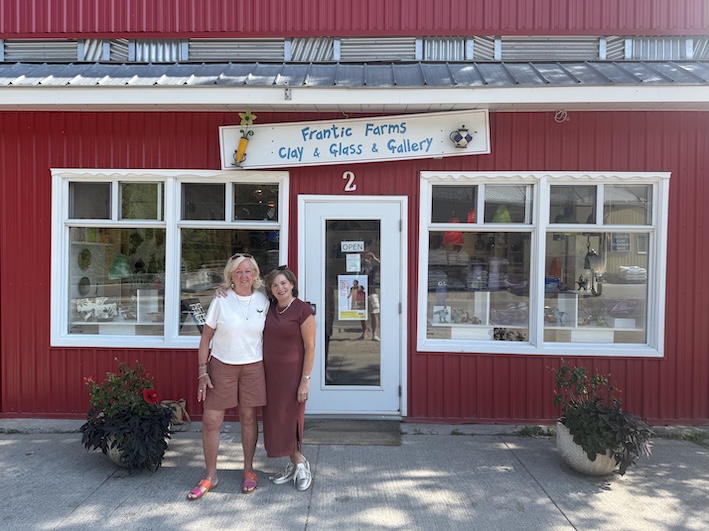
    We had just been there in July and had discovered Frantic Farms Gallery just around the corner from the main street. We recognized the pottery on display (along with glass and other hand-crafted items), having bought a tea pot in that style years ago from the Meta-4 gallery in Port Perry. My spouse really liked the design of a butter dish on display, but preferred one in a lemon pattern that was in use for a tea set we saw that day. It turned out the person behind the counter of the gallery was Monica Johnston, who makes the pottery on the premises. She offered to make us one. We agreed to return (Warkworth is a little over an hour from where we live) in August to pick it up.

    The butter dish by Monica Johnston that we travelled an hour to retrieve.

    Communities often look for the magic formula that will bring life to their town or city. Warkworth has that magic in its energetic shops and galleries. There are no chain store outlets here.

    Our neighbours had offered to drive when we suggested coming along, and we had gone cross country through a stunning countryside to get there. You can get there a few minutes faster by taking the 401 then heading north from the Big Apple (Colborne), itself a unique Ontario destination for visitors with its apple-themed shop and bakery. However, the extra few minutes was well worth it.

    Given we arrived early, we decided t visit the shops first, checking out the European Patisserie before moving on to the Cheeky Bee gallery (where we found some crazy books) then on to an amazing kitchen-ware shop that offered a range of utensils, dishes and foods, including a jar of Sour Cherry and Prosecco jam imported from the UK (I had some this morning). They also served coffee and treats. As we made our way along the street the small bags we, um I, was carrying expanded. We eventually found our way to the Centre and Main Chocolatier.

    Centre and Main Chocolatier in Warkworth, Ontario

    We were a bit stunned when we walked in the door. As another patron there had said to us, “it looks like a frickin’ art gallery.” That was true. The lighting was subdued, and on the back wall were dozens of varieties of chocolate bars, some of them award-winning, including the Blood Orange and Rosemary bar, which was among the varieties we purchased. The patron who spoke with us said he relied on the shop to find unusual gifts for friends and family. Our friends bought some sponge toffee covered in milk chocolate. We bought four unique bars of chocolate. Everything on display was made on the premises.

    We walked back up the other side of the road, the afternoon getting on and the need for food growing. I ducked into the antique store and got some records, including a 1976 Michel Pagliaro recording featuring three classic hits. I noticed that the lava lamp I saw last time was gone, but they did have a plasma ball that exudes what looks like lightning. The food offerings on the street were limited by the time we worked our way back up again — much of the blackboard erased at a booth where my spouse got a maple hot dog — but people were also going into the restaurants to bring out food to experience the huge communal dining experience. I chose to have a pulled beef sandwich with horseradish. We were also aware that we needed to get back to the pottery and glass studio to pick up the butter dish. Our friends also purchased a cream and sugar set.

    My spouse Geraldine (right) and her friend during a visit to Frantic Farms gallery in July of this year.

    We’ve been to Warkworth a number of times over the years, and always enjoy our visit. We caution our guests that it is not big, but it is a worthwhile visit.

    And it all started with a painting.

    Sign up to get notifications of new posts. And don’t forget to check out my gallery.

  • Arles without Vincent? Bah.

    Arles, France, was the starting point for our trip up the Rhone River. Throughout the town are signs indicating where Vincent Van Gogh painted many of his iconic pictures. That included one where the house he once shared with Paul Gauguin stood. It was the victim of Allied bombing in World War II, and is now just a grassy area not far from the river. It’s true that Arles is also known for its well-preserved Roman past, but what people get excited about is walking the same streets as Vincent. That includes clustering around the night cafe or visiting the grounds of the asylum.

    Clearly the town has recognized the importance of Van Gogh as a destination for travellers, which of course contributes significantly to the local economy. There are many Roman ruins throughout the Mediterranean and beyond. Arles is where the stories about Van Gogh live and breathe. You can feel it there.

    In June we took a walk along another art destination: Queen Street West in Toronto. Queen Street West used to be an affordable part of town that artists flocked to. As the artists came, the crowds followed, eventually making it too expensive and effectively shifting the arts community further West. I noticed more chain stores there than there used to be. And so it goes — the first step on the ladder to renewing a community is usually the arts. I just don’t understand why politicians don’t get this?

    The latest figures I could find on the arts in Canada were from 2023. All the arts combined amounted to a contribution of $63.2 billion to our GDP. The Visual and Applied Arts amounts to a fraction of that — about $700 million. That’s up from a decade ago, but recent data would suggest that it is now in a slight decline. By comparison, the visual arts alone in France contributes more than $4 billion (USD) to their economy. France has a population that is about 50 per cent larger than Canada, but the art market is more than five times as great. Is there a lesson there?

    The recent decline in economic activity surrounding the arts wouldn’t be a surprise given recent news about gallery closures internationally. Some have suggested that instead much more art is changing hands virtually than from traditional bricks and mortar commercial galleries, however, I find that hard to believe, nor have I seen any evidence to support that assertion. It could be that galleries are closing simply because the high rollers that make the big purchases have grown nervous amid a volatile US economy.

    It’s true that most commercial galleries post work by their artists on-line, but for most of us who don’t employ art consultants to advise us on our art acquisitions (I can hear the guffaws from here), its hard to get excited about work you haven’t seen in person. I’m attending an on-line workshop next week in how to better photograph my artwork, but no matter what I do to improve that representation, seeing a painting in person makes all the difference.

    That does make me also wonder about juried shows that do their work on-line. Are you picking the best work, or are you picking work that represents well on-line?

    When I first heard of school boards cutting back on art education, I wondered if we were bringing along a generation that would take little to no interest in the visual arts? There is no question that travelling to see many of the great art museums that I didn’t see many young people in these galleries, at least not accompanied by their parents.

    Modern art may have pushed the boundaries of art for more than a century (I would assert there are no boundaries now) but it may have also alienated a large segment of the public. We recently re-watched Burr Steers film Igby Goes Down, of which the director presents Jared Harris’ performance artist character as a point of comic relief. Steers real life brother was a figurative painter, so maybe there was something personal in what he was saying.

    Given our hyper-visual culture, having artists sharpen our focus on what we are seeing could be seen as important, make us question the environment we live in. I suspect that broader culture is changing how we interact with art too.

    Arles (2025) 12″ x 16″ Oil on Canvas

    Today’s painting is one I have previously posted in the gallery section of this BLOG. It’s of Arles, France, viewed from the steps leading up to the Roman Amphitheatre. I was reminded of this view last year watching a Polaris car commercial between innings of a baseball game. “I know that place!” I said out loud. I searched my photo library and sure enough, there it was. I loved the blue sky and the absolutely clear light that I’m sure Van Gogh was drawn to. And as I have said already on this BLOG, I’m drawn to cafes, even ones that haven’t quite opened for the day. If you look carefully, you can see in the shadows a man setting up.

    In my painting, I did choose to edit out the text on the side of the cafe, but otherwise, the scene is presented as I saw it. I didn’t try and emulate Vincent’s style (as some artists have tried), but rather chose to do it in my own style of painting.

    I did enter this painting — or at least a representation of it — into a competition. I didn’t make the final cut. But it remains one of my favorites from this year.

    Just a note on yesterday’s post — after thinking about it a bit more, I decided to join the artists’ group I spoke of. Hopefully it will lead to participation in a group show in Toronto in the not too distant future.

    Don’t miss another post! Use the black box on this page to subscribe. It’s free, and aside from the notifications of new posts, I won’t spam you.

  • Elbows up for a little painting

    I don’t recall how I ever found out about it. For three years I participated in an event called The Little Art Show which raised money for the Riverdale Art Walk.

    Once registered to participate, artists got sent a small 7″ x 9″ canvas and a deadline to send or bring it back, presumably, with a painting on it.

    The event took place in November at the BMW dealership that overlooks the Don Valley Parkway, the upper-floor room used for the event was mostly glass walled, which would have been challenging had the event been held in the daylight given the backlighting. The paintings, I recall about a hundred or more, were placed along a ledge on the window with an attached bid sheet for the silent auction. There was a lot of furious activity towards the end as people would literally stand beside the painting they wanted to take home less someone outbid them at the very end. I discovered it’s more than just hockey players capable of getting their elbows up.

    The event was well managed, with a cash bar and terrific food. Once it got rolling, the room was full of artists and collectors. There was a lot of art chatter. It used to be among the highlights of my year.

    I would not only show each year, but would also bid on work, taking home what I referred to as a replacement for my own entry. In fact, I ended up taking home four paintings in three years.

    Cobourg (2004) 7″ x 9″ Oil on Canvas.

    The first year I entered a tiny painting of the ice cream shop along the waterfront in Cobourg, Ontario (see also Almost Canada’s Capital), of which there was some competition that night in the bidding for it.

    I spoke with the winning bidder who said they recognized the location, having spent some time in Cobourg themselves (it’s a small world). Unfortunately the photo I took of the painting is a little bit blurry. It’s hard to work that small!

    That is my spouse dressed in green with a determined walk heading towards the door of the shop. The photo at top is from the 2004 show. Facing us is my first cousin Mariola, my spouse Geraldine and my fellow artist friend Robert.

    The Riverdale Art Walk is now in its 27th year, so those were early days, but I was impressed by their level of organization and ability to promote that particular fundraising event. I noticed that the same artists’ network now has a permanent gallery (Leslie Grove Gallery on Queen St. East at Jones) and a second Artwalk event at the Shops at Don Mills. They also organize seminars and have opportunities for networking. I love to see artists get organized in this way and may take out a membership soon.

    Don’t miss a post! Subscribe for free by using the little black box on this page.

  • Unheralded Spaces

    We pass by these places regularly without paying them much attention. Likely your kids, or in our case, our grandkids, play in them. They usually aren’t that large, little dots of green among a sea of houses. They are often the focal point of a subdivision. They dot suburbia.

    Our last two houses in Oshawa, Ontario have been within a block from a community park, usually a few baseball fields and a soccer field, maybe a play park. The one we are now closest to also has a club house, which is used as a rental. We sometimes vote there. On a summer night you can sometimes see large crowds turn out to watch their kids play organized sports. It transforms the environment. There are always at least a few people there.

    I think a lot about these spaces, often unloved but very much used. It is far from the places most of us think about that define our cities and towns, but they are crucial. Where and how we live does say a lot about us. If it takes a community to raise a child, it takes a park to give them somewhere to get outside, especially in an age of omnipresent screens.

    When I was a kid I met a lot of my friends in these little parks, Darcy, John and Keith holding court in the sandbox. We always made sure to bring a plastic shovel to first get rid of the cat poo.

    Connaught Park (2024) 24″ x 24″ Oil on Canvas

    I’ve painted these little spaces twice — last year I did a painting of Connaught Park, which I use regularly to go for walks or to cut through to a more commercial area if I don’t feel like driving my car. The cloud cover was quite dynamic that day, making me wonder if I should have brought an umbrella. I loved the shadows not only of what was in the picture, but what was outside the frame. It’s not the first time I’ve painted to reference the world outside the frame.

    Back in 2006 I painted Bathe Park, which is hemmed in on three sides by housing, making it en route to nowhere except for the park itself.

    Bathe Park (2006) 11″ x 14″ Oil on Canvas

    Sometimes if you look hard enough you can find a little beauty in these spaces.

    Be sure to check out my gallery of recent paintings by clicking here. Use the subscription button to get notification of all my new posts. It’s free! If you are in the Oshawa area, be sure to check out the Seniors competition/exhibition, which opens next Wednesday (August 19) at the Robert McLaughlin Galllery. You’ll see one of my larger works there.

  • South of France? Nope.

    There was a time when Lunenburg looked like what you would expect of a town of 2,300 permanent residents. Not a lot. The first time I visited was in the off season, and frankly, there wasn’t much there for casual visitors beyond the Fisheries Museum of the Atlantic and perhaps walking around to view the buildings that make up the town. There was a Chinese take-out restaurant along Lincoln Street, which on that day (a Sunday), was closed.

    Then in 1995 it was designated a UNESCO World Heritage site, the old town the best surviving example of a British pre-designed model town that could be essentially plunked down anywhere. To that end, Lunenburg shares a similar heritage to about 20 other towns and cities in North America, including Niagara-On-The-Lake.

    The old town has 400 buildings. According to Parks Canada, 70 per cent of them are from either the 18th or 19th centuries. The town was officially founded in 1753 by 1,453 German-speaking Swiss and French emigres. The town is perhaps best known for its wooden ship building, the home of the famed racing schooner Bluenose, and its successor Bluenose II.

    We almost didn’t make it there during my last trip to Nova Scotia in 2021. We had spent some time in nearby Mahone Bay and debated whether to go the additional distance. We had already driven a considerable way that day, doing the Peggy’s Cove loop before heading south along the Lighthouse Route past such communities as Hubbards, Chester, and Western Shore (where we saw signs for Oak Island).

    For a town essentially frozen by being named a UNESCO World Heritage site, a lot had changed. There were lively shops, attractive restaurants, galleries, an excellent ice cream shop, and even a Bluenose Company Store, which celebrated the refit that was going on at the time for the Bluenose II. I noticed that the locals had amped up the colour of the building stock too. The Fisheries Museum is still there along the waterfront.

    A friend had told me that some believed the Bluenose refit was so extensive the ship should have been renamed the Bluenose III. The Bluenose II was never intended to last as long as it eventually did — it was originally built as a promotion for Schooner Beer, but soon became a symbol of the province. I bought some Bluenose socks that day.

    It made me wonder how, according to the town of Lunenburg, 200 long standing active businesses could survive with such a small permanent year-round population? That’s about one registered business for every 10 permanent residents.

    I’ve been to Lunenburg many times, including for its folk festival in the summer. Having been away for a whiie, it made me realize what a difference the UNESCO designation has made to the town.

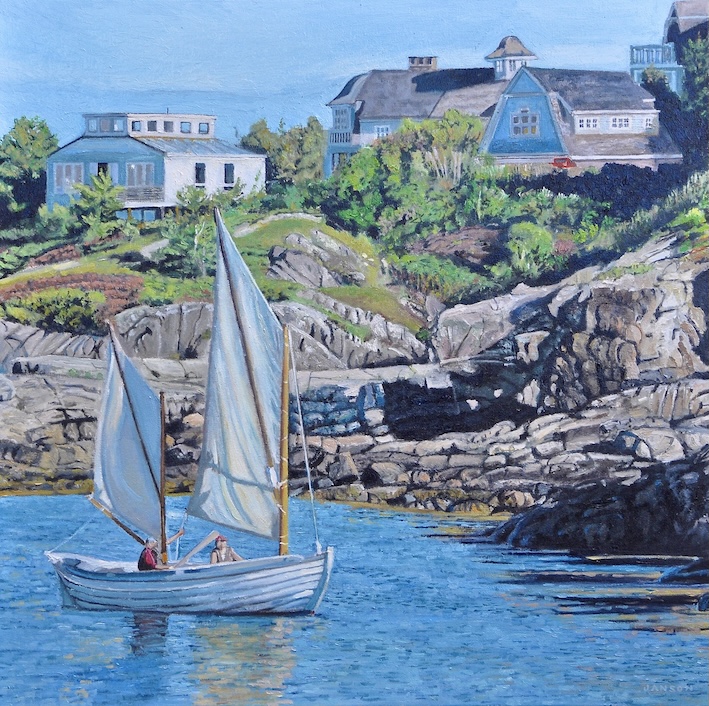
    Yellow House (Lunenburg)(2025) 14″ x 18″ Oil on Canvas

    I did this painting in tandem with the previous one of Peggy’s Cove. The photographs I used as reference were both shot on the same day.

    Unlike the Peggy’s Cove painting, I had no intention to make this one about tourism, although there were many visitors walking around that day amid the splendid sunshine. Perhaps that painting is to come.

    I liked the distant view in this one, giving some depth through the buildings and trees to the famed harbour and beyond. When my spouse first saw it, she thought it was from France (a lot of my paintings are). The light did look more like the south of France than Nova Scotia.

    I’ve previously noted that I have a tendency to tighten up as I go in for more detail. This time I consciously kept the painting loose, which I think in turn gives it a bit more energy. It likely helps that the canvas sizes are generally increasing for me, which gives me more latitude on the brush strokes. Likely it is also because of the format of this BLOG. When I first began using this WordPress template (Nook) the feature photo containers were all the same proportion. That was a problem, as it would crop my images. It finally struck me that I could do a detail as the feature image, and also insert an image of the painting in its original proportions further within the text. Cropping the details, I started to like what I was seeing, realizing I could still get the kind of details that bring a painting to life and at the same time keep the bush strokes alive. Hmmm. This could work.

    Yesterday I delivered a painting to Oshawa’s Robert McLaughlin Gallery (RMG) in response to a competition/exhibition call-out for work by seniors over age 55. The exhibit will run from August 15 to September 25. After speaking with the curator, I roamed the gallery to take in, among others, a small exhibit of work by the Painters Eleven Group. The Painters Eleven include such notable Canadian abstract artists as Jack Bush, Harold Town, William Ronald, Oscar Cahen, Tom Hodgson, Walter Yarwood and Kazuo Nakamura. The group essentially met at Alexandra Luke’s Oshawa cottage to plan an exhibition together in 1953, remaining as a group until 1966. Remarkably, the RMG holds in its permanent collection about a thousand pieces of work by these artists as a result of the involvement of Luke, herself a member of the group.

    Visit my on-line gallery. Click here.

  • Plasticine Flowers

    I’m probably pigeon-holed as a landscape painter. But in the past two years I have made an effort to stray outside my comfort zone by taking on some new genres, or at the very least to explore genres I haven’t visited in a long time (eg. portraiture). I calculated it would aid the effort to improve my overall painting. Flowers, huh? Never been there before.

    This started with my sister posting on FB a photo of some flowers she had placed in a glass vase. My initial thought was this may be easy to do. I liked the way the light refracted through the glass as well as the shadow it threw on the other side. If something is slightly off, who is going to notice? It’s not like a likeness was important. I calculated there was some leeway here.

    Looking at true flower painters I noticed how they manage to capture the delicacy of petals as well as the texture. Also the way they transition colour is often masterful. They often paint on much larger canvases too. Hmmm… there may be a reason for that.

    As you may have already surmised, that’s not really my jam.

    This was really hard. Matching the true colours was not easy — dammit, red flowers? I don’t think I ever got that right. I was tempted at one point to go look for some fluorescent oils as I couldn’t mix what my eye was seeing. Having them sit in space — super hard. To convey volume? Ugh. Delicacy? My painting makes the petals look like they are made out of plasticine.

    Having said all that, my little painting remains a fun bit of messing around. As Neil Young once said when accused of singing a bit flat — “that’s my style.”

    My inclination is to try this again, perhaps from my own flowers, where I can take time to light them in a way that helps defines the shapes in the way I want them. And for heaven’s sake — no reds next time!

    Barb’s Flowers (2024) 11″ x 14″, Oil on Canvas.

    Rushing around today getting ready a painting for a competition tomorrow.

    Want to see more pictures without all this writing stuff? Check out my gallery page. If you are on a computer the link is at the top of the page. If you are on your phone it is at the bottom of the page, or you could simply click here.